

Instead of banning 'castells', Franco opted to folklorize them, presenting them as 'regional peculiarities' that were part of a 'common homeland', like the San Fermín festival in Pamplona and the Fallas of Valencia. However, the 'castell' activity was conditioned by the repression of the victors. Some 'castellers' died during the Civil War, others were later murdered or imprisoned, and those who could went into exile. The towns where 'colles' existed before the military uprising of July 1936 were Tarragona, Valls (two), and El Vendrell (two). To control them better, in towns where there was more than one, the dictatorship decreed a merger into a single one. And to make it clear who they were performing for, some 'enxanetes' were forced to modify the characteristic gesture of the 'aleta' they make with their arm when crowning the top. They had to stretch it a little more in imitation of the fascist salute. From the 1950s onwards, normality began to be restored, and the 'castell' phenomenon gained vitality. Then a great rivalry would emerge between the 'colles' of Valls and the rest, which triggered the well-known 'war of the enxanetes'. In a time when performances were paid for individually, some 'castellers' would occasionally change shirts – literally – to earn an extra. Over time, it was decided to stop paying adult 'castellers', but not the youngest ones. These, however, would also eventually go unpaid. In return, they had other incentives, such as free school supplies or the possibility of going to the snow or to summer camps. Today, 'colles' are paid per performance, but not individually as was done in the past. In 1975, with Franco's death, human towers gained more prominence in the streets as a claim for Catalan culture. In 1992, they were very prominent in the opening ceremony of the Barcelona Olympic Games. In 1994, Canal 33 began covering 'diadas castelleres', which caused a real 'castell' boom. By the late 1990s, about sixty 'colles' had been created, double the number from ten years earlier. Today, there are about a hundred integrated into the Coordinadora de Colles Castelleres de Catalunya. In 2010, UNESCO declared 'castells' Intangible Cultural Heritage. The city of Valls, in Camp de Tarragona, is its capital. Since 2023, it has hosted the Museu Casteller de Catalunya. Currently, the movement continues to gain followers abroad, often at the initiative of Catalan residents. Thus, there are 'colles' in countries such as Chile, Canada, Sweden, Belgium, Denmark, Switzerland, Italy, and even in Australia and Japan. There are also some in Madrid and the Basque Country.
30 years of the Castellers de Mallorca
In 1996 the important coverage by Channel 33 of the casteller events in Catalonia encouraged a group of friends from Manacor and Palma to create, in parallel, their own colles. Today they are among the oldest of the hundred that exist throughout the Catalan region.
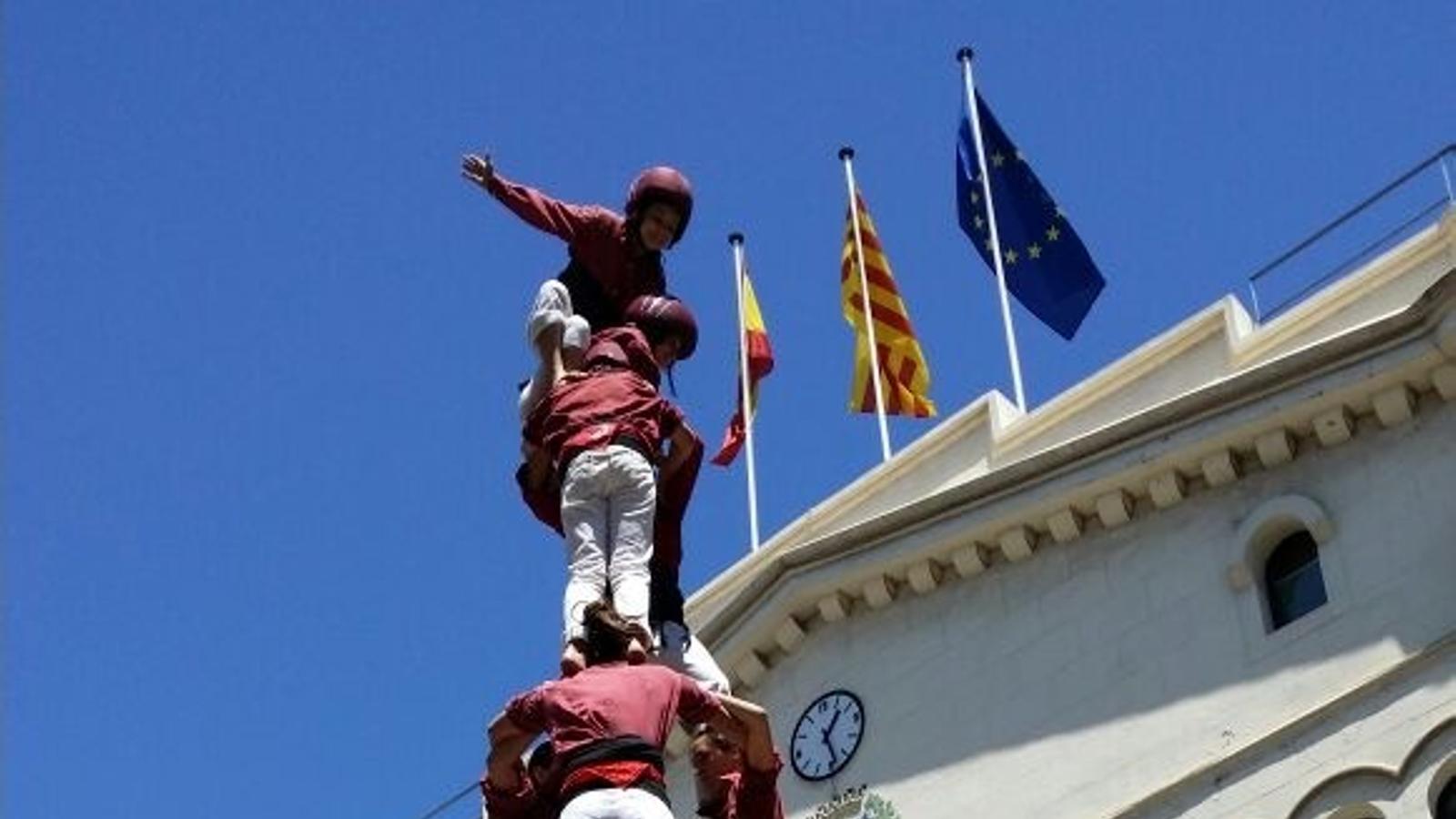

PalmThere are three weeks left until the Manacor Spring Fairs and Festivals and this year the nerves are very noticeable in the 'castellera' group Al·lots de Llevant. One of its members, Joan Llodrà Gayà, 52, assures it: “We hope to be able to raise a good tower to celebrate our thirtieth anniversary. We are among the first 'colles' in the Balearic Islands. We were born in 1996, the same year as Castellers de Mallorca, from Palma. We have been rehearsing for months. Our highest construction has been a four of eight, meaning eight floors with four people on each floor. We have only been able to raise it three times in our history. We almost always do seven floors”.

In October, the next important event for Al·lots de Llevant will be in Dénia. The Valencian Country is precisely where in the 17th century the antecedent of castells was born in the famous muixerangues. They were religious dances that culminated in the creation of human towers. The most popular would be those from the city of Algemesí. The term, surely of Arab origin, could refer to an ancient Moorish dance. Those curious collective constructions would end up making the leap to Catalonia. In the 18th century they took root especially in the Camp de Tarragona, in Penedès and in Garraf. Then, from being known as 'Ball de Valencians', they would come to be called castells.
Castilian ‘Boom’
In 1976, a year after Franco's death, Manacor was the first municipality in Mallorca to see people climbing to the sky. It was during the Spring Fairs and Festivals with the exhibition of the castellers Nens del Vendrell, which is one of the oldest, from 1926. In 1996, twenty years after that visit, the capital of Llevant was already taking over. “It was –says Llodrà– the year of the casteller boom in a time when there were only about forty collas in all Catalan-speaking territories. This boom was greatly influenced by the broadcasts of the Canal 33 casteller diadas, which had been covering them for two years. For the Christmas holidays of 1995, while on an excursion with some friends, the idea of creating our own colla in Manacor arose. We were young people of 20 years old”.
To attract other people from the region, the name chosen by that group of friends was Al·lots de Llevant. “The distinctive color of our shirts –assures the co-founder– is green. It was the one the shop where we ordered them had most readily available. We also had to get sashes, which have a dual function: to fix the castellers' backs well and to allow those who climb barefoot to hook their feet.” On January 20, 1996, about twenty people gathered at the Portocristo sports center to do the first rehearsals. “At that time there was no internet. To learn the first rudiments I consulted theEnciclopedia Catalana. It wasn't enough, so one day I hopped over to Barcelona to buy the book Castells i Castellers, which had just been published by Xavier Brotons. It was our Bible. Then we traveled to Vilanova i la Geltrú and managed to get the Xiquets de Reus to visit us to finish teaching us the technique.”

In summer those neophytes already performed their first acts in various towns of Mallorca. “We had to convince some daring father to let his young son be the enxaneta, the underage figure who crowns the top. When the towers are dismantled without any incident, the verb ‘unload’ is used. Otherwise, it is called ‘load’. It is at this moment that injuries can occur, but they are infinitely fewer than those that occur in any other sport. Now there are more safety measures and the children wear helmets.” The public’s response to that novelty could not have been better. “Very few voices criticized us for doing an activity that was not part of the local culture. Judo is not either, and it’s fine. What we wanted was to have a good time, and we did it with a cultural manifestation that is clearly linked to the feeling of Catalan identity.”
In 1998, after two years, Al·lots de Llevant debuted in Catalonia. In Torredembarra (Tarragona) they unloaded the first seven-story tower –the maximum is ten. Initially, the performances were done to the rhythm of the xeremies or the flabiol and tamboril. Progressively, the sound of the gralla, the characteristic wind instrument of the casteller universe, was introduced. Today, the music is handled by the Grallers de Manacor, a group independent of the colla, but born inland.
‘Strength, balance, courage, and common sense’
During these 30 years, nearly 800 people have passed through the Manacor castellera group. "Now we are about 120 and of all ages, half men and half women. Everyone is welcome to build a good base. Those who need to be in better physical shape are the people who climb, representing 20% of the group. We rehearse every Saturday afternoon in the gym of IES Mossèn Alcover". Llodrà recalls the motto of the casteller movement: 'Strength, balance, courage, and good sense'. "Castles are perseverance, conviction, boldness, and self-improvement. It is an activity that builds community and helps to socialize. There have been users of Proyecto Hombre who, as therapy, have been with us by medical prescription".
Since 2002, the Al·lots de Llevant have rented their own premises on Nou de Manacor street. Their integration into the town's festive world is total. “We feel very loved by the people. We existed before the figure of the mulassa, which was created in 2012 when the Sant Jaume festivals were revived. For Sant Antoni, the devils come to dance in front of our premises and we build a pillar for them. In 2002, the Escola de Mallorquí awarded us the Reconeixement de Mèrits, which is a very important award. Furthermore, we have always had the support of the City Council, regardless of political affiliation.”
The castellera season begins in spring. “It is an activity –Llodrà highlights– associated with good weather, which calls for sun and flies, as is often said. We start in March and finish in November. We perform about twenty shows a year. Where we are hired the most is in the towns of Levante. We also go to Palma twice and at least make one trip out”. The manacorense assures that, in the Principality, Al·lots de Llevant are no longer seen as a rarity: “We are a coll older than most of the existing hundred. Furthermore, our level is not bad at all. Half of the colls have not qualified for the important diada that takes place in Tarragona on the first Sunday of October in even-numbered years. We achieved it in 2016. On that occasion, we unloaded a meritorious four of eight”.
Castellers de Mallorca
In many of their performances, the Al·lots de Llevant perform alongside the Castellers de Mallorca, from Palma, who wear dark red. Both groups were founded in the same year, but independently and with different motivations. One of their founders, Josep Mallol Vicens, 65, from Tarragona, explains: “In 1996, I had been living in Palma for eight years. My wife was from here. At the Mata de Jonc school, which was a pioneer in teaching Catalan, we met other mixed-nationality couples. Our young children were enthusiastic about the castellers when we visited Catalonia. So we decided to bring them to the island. We had to learn the technique on our own. We started rehearsals with about twenty people at the Son Canals school and at the IES Joan Maria Thomàs.”

Shortly after, the Castellers de Mallorca learned of the existence of the Manacor group. “At first – assures the Tarragona native – we also received criticism from a small group of intolerant people who said this wasn't from here.” Mallol envies the institutional support that Al·lots de Llevant have. “We haven't managed to get our own premises. For a year now, on Saturdays and Thursdays, we meet in a friend's carpentry shop located in the Son Rossinyol industrial estate. There are about seventy of us. During the PP's time under Jaume Matas, there was more dialogue and we were hired for many celebrations. In contrast, with the current Palma City Council, communication is nonexistent. All the performances we do in Ciutat are thanks to the Federation of Neighbors.”
In recent years, the casteller landscape in the Balearic Islands has been enriched with new additions. In 2004, the Gambirots de la UIB group was formed, which has just been re-established after a long period of inactivity. In 2009, Ses Talaies de Formentera was born with castellers from the principality who gather in the summer to perform exhibitions with Formentera residents as part of the Santa Maria festivities. In 2022, in Puigpunyent, the Castellers de Tramuntana group was launched, and in 2023 it was the turn of the Boixos i Boixes de Eivissa, driven by young people from Ibiza who became fond of building human towers while studying in Catalonia. “Competition – concludes Mallol – is healthy and necessary for the survival of the casteller movement.”
