To live to pity what of him has died
The biographical trajectory of the poet was marked by family tragedies and by creative and linguistic evolution
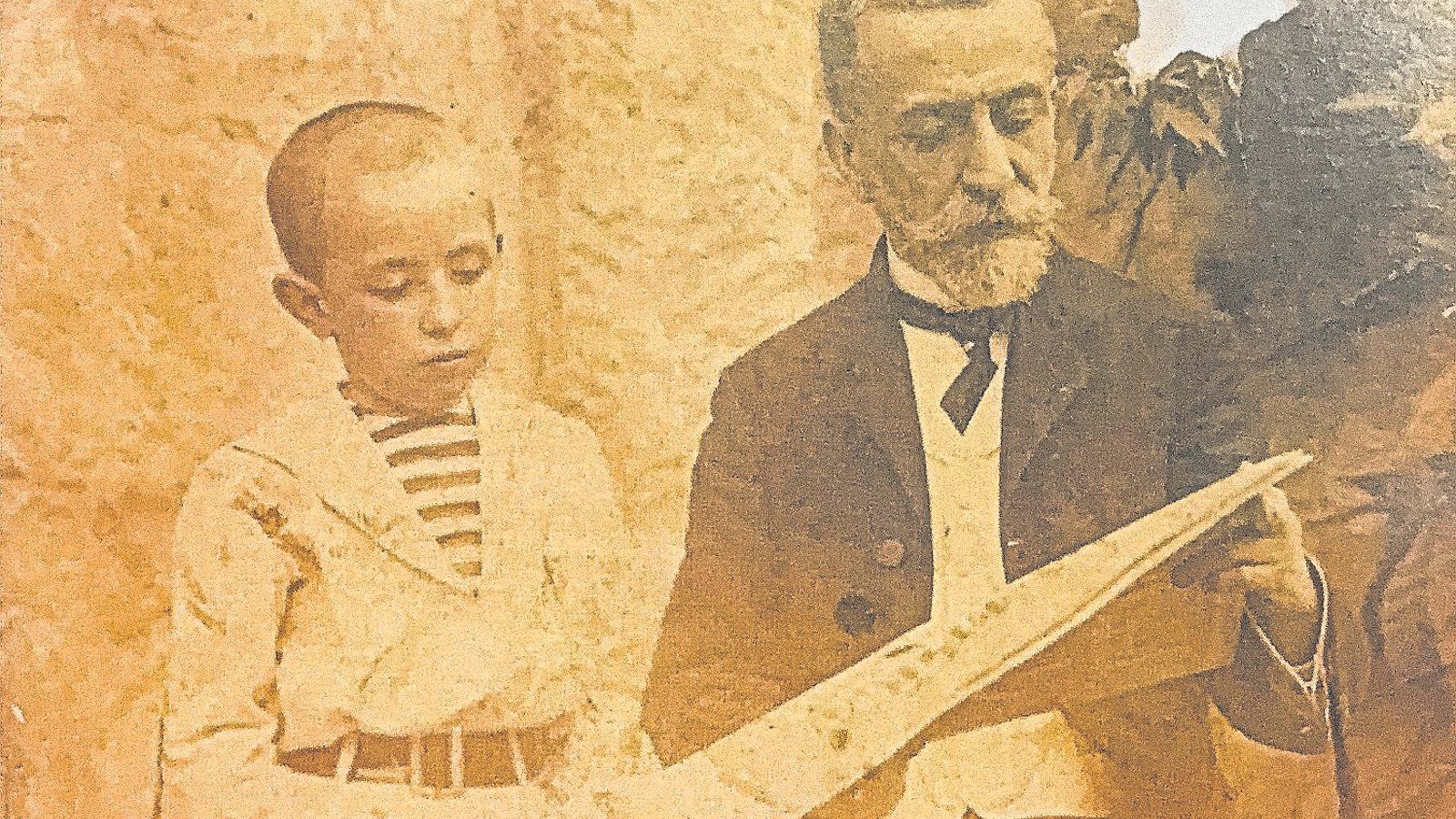
Palma“I live only to mourn what has died within me”. This last verse of the sonnet ‘Desolation’ summarizes the life of Joan Alcover to perfection in 13 words. I could end the article here and we would avoid the danger of redundancy.
Joan Alcover i Maspons was born in Palma on May 4, 1854, in a very traditional Mallorca, in a city where medieval walls still corseted it. The eldest son of a wealthy family, he grew up in a calm and familiar environment. His mother and grandmother played a key role, for through oral memory they told him stories, songs, folk tales, and lap stories that nourished his childhood imagination.
The ancestral home on Sant Alonso Street and the neighboring garden near Santa Clara constituted the small paradise where he played with his siblings. Natural elements such as the cypress planted by his father –a symbol of childhood and later of melancholy–, the centenary olive tree with the swing, and the fountain with the statue of a faun deeply marked his poetic sensibility. As time passed, those paradises became spaces of desolation and nostalgic memory.
In 1864, he entered the Balearic Institute, then located at Monti-sion, a cultural beacon where he coincided with an exceptional generation that included people like Miquel Costa i Llobera, Joan Rosselló de Son Forteza, Joan Lluís Estelrich, Antoni Maura, and Alexandre Rosselló. After studying Law and marrying Rosa Pujol, his friendship with Maura led him into politics and he was elected deputy to the Courts of Madrid during the Restoration. However, contact with active politics caused him a profound disillusionment due to partisan interests, a fact that led him to abandon his public career and take refuge in law and literature.
Years later, when the Empordà writer Josep Pla asked him for the reason for that sepulchral silence, Alcover made a disdainful gesture with his arm, as if he wanted to push away a repellent vision, and declared: “It is not worth it. I understood that there was nothing to be done...”
In his early youth, Alcover cultivated poetry in Spanish under the influence of romanticism and post-romanticism, publishing collections such as Poesías (1887), Nuevas poesías (1892), Poemas y armonías (1894) and Meteoros (1901), for which he received praise from literary greats like Menéndez y Pelayo. However, he experienced deep dissatisfaction with the superficiality of bourgeois circles, such as the gatherings at the Círculo Mallorquín, where he would read his poems to the ladies of Majorcan high society.
A decisive turning point was the death of his wife Rosa Pujol in 1887. Plunged into grief, he understood that literature could be a means of catharsis. After marrying Maria de Haro in 1891, who brought stability to his home, Alcover began his definitive transition toward the use of the Catalan language, his mother tongue.
He describes it perfectly in these verses: “To the Castilian muse / my best years I have given, / of another sister muse / deeply enamored”.
The most absolute desolation
The home on Sant Alonso street established itself over the years as the nerve center of the Majorcan School. Heir to the gatherings of Josep Maria Quadrado, Alcover's house hosted for more than twenty years a Sunday appointment where writers, artists, and thinkers of diverse tendencies met in an atmosphere of harmony. Through this space passed local and foreign figures such as Josep Carner, Santiago Rusiñol, Josep Pla, Maria Antònia Salvà, Miquel Costa i Llobera, and Miquel dels Sants Oliver. In 1898, moreover, he promoted the Beethoven salon together with Antoni Noguera to foster rigorous art.
Alcover's maturity was marked by a series of harrowing family tragedies. In January 1901 his daughter Teresa died, at 19 years old, a victim of tuberculosis, and in July 1905 his firstborn son, Pere, passed away at 25 years old, from typhoid fever.
Plunged into absolute desolation, Alcover found in art the only refuge. This suffering brought about a double transformation: he rejected literary artifices and assumed the theory of the living word of Joan Maragall. He solemnly proclaimed in 1906 at the first International Congress of the Catalan Language that “the country sings through the poet's mouth”.
In 1909 he published Cap al tard, the work that consecrates his lyrical maturity. Organized into four sections –‘Cançons de la Serra’ (Songs of the Mountain Range), ‘Elegies’ (Elegies), ‘Endreces’ (Dedication), and ‘Juvenils’ (Juvenile works)–, the book unites intimate pain with the Majorcan landscape. Notable is the famous poem ‘La Balanguera’ (1903), set to music by Amadeu Vives and turned into the anthem of Mallorca, which contrasts individual fleetingness with collective immortality. Alcover also defended useful and humanized art, a proposal he launched in his lecture Humanització de l’Art (Humanization of Art) (1904) under the motto “we are of earth and we belong to the earth”.
Consecrated at the Floral Games of Barcelona in 1909, with the Natural Flower for ‘A la vora del Tàmesi’ (On the banks of the Thames) and the title of master of the Gay Science, Alcover felt like a “stranger” marked by the absence of his loved ones. This infinite sadness finds its maximum expression in the sonnet ‘Desolació’ (Desolation), where he compares himself to a tree struck by lightning and torn by the storm, but which remains firm to the ground to narrate what he lacks: “I live only to mourn that which is dead within me”. Pain thus becomes a fertile element.
In 1918, he published Poemes bíblics, awarded the Fastenrath prize. The work uses figures from the Old Testament (Hagar, Abigail, Michal, Rizpah) to explore universal feelings and reflect the pain of paternal loss. The volume closes with ‘Fantasia’, where he evokes his deceased wife as a lost paradise: “I long for that moment of paradise, / my spirit is like a slack harp”.
In his final years, Alcover established himself as a cultural reference through conferences and essays such as Cultura del llenguatge (1916) and L’art segons Tolstoi (1922). On March 6, 1919, he suffered another devastating blow by losing two more children, Maria and Gaietà, just hours apart, as a result of a flu epidemic. Recognized by the RAE (1904), the Academy of Good Letters (1913), and the IEC (1916), and honored with a monument in Palma in 1920, he died on February 25, 1926. His life, marked by pain, definitively consecrated his work as a pinnacle of Catalan literature.
