Lullists against anti-Lullists: the battle for Ramon Llull
The long confrontation between enemies and supporters of the blessed, whose figure is commemorated on November 27

-
CAT -
CAST -
DE
PalmaIt began in the lifetime of the Illuminated Doctor and extended until the end of the 18th century, 250 years ago now. The confrontation between supporters and detractors of Ramon Llull became fierce. We recall this battle as we approach, as every November 27th, the feast of the Blessed one, recognized as such by the Catholic Church, despite the supposed heterodoxy of which he had been accused.
Already in the lifetime of Ramon Llull, between the mid-13th century and the beginning of the 14th, anti-Lullism began, which had a long trajectory. According to Pere Xamena and Francesc Riera, its origin should be sought at the University of Paris: they considered him too rationalistic in trying to demonstrate the faith with arguments, the famous Lullian ‘Ars’.
A Dominican and inquisitor of Girona, Nicolau Eimeric, in the 14th century, and another from Mallorca, Guillem Caselles, in the 15th, did everything possible to discredit him, both him and his work. Eimeric passed off his own notes as textual quotes from Llull to prove his supposed heresy. A bull by Pope Gregory XI, which in theory supported that accusation, never appeared in the Vatican archives.
Caselles acted as a corrected and augmented version of Eimeric and as an intense propagandist of his theses. Llull's books began to be included in the indexes or lists of prohibited reading, until the powerful Philip II, an enthusiast for the canonization of the Majorcan, managed to have them removed. This, for the moment, because upon the monarch's death they were included again.
Deep down, although according to tradition Saint Francis and Saint Dominic had been great friends, it responded, just like in The Name of the Rose, to a systematic rivalry between the Franciscans –the order to which Llull was linked all his life– and the Dominicans, who usually acted as inquisitors.
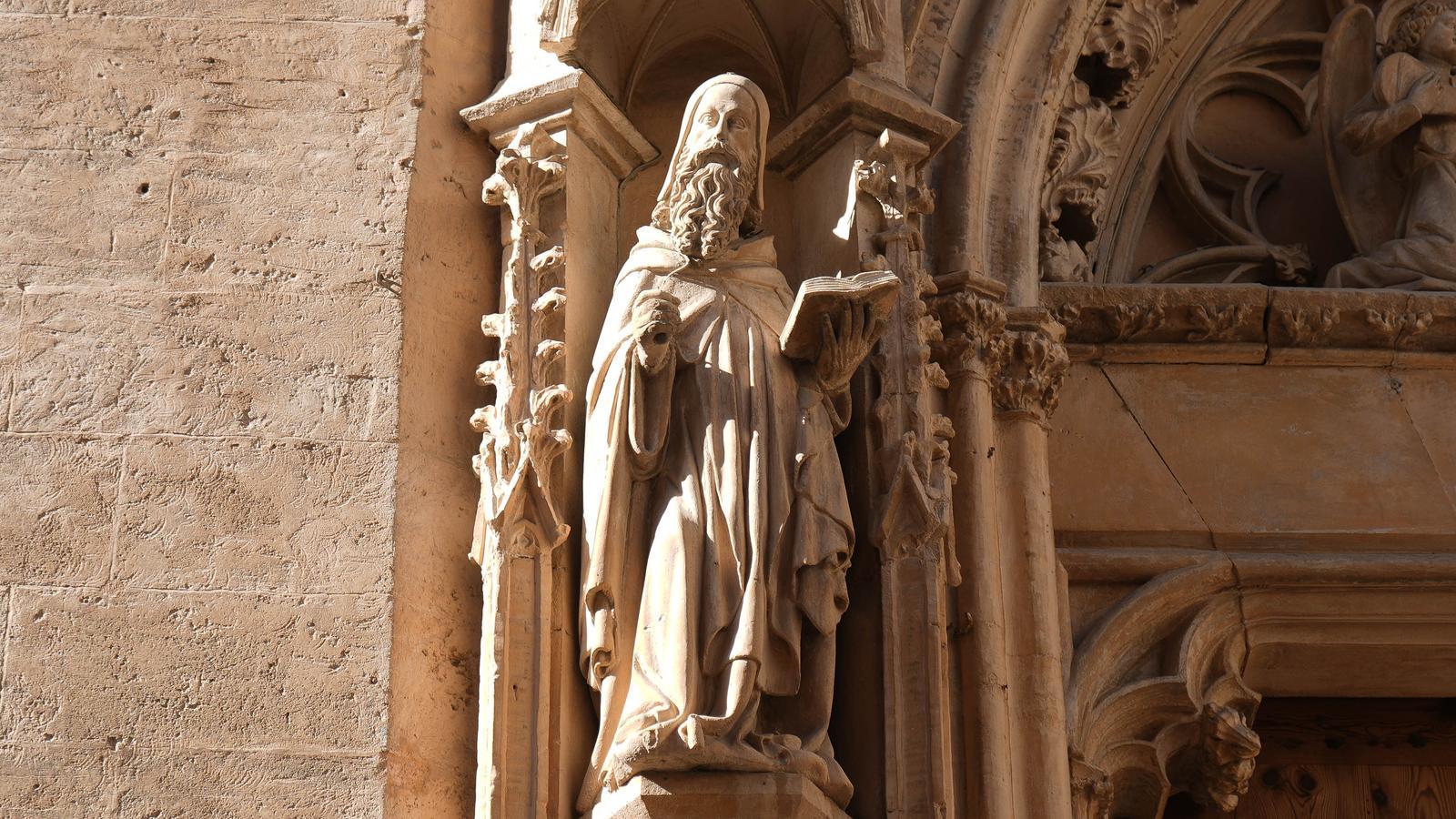
The controversy did not remain a dispute over theological nuances, but reached the most popular classes. Songs were composed and pamphlets were written, for and against, in which insults were sometimes resorted to. Llull's detractors were known as ‘marrells’, and his supporters as ‘teuladers’ or ‘gorrions’, just like the religious fanatics of Game of Thrones. In 1699, a statue of Ramon Llull appeared decapitated, with the inscription –in Latin in the original– “his place is among the heretics”. Bishop Pere d’Alagó invited the anti-Lullists to publicly express their opinions, but no one appeared.
In 1749, the now-disappeared convent of Sant Domingo in the city was stoned, and the friars had to ask for help from the judicial authority. Around 1761, as reported by Rafel Ramis, “couplets against Llull” were circulating. In 1763, riots occurred between supporters and detractors of the blessed one not only in Palma, but also in Santa Maria, Andratx, Felanitx, Manacor, and Calvià.

Like that of Cabrit and Bassa –the mythical defenders of the castle of Alaró against the King of Aragon Alfonso the Frank–, the cult of Ramon Llull was traditional and deeply rooted among the Majorcans. This could be an argument in favor of maintaining it, due to its antiquity. But also, if his ideas were indeed suspicious, it could be a form of superstition. Paradoxically, the always lucid Benito Feijoo, an 18th-century scholar who, for example, defended the equal capacities of men and women, was quite critical of Lullian work, and considered it a medieval relic.
The name Ramon prohibited for boys
In the mid-18th century, Pope Urban VIII forbade the worship of those who had not been canonized by the Church. However, Rome was very far away and the Bishop of Mallorca at the time, José Antonio Cepeda, allowed it. Another pope, Benedict XIV, on the other hand, qualified Llull as “Sanctus Martyr”, in 1757.
The battle reached its zenith when the Andalusian Juan Díaz de la Guerra was appointed Bishop of Mallorca in 1772. He set two essential objectives: to impose Spanish to the detriment of Catalan and to suppress the cult of Ramon Llull. Both campaigns fit in with the Bourbon reformism of the time: Castilianizing, on the one hand, and suspicious of dubious local cults, on the other. These two postulates were more related than it might seem: the Mallorcan nobles used the Lullian battle in their favor against the anti-Lullist Castilians who occupied the high positions. Furthermore, as Rosa Planas observes, Llull was “a symbol of Mallorcan identity” and despised by the reformers as one of the “picturesque antiquities of a kingdom diluted in history”.
The persecution of the cult of Llull reached surreal extremes. The new bishop forbade newborns from being named Ramon, and threatened with fines those rectors who did not pay attention. Since the sacrament of confirmation belongs to the bishop, Guerra himself took advantage of it to change a child's name, from Ramon Pau to Francesc Pau, ordering the parents, who must have been astonished, to maintain the modification.
Of course, the images of Ramon Llull that were in the Mallorcan churches had to be removed, whether paintings or sculptures. However, it was impossible to monitor them parish by parish and on a constant basis, so, for the most part, they remained in their place. The bishop's obsession reached such a point that he threatened the sacristan of the Cathedral to hand over some prints that were on display in the sacristy.
The oratory dedicated to the blessed one in Randa was closed, from which the images were removed. In Deià, a painting of his effigy, highly venerated, was withdrawn. In Calvià, the festivities in honor of Llull were suppressed. And in Felanitx, Guerra himself threatened the rector with immediate excommunication –a fearsome penalty, because it meant exclusion from the Church– if he did not remove the image of the Illuminated Doctor.
The revolt breaks out in Andratx
One of those removals of Llull's images generated a colossal uproar. According to Francisco José Garcia Pérez, on September 10, 1776, in the middle of mass, the neighbors noticed that a painting of the blessed one which, according to legend, had been painted by someone who had known him in person, had disappeared. Suddenly, suspicions fell upon Salvador Vadell, the rector's substitute, a former student of Saint Dominic in Palma. Vadell locked himself in the rectory and the mayor, Pere Joan Palmer, had to order it to be surrounded by the guard, just like in Western movies when the sheriff protects the suspect from the wrath of the population.
That represented a difficult compromise for Antoni d’Alòs, the captain general –equivalent to governor– of Mallorca. Bishop Guerra demanded that he send the army to Andratx. A judge of the Audience agreed, given that supposedly the chaplain of Andratx was without water and without food. But the response of Alòs, who must not have been very happy with the protests over the bishop's actions, was Solomonic: “Let him return the painting and I assure you that they will give him food and, if not, I will treat him to roast chicken”. It seems that this disagreement between bishops and politicians constitutes a long tradition in the Archipelago.
The crisis dragged on until the end of the following October and the chaplain Vadell, from the distress, had to be subjected to bloodletting, a systematic resource of the doctors of the time, until he was transferred to Palma, in tears. Guerra decreed the excommunication of the mayor and the councilors who had supported him. The bishop ordered that the decree of excommunication be posted on the door of the church of neighboring Calvià, and its mayor, in solidarity with his colleague from Andratx, made a bonfire in the square and threw the order into the fire, amidst the clamor of the neighbors. In Algaida, Felanitx, and Deià, disturbances were also recorded. In the city, human chains were formed –no, it is not a recent invention– around the convents to prevent the removal of Llull's images. People sang and danced in honor of their medieval hero and shouted insults at the doors of the bishop's palace.
How big must that have been for what was happening in a peripheral territory to reach Madrid. And indeed, Charles III, who was not foolish, ordered the bishop to lift the excommunications and return the images of Llull to their place. The following March, Díaz de la Guerra left the island to take possession of another bishopric, that of Sigüenza. Unlike what had happened in Mallorca, he left a very good memory there. The painting from Andratx was finally found, although in pieces, and a new one had to be put in its place.
Ramon Llull was finally officially declared blessed by Pope Pius IX some decades later, in 1847. However, the highest degree –that of saint– he has not yet reached. Since his official recognition by the Catholic Church, though, anti-Lullism has become merely a memory of some very turbulent times for a place that some have called “the island of calm”.
Sister Anna Maria of the Blessed Sacrament, born Margarida Mas Pujol, represented a curious case of a 17th-century Dominican nun who was a student of Ramon Llull and a commentator on his work, as noted by Rosa Planas Ferrer in her recently published book Si tota la mar fos tinta (Lleonard Muntaner Editor). This broke the systematic opposition between the two orders and was, of course, used by the supporters of the blessed one as an argument in favor of Lullism.
The Mallorcan nun approached Lullian work on the initiative of her confessor, who encouraged her to read the Book of the Lover and the Beloved. The value of Sister Anna's writings was recognized by the Bishop of Mallorca, Llorenç Despuig, who facilitated the publication of her texts.
Margarida Mas died in 1728 and shortly thereafter, talk began of miraculous healings through contact with her relics. And that is how she met her “double death,” as Planas puts it. Now, it is almost 250 years since the condemnation by the anti-Lullian bishop Juan Díaz de la Guerra who, on November 29, 1776, prohibited “the publication or dissemination of prints with the image of Sister Anna Maria or any form of expression of worship or veneration of her memory.” A woman, a Dominican, and a Lullian? That could not be allowed.
Information prepared based on texts by Josep Amengual i Batle, Francisco José García Pérez, Pere Xamena and Francesc Riera, Rosa Planas Ferrer, Miquel Àngel Casasnovas Camps and Rafel Ramis Barceló.
