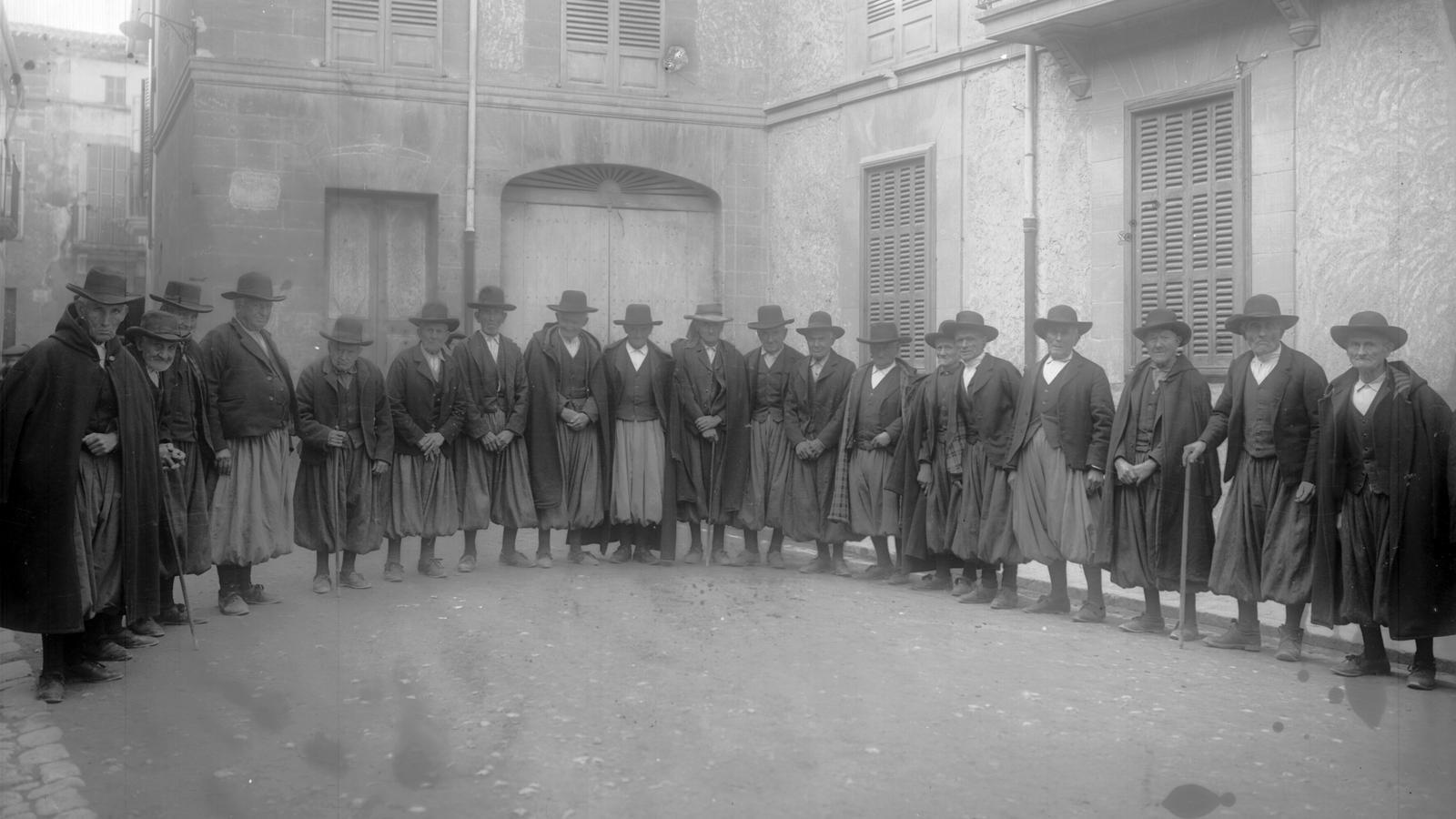
At the beginning of the 20th century, the photographer Guillem Bestard portrayed in Pollença the last peasants with traditional attire, already considered an anachronism since the 19th century. Today, several associations claim this ancestral clothing, which during the tourist 'boom' was a victim of folklorization.
6 min
Group of men dressed loosely in the Old Square of Pollença at the beginning of the 20th century.Fons fotogràfic Bestard / Cerdà. Ajuntament de Pollença
PalmaSince 1963, in the Olivar market in Palma there is a marble sculpture titled The latest wide dress, which was initially located at the intersection between the Avingudes and Aragó street. The work is by the artist Tomàs Vila and he sculpted it in 1951 in tribute to the last generation of Mallorcans who wore traditional clothing. It was one of the iconic images that the boom tourist in folk representations and which, nevertheless, did not conform to historical reality. This is asserted by Miquel Matas, a member of the traditional music and dance group Aires d’Andratx and co-author of the book Avior. Our textile heritage (2022), together with Macià Tomàs and Juan Cruz. “The breeches with puffs, popularly known as baldragues or wide-legged trousers, allowed peasants to go dressed in the style known as 'a l'ampla' (the wide way). They were very ephemeral, lasting only about thirty years, from 1830 until around 1860. Afterwards, other international trends took hold that were more appealing to the new generations. In the villages of the Tramuntana mountain range, the elderly wore breeches with puffs until the beginning of the 20th century, as reflected in some photos by the Pollença-born Guillem Bestard. On the other hand, in the Pla and Llevant regions, they disappeared much earlier”.
At the end of the 19th century, Archduke Ludwig Salvator confirmed in Die Balearen that traditional clothing was already a relic of the past. In 1918, in a speech in Barcelona, the distinguished Pollença poet Miquel Costa i Llobera made the following observation: “Amidst the present cosmopolitan uniformity, Pollença is the only Mallorcan town where one can still see farmers dressed in the loose, proud attire of days gone by”. In August 1926, the Palma musicologist Baltasar Samper completed the X-ray: “This morning we went to photograph the embroiderers of Ca na Maria Bel, who were already waiting for us dressed as ‘peasant women’, just as we had agreed. These dresses are rarely seen now, because everywhere women have adopted what they call ‘city-style’, that is to say, current fashion”. “At the beginning of the 20th century – recalls Matas – the Sineu photographer Josep Pons Frau was already in charge of portraying staged scenes of rural life. He had some of the participants dress in traditional clothes that they no longer used”.
Skirts and shawls
“From the 19th century onwards –continues the researcher– women of the bourgeoisie and nobility began to dress following European fashions. It was then that the concept of ‘peasant dress’ was coined to refer to the attire of the peasantry”. In the case of women, skirts were the star garment in both the wealthy and popular classes. “They changed according to the era. In the mid-19th century, on holidays they could wear up to seven petticoats under the main skirt to puff it out. Before, in winter, it was colder than it is now and layers were added to keep warm. And in summer, with the heat, they would remove them”. Clothing of that time was not so bothersome, because it was made with natural fabrics (cotton, linen, woollen cloth, silk and wool), which were thicker for field wear. “Garments like skirts or waistcoats were washed very little or not at all. Instead of doing laundry, there were other techniques like leaving them in the sun or out in the dew [outdoors during the night]. Today, however, we use washing machines all the time”.
Visit of the President of the Republic Niceto Alcalá-Zamora to Pollença in 1932.Bestard / Cerdà Photographic Collection. Pollença City Council
Another characteristic element of women's clothing was the 'rebosillo'. “Contrary to what people believe,” notes Matas, “it has no sexist connotation, unlike the shawls that Christianity required women to wear to enter a church. It is the evolution of a medieval garment known as a ‘toca’ (wimple). Initially, it was long, but by the beginning of the 19th century, it began to shrink until, when earrings that encouraged aesthetic vanity became fashionable, it became a small ruffle behind the ears. By the 1920s, it had almost completely disappeared.” Rebosillo derives from the Spanish verb rebozar, as it was an element that ‘covered’ the head. It had a dual function. “Women wore them for hygienic reasons, but also for the sake of comfort, because when working, it preserved the braids they wore in an era when they were required to have long hair. On holidays, they would display embroidered 'rebosillos' made of higher quality fabrics. Likewise, they would put on all their jewelry as a display of family wealth.”
In those times, women's underwear did not exist. “Men,” highlights the researcher, “wore simple white trousers. Women, on the other hand, did not wear panties. They dressed in a long shirt that reached below the knees, which they also wore to sleep. This allowed them to urinate standing up until the beginning of the 20th century, which was when the more refined ones switched the long shirt for a type of knickers.” Women did not wear bras either, but rather a corset, a sash known in Spanish as a corsé. “They wore it under a very tight, boned shirt called a ‘gipó’ (bodice). With the bodices, they could wear low-cut tops, but they would cover themselves with a shawl or with the 'rebosillo' itself if it were long.” Bras began to become widespread in the USA after the First World War. It was due to the massive incorporation of women into factories, which required much more comfortable clothing.
In ancient times, the ideal of feminine beauty was also quite different. “It was the French fashion designer Coco Chanel –points out Matas– who in 1923, upon returning from a cruise vacation in the Mediterranean, popularized the obsession with being tanned. Before, however, the fashion was to show off white skin, because it was a symbol of the upper class that did not work from sunup to sundown. Thus, so as not to return tan and to also protect themselves from scratches, women covered their hands and arms with pieces known as sleeves. They also wore hats or scarves on their heads”.
With hats and without shoes
Men also wore their heads covered. “They were always,” says the scholar, “wearing headscarves, both on workdays and on holidays. They could also wear a barretina or a hat, which varied in style according to the historical moment and depending on whether it was a rural or industrial center. It responded not only to aesthetic questions, but also hygienic ones (it prevented the contagion of lice and other insects) and practical ones, since it allowed them to keep their hair tied back. Some time ago, men also wore it long, down to their shoulders, without, however, reaching the length of women's hair. Young people began to wear it short in the mid-19th century based on hygienist theories and other European fashions.” As an essential element for working, farmers wore a sash. “Tightly fastened to the back, it served to prevent dislocations.”
Clothing worn by the men.Arxiu Sergi MuñozWomen's clothing.Arxiu Sergi Muñoz
We must also imagine the old peasantry without shoes. “Everyone went barefoot,” insists Matas. “Back then, shoes were a luxury item reserved only for going to mass on Sundays or for solemn occasions like a wedding. Within a poor family, members took turns wearing them. Many people couldn’t even afford to wear espadrilles. At the beginning of the 20th century, in Puigpunyent—where I am from—there were still women who went to harvest olives without any protection on their feet. It must have hurt a lot. From the 1930s onwards, when citizens no longer dressed like peasants, that was when high-soled shoes, the famous ‘porqueres,’ became popular.”
Folklorization
Matas is part of a research team that, from Aires d’Andratx, organizes parades of traditional clothing in a show titled A Century of Clothing. Others, such as traditional music and dance groups like Aires Sollerics, do the same. Recently, one of its members, Joan Carles Simó, has just published the first thematic encyclopedia: Thread and Needle. Vocabulary of Mallorcan Clothing (El Gall Editor). “Some of the clothing items we exhibit,” says the spokesperson for the Andratx entity, “belong to our grandmothers, who kept them for sentimental value. Others belong to collectors.” Amidst this craze for ancestry, there are also tailors like Mateu Abdón Martorell who accurately reproduce 19th-century Mallorcan costumes. And on social media, Joan Adrover Vila promotes them through the profile @alampla.
Matas recalls the folklorization that, during the tourism boom, traditional dress suffered at the hands of the Falange’s Women’s Section, which managed Coros y Danzas. “For the 'ball de bot' exhibitions, a standard of dress was popularized that lacked any historical rigor, mixing pieces from one century with another, which has persisted to this day. In the 60s, there were only a few older women who still dressed as peasant women, all in black, with a headscarf and shawl. Women were always more resistant to urban trends and, therefore, more faithful to tradition than men, who from the 19th century onwards began wearing frock coats, waistcoats, and pleated trousers.” Today, the peasant costume is a characteristic element of patronal festivals such as the Firó in Sóller and the Beata in Valldemossa and Santa Margalida. “In recent years,” the researcher emphasizes, “the organizations behind this are very concerned about maintaining the purity of an attire that had been squandered. They claim dressing well in the old style as a form of identity. They do not want their customs to be part of a costume party.”
Traditional Menorcan attire is similar to that of Mallorca, but it began to be abandoned a century earlier, in the 18th century. This was due to British and French rule, which introduced European fashions to the island. The typical dress of the Pityusic Islands, on the other hand, is completely different and is the one that has lasted the longest. One of the most representative garments of its female repertoire is the gonella. As the Gallic etymology of the term indicates, it is a kind of 'tunic' (gunna) that covers the entire body—it was also worn by men in the past. According to the book Dones de pagesa: els treballs i els dies by Vicent Marí Tur, in 2009 there were nearly a hundred gonellas in Ibiza and Formentera, women who still wore the ancestral costume. “Now,” asserts anthropologist Lina Sansano, “there must be three left alive.”
The gonella could be of various colors. However, the garment has become associated with black because it marked the mourning of its last wearers. “For the death of any relative,” notes Sansano, “women could wear mourning for seven years. If they became widows, they wore it forever.” In the Pityusic Islands, traditional costumes began to be cast aside in the 1930s. “Many seven-year-old girls already told their mothers that they didn’t want to wear them. They preferred to be more modern. Even so, women maintained traditional attire longer than men. During the tourism boom, my grandmother, who was widowed at 59 with six children, did not take off her gonella to go to work at a hotel in Sant Antoni.”
Just as it happened in Mallorca, from the 1950s onwards, traditional Pityusic clothing began to be recovered along with popular dances under the supervision of Coros y Danzas, an organization controlled by the Women’s Section of the Falange. That recovery also involved a standardization of typical pieces not always sufficiently faithful to historical reality. Then, the woman was dressed in a very showy outfit, showing off the 'emprendada,' the exclusive set of family jewels, a symbol of her social status. The man, on the other hand, was given a barretina hat and a white shirt and trousers with a red sash.
That whole universe of clothing was consolidated during the tourism boom with performances of danzas típicas de Ibiza (typical dances of Ibiza). They were performances that provided extra money to dancers who for the first time became objects of spectacle—previously, people danced to have fun. Francoism thus promoted a folklorization of ‘regional’ culture. By selling a folkloric diversity, it managed to hide the political diversity of the Spanish state. Inspired by the petticoats worn by Ibizan peasant women, Adlib fashion was born in Ibiza in 1971, which today is an international clothing brand of artisanal origin. Initially, it took advantage of the anonymous work of hundreds of island women who, since the 19th century, had begun to become economically emancipated by working for Catalan textile companies.