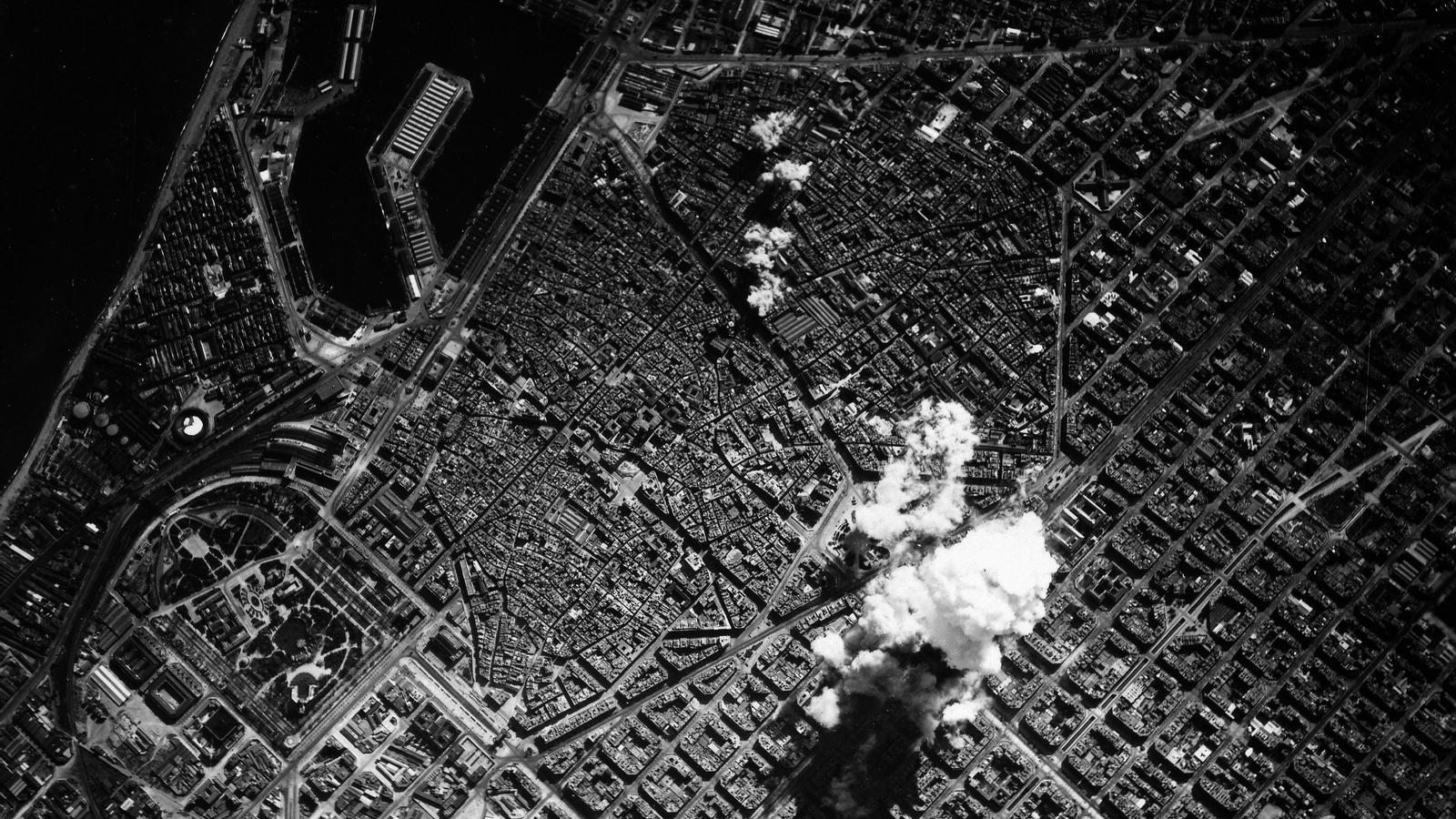
Thanks to a book by the journalist Giovanni Dozzini, Italy has just discovered the terrible bombings, unprecedented in Europe, that, starting in 1937, Mussolini ordered against the Catalan capital and that left more than 2,500 dead. It was with the fascist aviation that he had installed in Mallorca to help Franco win the Civil War
6 min
Aerial image of the effects of the bombings by the Italian aviation, March 17, 1938UHA UIG Getty Images
PalmaThe 48-year-old Italian journalist Giovanni Dozzini has just held a mirror up to his country. He has done so following a quote from Bertolt Brecht: “Let others speak of their shame; I speak of my own”. Italy's shame is its savage foreign policy, which Dozzini has now rescued from oblivion with Maiorca (Fandango Libri), still awaiting translation into Catalan and Spanish. The book, a hybrid between essay and fiction written in the first person, recounts the bombings of Barcelona that Mussolini's air force perpetrated from Mallorca, half an hour away by flight, throughout the entire Civil War.
“In Italy –says the author– there is absolute amnesia regarding this subject. Barcelona was the first major European city to suffer systematic mass bombings against the civilian population with a terrible toll: just on the 16th, 17th, and 18th of March 1938, there were a thousand deaths. The objective was to instill terror and psychological wear and tear on the Republican rearguard. Those three days of continuous air attacks were far more lethal than those Madrid had already suffered in November 1936. In contrast, the massacre by the German Condor Legion in Gernika (Biscay) took place in a single day, on the 26th of April 1937”.
On the 17th of July 1936, when the military insurrection took place in Melilla, Il Duce had been governing Italy for almost 14 years and Hitler had been in power for two years in Germany. Two weeks later, both leaders sent planes to Morocco to help the rebel army cross the Strait of Gibraltar. They cared little about breaking the non-intervention pact in the Spanish conflict that 25 countries, including the USSR, signed on the 25th of July under British pressure. Thus was written the prologue to the Second World War.
Mussolini's colonial ambitions
The initial support of Fascist Italy to the coup plotters had a price: one million pounds sterling. They were paid out by the Margalida native Joan March, the banker of Franco, who was following events from Rome. An euphoric Mussolini aspired to divide North Africa with Spain. He was also, however, worried about 'the communist threat'. “If the Bolsheviks control Spain –he argued to his wife–, that means they will end up controlling France and Italy, and the Bolshevik danger will have spread throughout Europe”. Weeks later, Il Duce demanded more money to stop the republican expedition of Captain Alberto Bayo, who on August 16th had landed in the east of Mallorca. He sent to the island three Savoia S-55 seaplanes and the steamship Morandi with three CR-32 fighters and three dismantled Machhi 51 seaplanes.
On August 26th, to supervise that operation, the Bolognese squadrist Arconovaldo Bonacorsi, known as Count Rossi, 38 years old, landed in Mallorca. He was able to claim victory when on September 4th Bayo's troops were forced to re-embark. Il Duce's advisor sowed terror through the villages he visited with the cry of “Tutti i rossi fucilati!” ('All reds shot') –according to the historian Bartomeu Garí, he would be responsible for some 450 murders. The Spanish military soon grew tired of the arrogance of the fascist emissary and four months later demanded that Franco expel him from Mallorca. “In Italy –claims Dozzini– he is a completely unknown character. Nobody knows the atrocities he committed in Mallorca”.
On September 18, 1936, two weeks after the withdrawal of the republican expedition, the Communist International launched the recruitment of the famous International Brigades to go and defend the Republic. Until October 1938, nearly 34,000 volunteers for freedom were mobilized. The figure is considerably lower than the number of foreign volunteers who enlisted in the rebel side: more than 70,000 Italians –66 are buried in a mausoleum in the Palma cemetery–, about 18,000 Germans, nearly 10,000 Portuguese, at least 50,000 Moroccans and 2,000 more of other nationalities.
Italian aircraft carrier
The Aviazione Legionaria of the Balearic Islands operated from four base camps: the Son Sant Joan airfield and the Son Bonet one (Palma), a runway set up on a fig field in ses Salines and the port of Pollença, from February 1937 under the supervision of Ramón Franco, the dictator's younger brother –from August 1937, the Pollença base would be shared with the Condor Legion, which four months earlier had massacred Guernica. In the port of Sóller, the Italians would also have submarines there, very effective when it came to blocking the Republic's maritime traffic. Il Duce thus turned Mallorca into an immense aircraft carrier that would allow him to limit the area of influence of England and France over the Western Mediterranean. He trusted that Franco would end up ceding the island to him.
Giovanni Dozzini with the book 'Maiorca' in his arms.UHA / UIG - Getty
Mussolini sent to Spain more than 800 warplanes –Hitler provided about 700. They were more sophisticated machines than the seaplanes of the Republican Navy, which were completely outdated. From Mallorca, the fascist aviation did not spare efforts to subdue the rest of the Balearic Islands. Ibiza, recovered by Bayo's troops on August 8, 1936, was bombed on September 13 with a death toll of about forty. In Menorca, the logistical center of the Republican expedition, the first air attack took place on September 26 over Mahón. The island, the only one that resisted until the end of the war, would suffer a total of about sixty bombings, which left more than 300 buildings destroyed and thirty fatalities –the hundred air-raid shelters that were set up saved many lives.
On February 8, 1937, Italian and German planes stifled the well-known 'desbandá': a diaspora of 150,000 residents of Malaga who, as the city was being bombed, fled towards Almeria along the only coastal road that existed. While from the air they did not stop machine-gunning them, from the sea a rain of shells fell upon them, launched by three ships, among which was the Baleares, which one year later would be sunk near Cartagena by the Republican fleet – there were 765 casualties. In the 'desbandá'’, nearly 5,000 people died, the majority women and children. Two months later, the bombing of the Condor Legion in Guernica caused more than 2,000 deaths.
Three days of horror in Barcelona
On March 16, 17, and 18, 1938, the German squadron acted as a supporting cast in one of the most ruthless interventions by the Italian air force. It was in Barcelona, which concentrated the main war industry and which in February 1937 had already suffered the first naval bombardment by a fascist navy ship – in March it experienced the first purely aerial one. “The order,” says Giovanni Dozzini, “was given directly by Mussolini to the Italian general Velardi. In less than 41 hours, 14 attacks were carried out that dropped more than 200 projectiles on the center of the countal city. There were more than a thousand deaths (a hundred were children) and about 1,500 injured. Areas like the Raval, the Gran Via, and the Sagrada Família neighborhood were left in a completely ruinous state. The Italian aviators would leave to bomb in the early afternoon and by the evening they were back in Mallorca to have dinner, as if nothing had happened. The parties they held at the Hotel Mediterráneo, in Palma, were famous.”
The international community immediately stood in solidarity with Juan Negrín's government and condemned the brutality of those incursions. “10 days later,” assures the journalist, “Franco ordered in writing to the Italian commander the prohibition of any other bombing without his consent.” That formality would not prevent the air offensive from continuing. And it did so with even more force – some flights would include the participation of Bruno Mussolini, son of the Duce, who would stay incognito at the Gran Hotel in Palma. Throughout the war, more than 140 Catalan towns were bombed. The material damages were countless and there were thousands of injured and more than 5,500 fatalities, more than half of which were in Barcelona, which suffered about 158 attacks until the end of the conflict. After the Catalan capital, the cities with the most casualties would be Madrid and Valencia, with about 2,000 and 800 deaths, respectively.
One of the images of the bombing of March 18, 1938, taken by Italian aviators.ARCHIVIO MILITARE DELL’AERONAUTICA ITALIANA
Laboratory
On January 2, 1937, the United Kingdom and Italy had signed the Gentlemen’s Agreement, by which they committed to maintaining the statu quo of Spain's territory. Trust, however, was broken at the beginning of February 1939 when the British negotiated with Franco for the surrender of Menorca. Mussolini exploded with anger, as he longed to keep it for himself. As revenge, on February 8, he ordered the bombing of the port of Maó.
When the war ended on April 1, Il Duce tried to keep his Majorcan aircraft carrier. Over Europe, however, new warlike winds were blowing. In June, the German, Portuguese, and Italian forces allied with Franco were repatriated – in Palma, as gratitude for their support, there are avenues named Germany, Portugal, and Rome, with two Roman statues at the end of the Rambla. Two and a half months later, the Second World War began. “The Civil War – concludes Dozzini – was the first armed conflict in which aviation played a decisive role and in which the civilian population in the rearguard was targeted. It served as a laboratory for the global disaster that came later”. On Tuesday, November 17, the author of Maiorca will present the book in Palma (6:00 p.m. at the UNED headquarters).
Last March, at the behest of Vox, Marga Prohens' government repealed the Law of Democratic Memory, a repeal that has now been provisionally suspended by the Constitutional Court. In July, Prohens attended the inauguration in Palma of a memorial to the 73 civilian victims who died in Mallorca due to Republican bombings during the Civil War. Their names were engraved on a plaque christened the Wall of Dignity, which was placed on the Passeig de Sagrera, near the air-raid shelter of the Baluard de Sant Pere. In 1998, Father Massot was the first person to study this episode in the book The Bombings of Mallorca during the Civil War (1936-1938).
“For me,” said the monk from Montserrat, “the victims of a bombing are very respectable, whether they were from one side or the other, but I do not believe that any special honor needs to be paid to them; rather, we should lament the results of a fratricidal war and do everything possible […] so that such a disaster never happens again. I would not say the same for people murdered in an extrajudicial killing, who deserve a special remembrance [according to researcher Bartomeu Garí, nearly 1,800 people were murdered in Mallorca during the war].” Recently, Father Massot's study has been joined by the book Mallorca in Flames, by historian Manuel Aguilera, and the work Aerial bombings coming from the Balearic Islands and bombings caused in the Balearic Islands, carried out by historians Miquel López and Carlos de Salort within the framework of the Executive's Fourth Grave Plan 2023-2024.
In July 1936, the insurgent military immediately had Mallorca under control. Starting July 23, to recover it, José Giral's government began a series of propaganda and bombing flights over the island. The incursions intensified in August with the aim of paving the way for Captain Bayo's expedition, which, having occupied Formentera and Ibiza on the 7th and 8th, prepared to land in Portocristo on the 16th. Meanwhile, at the end of the month, the German air force, allied with Franco, undertook the first bombings over Madrid.
In Mallorca, the most virulent air attacks were recorded during 1937 with Indalecio Prieto as Minister of National Defense. That year was when air-raid shelters began to be built in Palma, but also in towns like Inca and Manacor. Although the targets were military, there were bombs that fell on working-class neighborhoods and commercial areas. In total, the Republican offensive left nearly a hundred dead and about 200 injured. Those bombings enraged the writer Llorenç Villalonga, who was a member of the Falange. On August 7, 1936, he published an article in the newspaper El Día titled ‘My Manifesto’. “The planes,” he said, “that the Generalitat sends us are the direct heirs of the anarchists who years ago threw bombs at the Liceu.”