Fulgencio Coll (father), the man who voted no
The father of the Vox leader in Palma was the only attorney of the Balearic Islands in the Francoist Cortes who opposed the political reform half a century ago now

-
CAT -
CAST -
DE
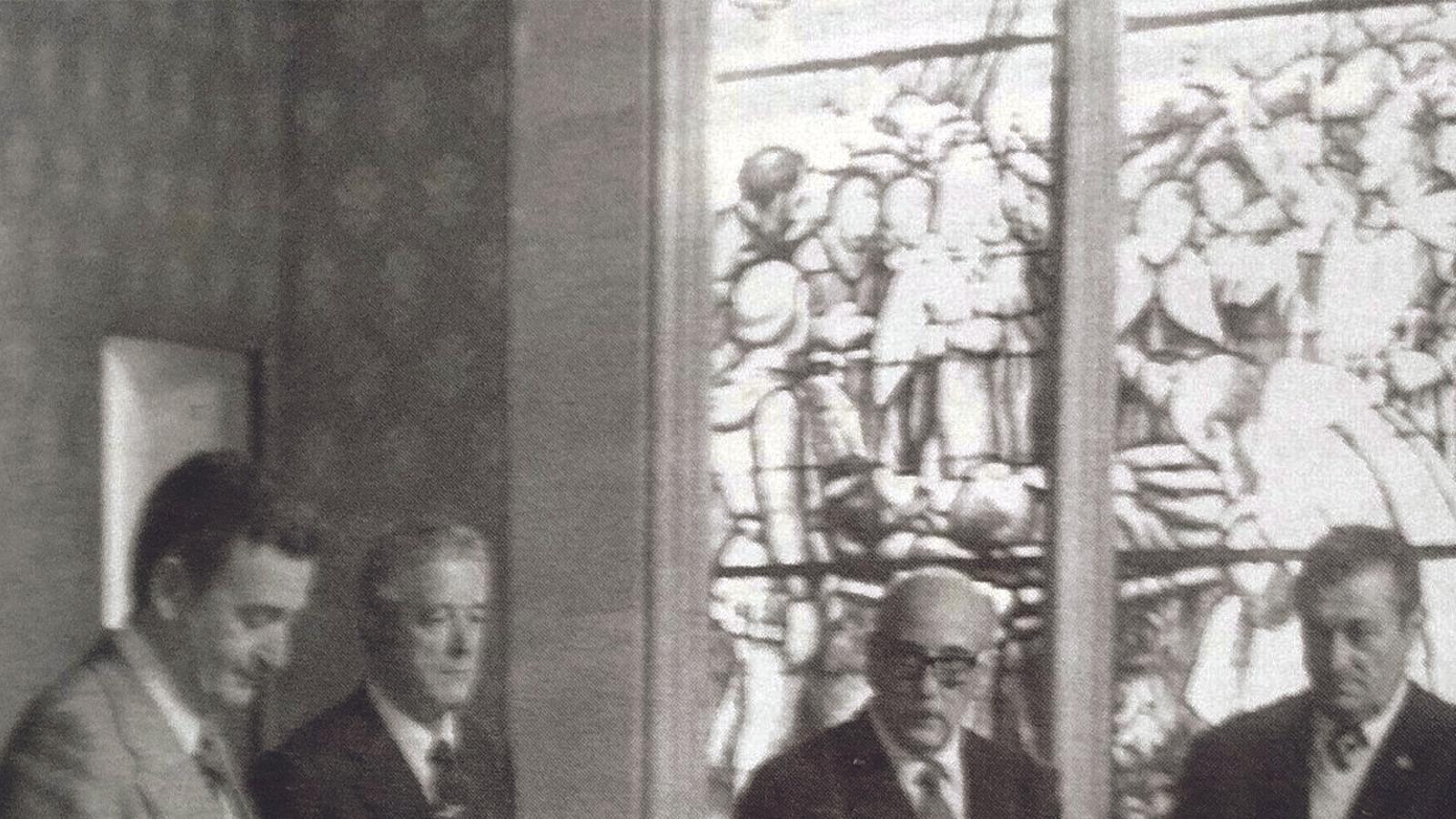
PalmaHe was the only representative from the Balearic Islands in the Francoist Cortes who voted against the Law for Political Reform, the norm that opened the path toward democracy. Fulgencio Coll de San Simon –father of the current Vox councilor for Palma, Fulgencio Coll Bucher– was also a military man, and was civil governor of Biscay and president of the Provincial Council of the Islands. We recover his figure as it has been half a century since that vote, on November 18, 1976, in which the last Cortes of the dictatorship committed harakiri and liquidated the Franco regime.
The Colls come from a prominent family of politicians, judges, and military personnel. Miquel Payeras points out that two Colls, Gaspar and Joan, were mayors of Palma. Fulgencio the father was born in Palma on May 26, 1907, studied at the Infantry Academy of Toledo, and was stationed in Morocco, then a Spanish-French colony under the euphemism of a ‘protectorate’.
When the coup d'état of July 1936 occurred, Coll was not in Mallorca, but his father, Joan Coll Fuster, who had left the army by virtue of the Azaña Law, which allowed officers to retire with their full salary, was there, as was another of his sons, Jordi. Both joined the revolt. Because of that early adherence, Joan Coll Fuster would become mayor of Palma in 1945; in 1954 he would receive the Gold Medal of the City.

The young Fulgencio fought on the Francoist side and was seriously wounded in the legendary battle of Guadalajara. After the Civil War, he went through the usual dance of destinies: Menorca, Mallorca, Jerez, and once again Menorca, this time as military governor. In 1966 he was promoted to general. Meanwhile, he had climbed positions within the regime's infrastructure: advisor and provincial delegate of the youth branch, the Frente de Juventudes, and provincial sub-chief of the Movimiento.
Coll de San Simón was –notes Gregorio Morán– “an individual from another century”. Of stony loyalty to the regime, of course, and with a solid culture, polyglot, subscriber to the Geographic Magazine and married to a Swiss citizen. He obtained his commander's office at Fort Benning, in the United States.
It was 1968 when he was appointed civil governor of Biscay, at that time the most problematic territory in the entire State: the organization Euskadi Ta Askatasuna (Basque Homeland and Liberty), ETA, had begun violent actions. It was not so much a matter of acting as a viceroy as it was of being a transmission belt with the State government for everything that was happening.
According to Morán, the governor-general received the nickname don Fulgencio Coll de San Simón y San Exupéry y de los Grandes Expresos, for the "lineage and arrogance" that were characteristic of him. His appointment responded, probably, to the desire to appease the spirits of the 'negurítics', that is to say, the great business families, uneasy about the reappearance of political violence. "That gentleman from Mallorca", from an illustrious family, was seen by them as one of their own. On June 19, 1970, he presided over the usual commemorative parade of the 'liberation' of Bilbao, that is to say, the capture by the Francoist troops, accompanied by the top brass of the Biscayan oligarchy.
In 1974 his dismissal arrived, after fulfilling the task that had been entrusted to him: to exercise repression, observe the situation to report to Madrid and maintain good relations. The day he embarked at the Biscayan airport, no one came to say goodbye to him.
President of the Provincial Council
The replacement took place when –justly!– a new president had to be designated for the Provincial Council of the Balearic Islands, replacing Josep Alcover –yes, the one who had humbly offered the Marivent palace, which was supposed to be a museum, to the then-Prince Juan Carlos. So his name immediately came up. He swore the oath of office on his knees, as was the custom at the time, before the civil governor of the moment, another military man: Carlos de Meer, a notorious member of the most hardline sector of the regime, of what would soon be called 'the bunker', and Coll became a valuable ally of his.
The name of the procurator –equivalent to the current deputies– also had to be chosen for the Francoist Cortes, in representation of the provincial entity. And there was only one candidate: Coll de San Simón himself. He was chosen by almost total unanimity, with only one blank vote.

It was during that stage that a special regime for the Balearic Islands was proposed –once again– to compensate for the insularity. Despite the iron centralism of the era, it was nothing strange: the Canary Islands already had the cabildos –the equivalent of the councils– since 1912, and Álava and Navarre had an economic agreement, that is to say, their own treasury. That did not quite convince Coll: he immediately pointed out that it was a matter of "deconcentrating", not "decentralizing".
Until then, the vice president and interim president of the Provincial Council had been Jaume Binimelis, a Falangist and 'Joseantoniano', but distanced from the bunker-like immobilism. Between Coll and Binimelis, a more than notable rivalry was unleashed, leading to the sudden dismissal of the vice president, who spoke his mind freely in statements to Diario de Mallorca, in which, curiously, while maintaining his ideals, he opted for a democratic system.
A little later, in January 1976, De Meer himself fell: Coll was one of the loyalists who attended his farewell dinner. With a new governor, Ramiro Pérez Maura, and with the Palma City Council in the hands of the reformists, with Paulí Buchens as mayor, the Provincial Council became the last bastion of the 'bunker'. The general managed to be re-elected at the head of the provincial entity, but the unanimity was beginning to crumble: 8 votes, out of the 15 cast.
Reformist siren songs were sounding and Coll pointed out that under no circumstances should the State imitate "institutions of other countries whose temperament is much more collectivist"; for him, the Spanish character was individualistic, in need of "self-control and self-discipline". Fulgencio Coll was one of the procurators who opposed the decriminalization –even if it were partial– of political parties, which were still illegal at the time.
The harakiri of the Cortes
But the Transition continued, unstoppable, especially when that unknown man named Adolfo Suárez acceded to the presidency of the central government. The democratic opposition, illegal, did not quite trust that Falangist who stated that “to elevate to the category of normal what is fully normal in the street sphere”: they wanted rupture, not reform. As Josep Maria Llompart would later say: “It is not for this that we fought, but we must take advantage of it”.
And the hour of truth arrived: half a century ago, the last Francoist Cortes had to pronounce themselves on the government's Law for Political Reform project, which consecrated their replacement by the future Congress and Senate, democratically elected. It meant, in fact, the liquidation of Francoism.
Another Majorcan member of those Cortes, though of an opposite political position, Josep Melià, expressed confidence that it would move forward, because, as he declared to Diario de Mallorca, “the Cortes are a machine for approving things and opposing them is equivalent to going against their nature”. They had always said “amen”, and it was not foreseeable that they would change the trend. A Primo de Rivera, Miguel, nephew of the founder of the Falange, took charge of defending the proposal: he was, he said, Joseantoniano and Francoist. But, with Franco dead, it had to be “substituted by the will of the Spaniards”.
There were only two days left until the first anniversary of the dictator's death when, on November 18, 1976, the vote took place. It had to be approved by two-thirds of the Chamber and, just as Melià had predicted, the regime's Cortes disciplinedly accepted their disappearance: the harakiri or ritual suicide, as it was qualified. The project received 425 votes in favor, 13 abstentions, and only 59 against. One of them, that of Coll. He was the only one of the five members from the Balearic Islands, among whom were Melià and Buchens, who had voted against it.
Fulgencio Coll declared to Última Hora that he had voted ‘no’ “out of moral principles”. That project had been processed via an emergency procedure, when it “should have followed the normal procedure”. In it, he acknowledged that “the Spanish people have acquired enough maturity to exercise their right to self-determination”. And he added: “But I have acted in conscience, and even the republican constitution respects the dictates of conscience”. It is certainly curious that a defender of Francoism would take as a reference the legality that Francoism had destroyed.
The Provincial Council that Coll presided over also spoke out against it, only a few days after sending a telegram to President Suárez to congratulate him on the approval of the political reform. Mind you, with a very tight result, of eight votes to six. The times were changing.
It was rumored –adds Payeras– that he would run in the elections the following June. But no. Coll de San Simón resigned as president and handed over the position to Gabriel Sampol, who would be the last one of the Provincial Council, as it would disappear to give way to the island councils. He died in Palma in 1978. He was, certainly, a man of another era, and that stage had come to an end.
It was the then mayor of Ciutadella, Antoni Casasnovas, who in May 1976, as reported by Miquel Payeras, requested that Catalan be used in the Provincial Council of the Balearic Islands, even if only for pleas and questions. Of course, Coll de San Simón refused, which led to a scathing response in the press from the then president of the Obra Cultural Balear, Climent Garau.
The following January, with the political reform already approved by referendum and the elections approaching, Casasnovas reiterated his request. And once again Coll de San Simón refused, stating: “What we cannot do is request co-officiality because Catalonia has requested it, with which we have nothing to do”. The Menorcan pointed out to him that, in fact, both of them were speaking in Catalan, so Coll blurted out to the secretary: “You haven't heard anything and we haven't said anything”. And that was that.
Information prepared based on texts by Miquel Payeras Femenias, Joan Mas Quetglas, Gregorio Morán, Antoni Ignasi Alomar i Canyelles, the Gran Enciclopèdia de Mallorca, the volume Memòria viva, the newspapers Última Horaand Diario de Mallorca and the magazine El Temps.
