The bull is also Catalan
How many times have we seen the Spanish flag presided over by a bull? We all assume that the bull is a symbol of Spanishness. Despite everything, we must know that the bull is an animal very present in Catalan culture and language.
-
CAT -
CAST -
DE
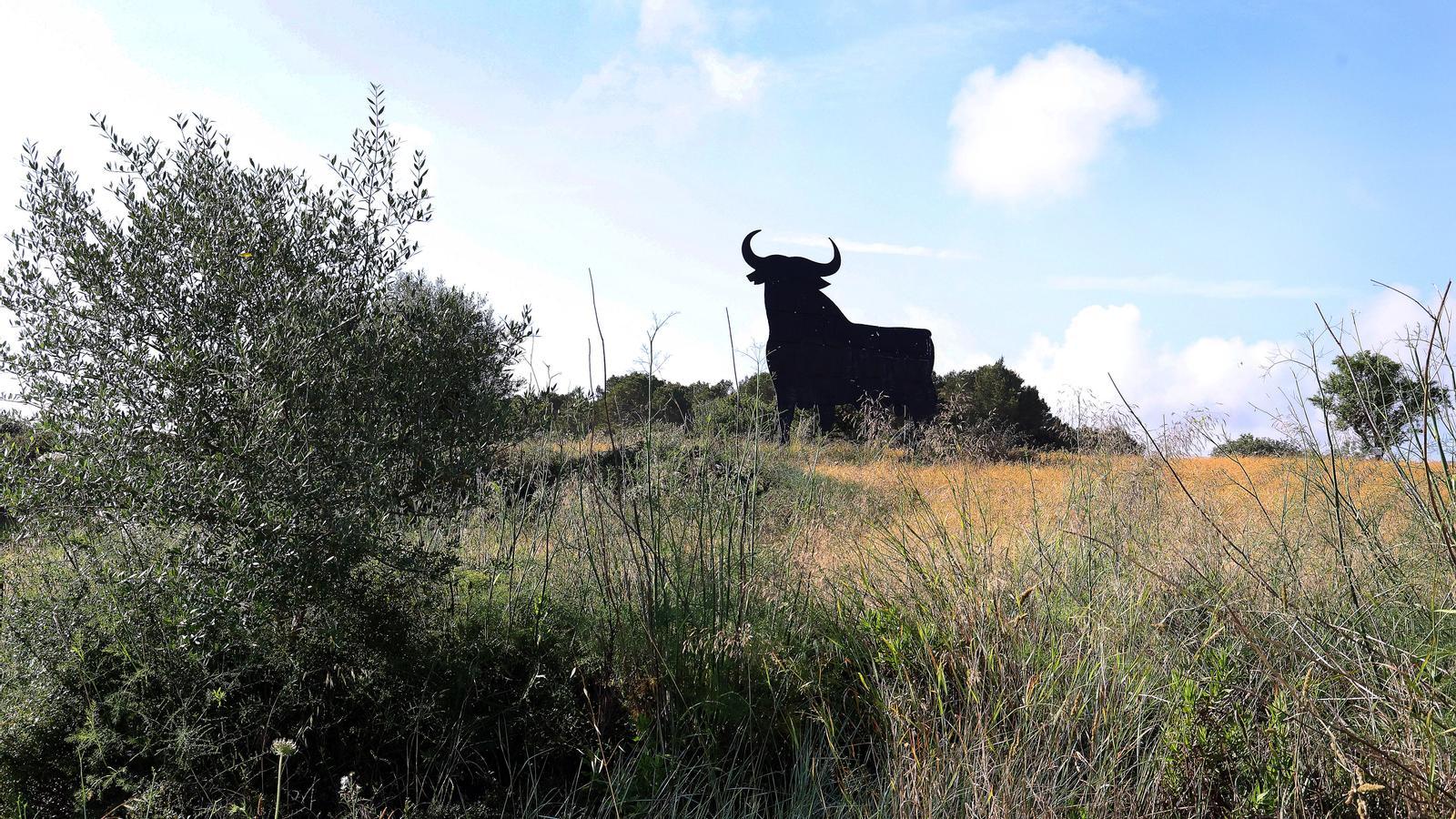
PalmIn 1956, the Osborne Group, a company dedicated to wines and spirits, placed a billboard in the shape of a bull on the Madrid-Burgos highway. That silhouette, fourteen meters high, had been designed to advertise Veterano brandy. Two years later, the bull expanded to the different roads of the State. The popularity of this animal was so great that, today, it is still a national symbol. For three generations, the idea that the bull is the animal that best represents Spain has been installed in the Spanish collective consciousness. This animal has transcended Spanish culture and symbolism so much that, even in 2017, the Supreme Court had to clarify that the bull is not an official symbol of the State. Even so, very often we still see bovine stickers on cars. In this article, we will see that this animal is much more than a brandy brand or a Spanish nationalist icon. The bull is a living animal in our language, toponymy, and popular parlance. So much so that we could say that the bull also has a Catalan root.
The bull, like the donkey or the she-donkey, has been, since time immemorial, an indispensable animal in Majorcan agriculture. For centuries, this beast has helped many families to till the fields. When there were no tractors yet, this was the draft animal that did the dirty work. It is for this reason that we have so many popular expressions linked to this animal that, until a handful of decades ago, still coexisted with us. Surely you have heard someone say "don't put the plow in front of the bull" when someone wanted to act too quickly and get ahead of events. Perhaps on some occasion, you have been rushed by being told to walk "at a bull's pace." Sometimes, when someone is systematically late, they are told they are "like the mascard bull, who, being able to go fast, always arrives late." Or, you may have even heard someone being criticized with this saying: "Fresh out of the egg, he already thinks he's a bull."
Proverbs and set phrases
If we search for the word ‘bou’ in the Diccionari Català Valencià Balear (DCVB), we will not only find the definition of the word, but we will also come across two dozen proverbs and about twenty set phrases. We have proverbs such as “allà on va el bou va el picarol”, “el bou per la banya i l’home per la paraula”, and “més caga un bou que cent orenetes”, among others. We also have many idioms that we use in our daily lives to express an idea or a fact: “perdre bous i esquelles”, “pujar més la corda que el bou”, and “no veure un bou a tres passes”.
In addition to the great richness that the bull brings to popular language, this word has 24 meanings in the Alcover-Moll dictionary, which demonstrates the great polysemy of the word. Most definitions refer to tools or tack used in agricultural, hunting, or fishing tasks that were done in our grandparents' time. Below are some utensils that are called ‘bou’:
A stone slightly protruding from a wall with a hole suitable for tying beasts. A crosspiece that holds the two heads of a yoke, in a plow yoke.A rope used to tie a cartload of sheaves along its entire length.A part of hunting snares, consisting of a stake and a set of threads.‘Pescar al bou’: a type of fishing consisting of a large net pulled by two boats, called ‘pareja del bou’.The bull is also present in fauna and nature and gives its name to animals such as the bovine snail, Saint George's bull (poriol), and the bull (a mollusc similar to a slug), among others. We also find the bull if we look at the sky. The bovine star refers to the planet Venus, which appears in the sky at dusk. The appearance of the star is the signal for ox-herders, swineherds, and shepherds to retire. The Red Bull is a “cloud that is a sign of rain”.
In Balearic toponymy
The bull is also a presence in Balearic toponymy: Son Bou (Alaior), Caló d’en Bou (Eivissa), bassa dels Bous (Santa Maria), cementiri dels Bous (Artà), cingle dels Bous (Escorca), pla del Bou (Pollença, Puigpunyent), penyal dels Bous (Binissalem), etc. Even, we have the Bous de Costitx, which are Talayotic sculptures of great heritage and historical value and which, moreover, are older than the Osborne bull.
After this linguistic journey, we can affirm that the bull does not only belong to Spanish symbolism, but that we, the Catalan speakers, also have our own bull and we carry it in our language. In short, the bull is also ours!
To finish, it is worth reflecting. In Menorca they say that “in strange lands, cows eat bulls”. This means that when outside their home, even the strongest is at a disadvantage. Unfortunately, islanders, both outside and at home, are in a vulnerable and inferior situation. We would be better off learning to “take the bull by the horns” and face up to certain animals. If we talk about current language policy, we can say very clearly that “for the love of the bull, the wolf licks the yoke”, which refers to people who humiliate themselves and resign themselves to doing unpleasant things to achieve a benefit. In the case of Balearic policy, selling one's own language to stay in power. However, if they want to make us eat bull in our home, let it at least be a domestic and healthy bull, not a rabid bull that charges the language at every step. But, above all, if we are to have a bull, let it at least be a bull that speaks, chatters or speaks Catalan.
