What the State took away
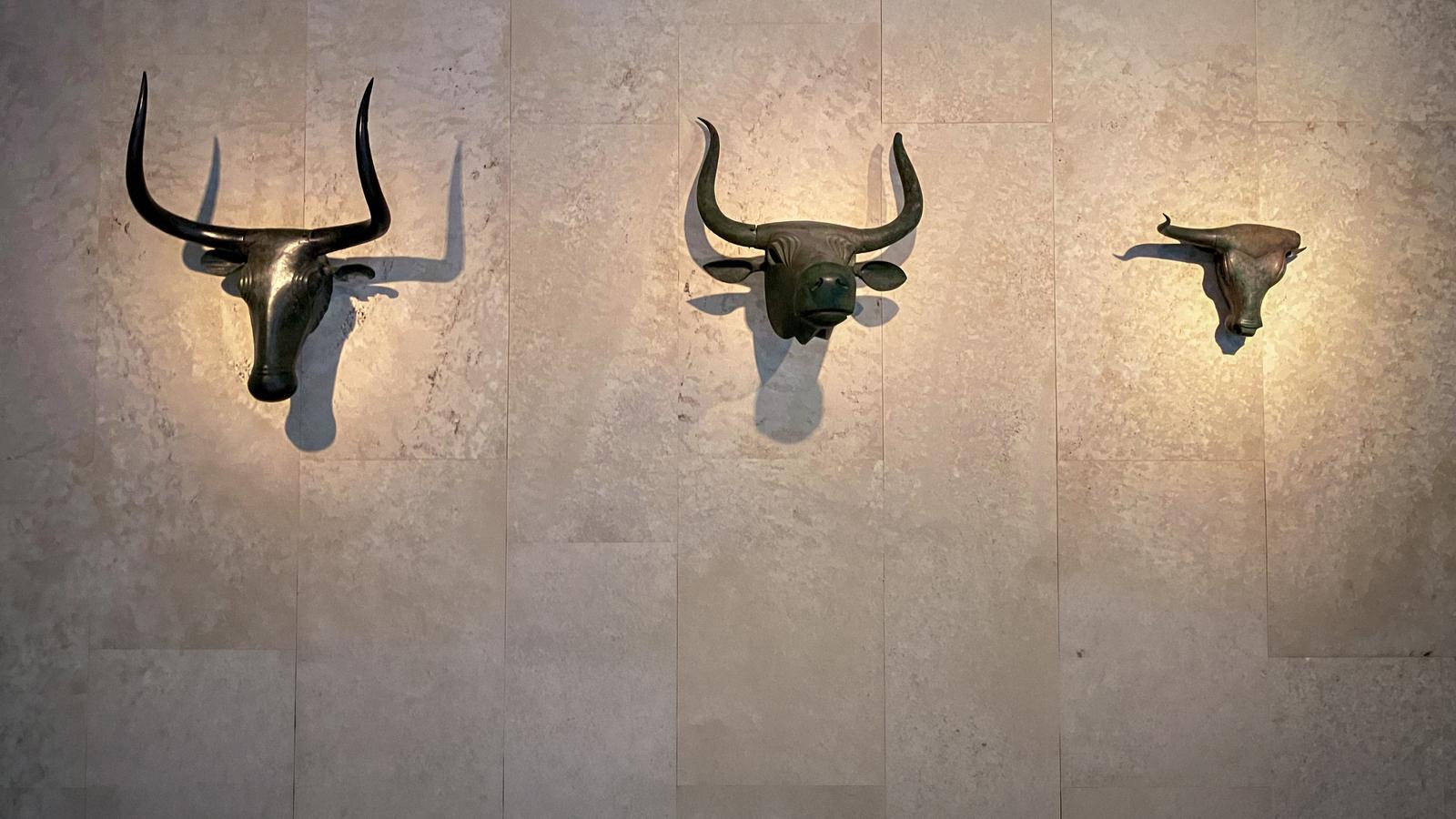
We recall the history of the bulls of Costitx and their departure from Mallorca, now that the state government has denied their temporary cession

-
CAT -
CAST -
GER
PalmaAlmost at the same time, just a few days ago, two pieces of news reached us. One: the State denied the temporary loan of the three prehistoric bull heads found over a century ago in Costitx, to be exhibited at the Museum of Mallorca. "The Ministry of Culture is laughing at the Majorcans," stated the president of the Council, Llorenç Galmés. Two: the discovery in the Tramuntana mountain range of a small bull head – precisely! – which this time will remain on the island. We recall the discovery of the bulls and how and why they ended up in Madrid, at the National Archaeological Museum (MAN).
As happened now with the small bull head, the discovery occurred by chance in 1894, when, as Rafel Horrach, the owner of Son Corro in Costitx, recounts, he was working on widening some walls. The event was reported in the newspapers, and the Lul·lian Archaeological Society, an entity founded precisely for the defense and conservation of historical heritage, immediately became interested.
A group of members, including Estanislau Aguiló and Bartomeu Ferrà, vice-president of the Provincial Commission of Monuments, traveled to Son Corro and took photographs, drawings, and notes. There were not only the three famous bulls but much more material, including seven cylindrical pillars, ceramics and iron fragments, human and animal remains, and horns corresponding not to three bull heads, but to seven.
The representatives of the Lul·lian Archaeological Society warned the owner that, just like at crime scenes, he should not move anything. The unpleasant surprise they found upon returning was that the pillars had been uprooted and the earth disturbed. It seemed as if the owner had believed in that legend, so widespread in Mallorca, about treasures hidden by the 'Moors' when they had to flee due to the conquest, and thought he might find one.
No one lifted a finger for the bulls
But the owner of Son Corró had indeed found a treasure. At that time, the law stipulated that the owner of the land where an archaeological find appeared could request economic compensation. And he set a price for the lot: 3,500 pesetas, a very respectable amount for the time. Lul·liana didn't have anywhere near that much money, so she approached the Provincial Council, so that it would acquire all that material and prevent it from leaving Mallorca. The press had already echoed the interest of some antique dealers in obtaining the pieces.
It was in vain: the Council only agreed to pay 20 pesetas, to make replicas of the bulls. Nor, relates Josep Mascaró Pasarius, did the Palma City Council, nor the civil government, nor the Mallorcans with economic means, lift a finger for the bulls of Costitx. It would probably have been different if it had been about buying a new ship for Alfonso XIII, considering what would happen to his grandson the following century. The Archaeological Society opened a popular subscription to cover the expense, without success. By the way, there are indeed copies in Mallorca: some at the Museum of Mallorca and others at the House of Culture of Costitx.
Faced with this situation and with the prospect that those pieces would end up in the Louvre Museum, Bartomeu Ferrà and another member of the Lul·liana, Gabriel Llabrés, contacted the National Archaeological Museum of Madrid, to which they sent photographs and drawings of the bull's heads. This material was seen during a visit to the museum by the then president of the state government, Antonio Cánovas del Castillo, a great lover of antiquities, who ordered the 3,500 pesetas to be paid to the owner of Son Corraó. “This is the authentic and sad story, and the naked and shameful truth”, writes Mascaró about why the State took these pieces to Madrid, which, many years later, have been so claimed by the descendants of the Majorcans who let them go.
That was not surprising either. As an indignant Miquel dels Sants Oliver wrote at the same time: “The provinces had paintings, weapons, antiquities of merit, everything went to the Court”. Around 1831, the nefarious Ferdinand VII forced the Palma City Council to cede the crest of King Martí, emblem of the Festa de l’Estendard, to the Royal Armoury of Madrid. In 1870, the National Library acquired Miquel Capdebou's bibliographical collection on Balearic themes. This time, at least, by opening the purse, as in the case of the bulls of Costitx.
It was only a matter of time before someone realized that, although it was the State that had paid the 3,500 pesetas for the bulls, it turns out that the State is all of us: we are also us, and the corresponding part came from the taxes of the Majorcans. Rafel Horrach collects as a claim from almost half a century ago the one made in 1979 by the then mayor of Costitx, Maria Antònia Munar, requesting that the bronze heads be transferred to the Museum of Mallorca. It was the beginnings of the State of autonomies: with raw centralism it was doubtful that such questions would have been raised, and with Francoism, much less.

Returning bulls “attacks unity”
Munar was interviewed in Madrid by the then director of the National Archaeological Museum, Martín Almagro. According to the press, he replied that this claim “atentated against the unity of the lands and people of Spain”, using an expression that was one of the characteristic mantras of the dictatorship's official language. It was noticeable that democracy had only been established a couple of years before.
However, those efforts eventually bore fruit in the long term. In October 1995, the three bull heads returned to Mallorca, on temporary loan, for the exhibition at the Museum of Mallorca The Talayotic sanctuary of Costitx, coinciding with the centenary of its discovery. In a hundred years, the cost of living had risen significantly: the 3,500 pesetas for which the State bought them had now risen to the 150 million pesetas at which they were insured, about 900,000 euros today.
The bulls were the star piece of an exhibition that also included two pieces discovered at the site that same year: a Talayotic warrior and a Roman deity. Afterwards, they were packed back into their boxes and made their way back to Madrid, where they still remain.
In the same year, 1995, Son Corró, whose land had been acquired by the Town Hall, underwent restoration, as the pillars found a hundred years earlier were placed there. This generated a sharp scientific controversy: the archaeologist Víctor Guerrero stated that the reconstruction had been carried out without following the plans of Bartomeu Ferrà, who had known the sanctuary firsthand at the time of its discovery.
The Costitx Town Hall also planned a small museum, which would be intended to house the bulls, if they could be permanently returned to Mallorca, which, it must be said, makes sense: why should they end up in Palma if they were found in Costitx? It is still another form of centralism.
Ten years later, in 2005, the possible return of the bulls was addressed by the Balearic Parliament, at the initiative of the Nationalist Left group. It was approved to request their transfer to the Museum of Mallorca. Which, incidentally, belongs to the State, although its management was first carried out by the regional government, and currently by the Consell de Mallorca.
In 2006, the issue was debated in Madrid, in the Culture Committee of the Congress: it was raised by the then deputy Josep Antoni Duran i Lleida and one of his arguments was the appeal that those pieces could have for cultural tourism in Mallorca. The proposal did not go ahead, but the People's Party left the door open to temporary loan.
Precisely that: temporary loan has been the latest request – for now – made from Mallorca, in this case for a new exhibition at the Museum of Mallorca, a request that has been met with a refusal. Why in 1995 the transfer was possible and now it is not, in both cases with governments of different political colors in Madrid and Mallorca, is an enigma worthy of being deciphered in another archaeological site, a few thousand years from now.
The two great unknowns surrounding the bulls of Costitx, besides what the devil they are doing in Madrid, have been their meaning and origin. Carlos Garrido emphasizes how the bull was, in the Talayotic era, “an object of worship throughout the Mediterranean”. This animal is a symbol of male strength, but, at the same time, due to its horns, it is related to the Moon, feminine. Its ritual sacrifice would represent a kind of scapegoat. In Rhodes it was said that bronze bulls moaned desperately when disaster approached.Besides the famous ones from Costitx and the recent discovery of a small head, figures of bulls and their horns, as well as remains of these animals, have been found in both Mallorca and Menorca. In Pollença, wooden sarcophagi carved in a taurine shape. In Torralba, a small bronze bull appeared at the feet of one of the characteristic Menorcan tables. Garrido suggests they would serve as altars on which to place the sacrificed bulls, while Mascaró Pasarius believes that perhaps this T-shaped figure is a representation of the bull god.This, if the bulls of Costitx are indeed religious representations. Because other possibilities exist. The archaeologist José María Luzón has suggested that they could be figureheads, from ships that would have been captured by the primitive Majorcans and installed at Son Corró, as offerings, or as a kind of war trophies. Curiously, this expression, ‘war trophies’, is what the group Esquerra Nacionalista would use in 2005, in one of the eternal debates about their return, alluding to how these pieces were displayed in Madrid.Here arises the question of whether the bulls are of Majorcan manufacture or came from abroad. The archaeologist Pierre Paris assured that, due to their originality, they had been made on the island, and he even coined the term ‘Costitx style’. While his colleague Antonio García Bellido was of the exact opposite opinion: due to their careful craftsmanship, they must have been imported – how else could such marvels have been made by peripherals! If they were manufactured on the island, the ancestors of present-day Majorcans would not have made them either, as the indigenous population practically disappeared following the Catalan conquest.
Information prepared from texts by Rafel Horrach, Carlos Garrido, Josep Mascaró Pasarius, Miquel Àngel Casasnovas Camps and Bartomeu Bestard, the Gran Enciclopèdia de Mallorca and the newspapers Última Hora, Diario de Mallorca and El Día del Mundo.
