The cultural sector, much more professional, but still with too many shortcomings
Despite the spectacular advances, around 65% of authors “do not receive remuneration for the acts to which they are invited”, as denounced by the AELC

-
CAT -
CAST -
GER
PalmaThe diagnosis is practically unanimous: there has been an extraordinary advance in the professionalization of culture creators in the Balearic Islands in this 21st century, but there is still much to be done. The improvement of working conditions, the support of institutions, and the adaptation to technical transformations are among the challenges faced by art professionals in the Archipelago.
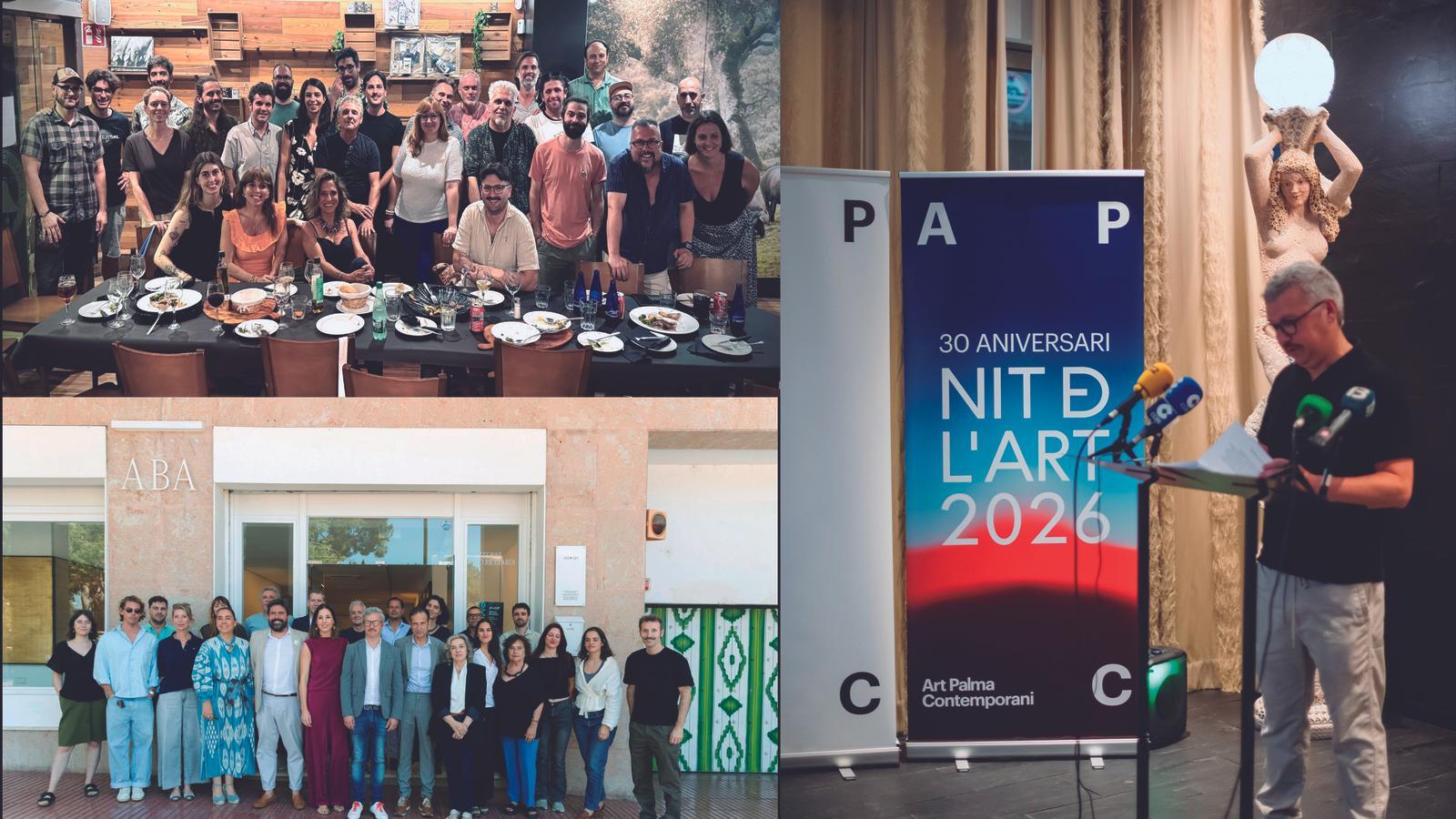
Fran Reus, president of the Art Palma Contemporani gallery association, states that "without a doubt, the leap in scale has been spectacular." The change "is clearly seen in our key milestone: the Nit de l'Art," which, with minimal initial attendance, "has indisputably become one of the most important and massive cultural events in the Balearic Islands. This civic maturation has gone hand in hand with a professional transformation of the galleries, which now operate under strict international standards: we master global logistics management, professional curatorship, and new technologies."
"I don't know if there is a stronger professionalization," points out Pere Joan, president of the Comic and New Media Cluster of Mallorca, "but there is a recognition of our activity and a visualization of the sector by society, and we are often called upon for collaborations."
What are the still pending issues? The gallery owners demand "a harmonization of the VAT on art with the rest of Europe, so as not to compete at a disadvantage in the international market," the "consolidation and continuity of public acquisitions," and the "promotion of private collecting with effective patronage laws." Sources from the Comic Cluster point out "a challenge that all audiovisual sectors and all of society are already facing": artificial intelligence. "In competitions, we have already requested that prizes not be given to works made exclusively by AI."
Good practices
The Association of Visual Artists of the Balearic Islands already developed, within the Union of Visual Artists Associations, a good practice manual for professional relations with gallery owners, curators, managers, and critics, as well as with museums and art centers. Currently, the sector is awaiting the Artist Statute, recently approved this July by the State government.
"We are not asking for anything extraordinary," expresses Rosie Nguyen, president of the Union of Creators of Mallorca, but rather that "artistic work be considered work and that it receive fair remuneration. When we participate in an event, too often the organization frames it as a promotional opportunity or as a 'favor' done to the artist, instead of work that must be remunerated."

In the field of literary creation, the Association of Writers in the Catalan Language presented this July, together with other entities from the same linguistic sphere, an agreement "to promote more transparent, balanced, and respectful contractual relationships with copyright." Sebastià Portell, a Majorcan, its president, perceives a notable improvement, with significant collaboration from the Institut d’Estudis Baleàrics and the Fundació Mallorca Literària. Still, however, around 65% of authors "do not receive remuneration for the events to which they are invited".
For Miquel Ferrer, president of the Guild of Booksellers of Mallorca, "the way of working has changed with greater digitalization and the need to be more multitasking, since to the sale of books is added cultural management and all online communication". The challenges? "Large department stores and large multinational platforms, generational turnover, local rents, and the respect and maintenance of the Book Law".
Maria Muntaner, president of the Associated Publishers of the Balearic Islands, finds that a recent change "has been that we publishers have opened ourselves beyond" the Archipelago, "precisely to attend to this natural market for books in Catalan". "This is one of the clearest signs of the professionalization of recent years," she assures. Although two issues from some time ago have not yet been resolved: "On the one hand, finding a way to distribute our books nimbly between the Islands and also abroad; on the other, working to connect with more readers: new readers, this is the key that, naturally, does not depend only on us".
The Professional Association of Dance of the Balearic Islands admits that "there has been an important evolution", but "professionalization has not yet consolidated". It remains to "increase public investment in dance, create stable circuits for exhibition and hiring throughout the Islands, guarantee decent working conditions and adequate remuneration, and increase opportunities for creation, residency, and research".
Spaces, another necessity
The Association of Circus Professionals of the Balearic Islands also registers an evident transformation: “Two or three decades ago, there was practically no professional circus circuit comparable to the current one. There were artists and initiatives, but not the current fabric of companies, festivals, schools, training projects, own production, and exhibition circuits.” They call for “decent working conditions and remuneration, spaces to train, create, research, and exhibit” – hence the demand for Can Ribes, in Palma, and the Ferreries Circus School – and “recognition of the circus as an artistic discipline on equal terms”.

A veteran like Miquel Àngel Sancho, president of the Association of Musical Producer Entrepreneurs of the Balearic Islands, points out that “the major changes produced over recent years are evident. New technologies have deeply transformed the sector, especially regarding new ways of listening to music”.
The change is also evident for the Ibiza Musicians' Association: “Before, there were not many freelance musicians on the Islands, nor were there music schools. The Administration has contributed a lot in recent years”. In Ibiza, “the main challenge is a space to be able to organize events and concerts”. Promúsics Mallorca, Association of Music Professionals, sets among its objectives “to manage to adapt a current and specific labor, legal and fiscal framework for artists”, “to stipulate a minimum fee at a local level” and “to achieve dignified recognition of the cultural importance of musicians”.
The Association of Filmmakers of the Balearic Islands celebrates its 20th anniversary this year and the board of directors acknowledges that, in this time, “some things have improved a great deal. There is more talent, more professionalization and trajectories of Balearic filmmakers that already have a significant enough track record”. Precisely for this reason, they miss a more decisive commitment from the institutions: “It is a sector that has demonstrated with numbers that it is a source of economic and cultural wealth, that it generates social cohesion and impact, and also positions the territory in the world. We are especially worried about the situation of the Mallorca Film Commission –which depends on the Council and it is as if it had disappeared– and of IB3, which in recent times has ceased to be an ally and engine of Balearic talent”.
Essentially, another entity in the same field agrees, the Association of Audiovisual Producers of the Balearic Islands: “In recent decades, the audiovisual sector of the Balearic Islands has experienced a very important professionalization. Today we have consolidated production companies, highly qualified technical and artistic teams, and companies capable of developing projects with the quality standards required by the current market.” They also ask for “greater institutional support so that this evolution is also translated into stronger companies, more stable jobs, and budgets that allow for the consolidation of all the potential that has already been demonstrated.”
These are no longer the Islands where Joan Alcover and Antoni Gelabert had to work as a magistrate and as a barber, or where Pilar Montaner and Maria Antònia Salvà could dedicate themselves to creation thanks to family money. Now there are hundreds of professionals, groups, and companies that make a living from culture. But there is still room for improvement.
Around the eighties, when leading companies today, such as Iguana Teatre and Estudi Zero, started out, it was often said that only the legendary actor, author, and director Xesc Forteza could make a living from doing theater in Mallorca. Actor Carles Molinet, founder of Iguana Teatre, acknowledges that the change has been radical. But also because “society has changed.” From doing things in any way possible, we have moved to demands for regularization, compliance with tax obligations, or registering cultural workers, now commonly accepted.
Iguana, created in 1985, was one of the first groups to form as a company, as a cooperative. They had to do it, whether they liked it or not, if they wanted to access the foreign market, since this was a requirement of the Ministry of Culture. Currently, there are eighteen performing arts companies that make up their association, Illescena: seventeen from Mallorca and one from Menorca.
“It is feasible to make a living from doing theater in Mallorca,” states Molinet, “if you work more hours than a clock,” juggling different productions. “Hardly in Menorca and Ibiza and impossible in Formentera,” he adds. The creation of the Higher School of Dramatic Art, of which he was the first director, has contributed to professionalization, but often not in strict dramatic activity, but in “other parallel trades,” such as training, cultural management, and production.
Pedro Mas, secretary of the Association of Professional Actors and Actresses of the Balearic Islands, recalls that “before, everyone who wanted to professionalize had to leave for Barcelona or Madrid.” They are currently negotiating “what will be the first framework agreement for theater in the Balearics” to “dignify as much as we can the salaries of professionals in the face of the increase in the cost of living, particularly on the Islands.” In Ibiza and Formentera, the Association of Performing Arts Professionals of the Pityusic Islands has been established.
The Association of Playwrights of the Balearic Islands acknowledges that “twenty years ago there was nothing. But, even so, political cycles condition the stability of circuits and this makes professionalization very difficult, as well as the ability to propose long-term and stable projects. It is necessary that we assert our work and that institutions recognize the good moment that dramaturgy made at home is experiencing, support us, give us confidence, and contribute more investment so that we can live with dignity from our work.”
