Marcos Augusto: "The violence that any desire entails is uncomfortable"
Journalist and writer
-
CAT -
CAST -
DE
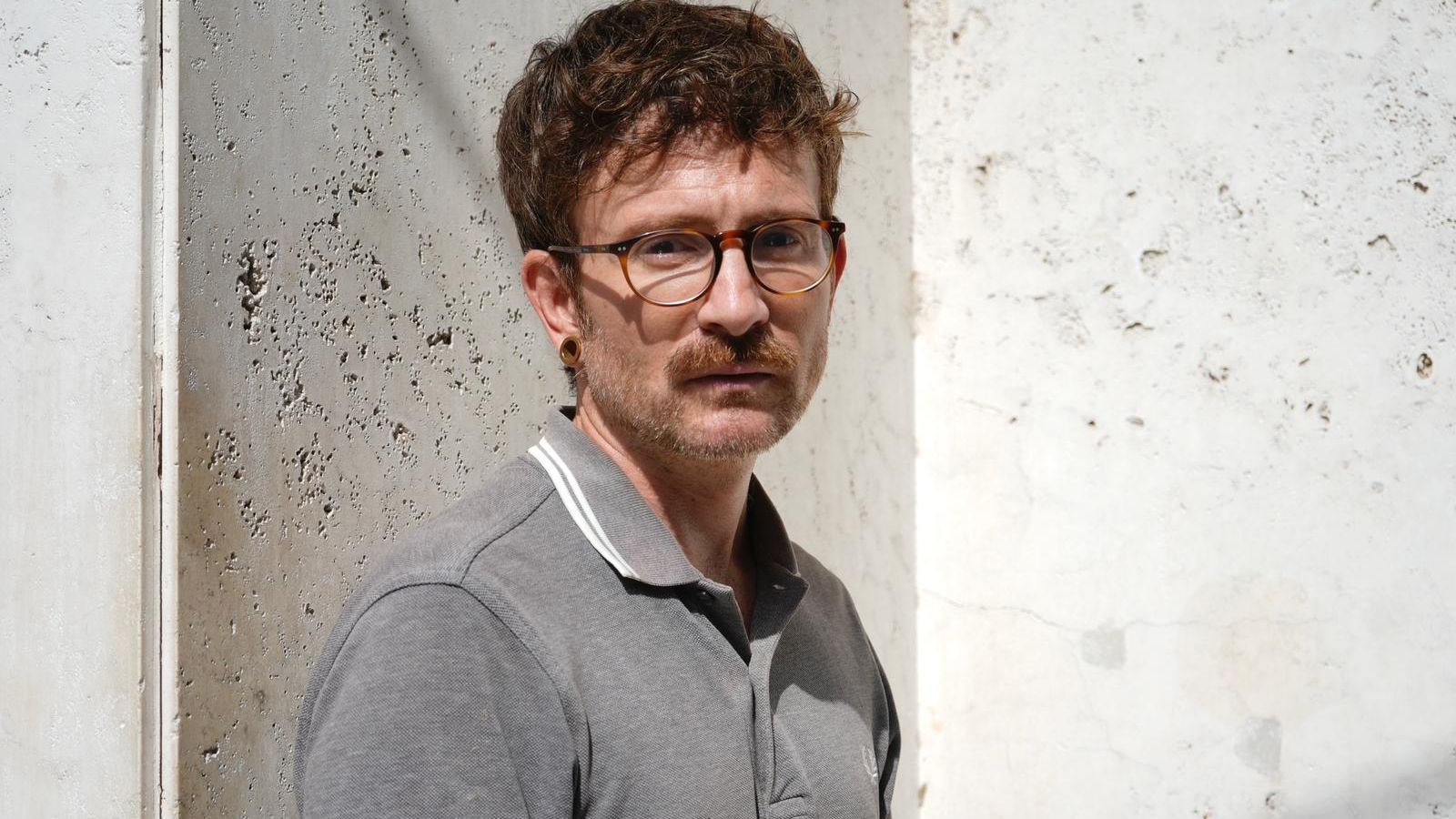
PalmaThe Majorcan poet Marcos Augusto debuts as a novelist with Te hice dios (Random House), a work that explores desire, illness, guilt, and moral limits through a story that is as uncomfortable as it is ambitious. Two men meet in a chat looking for sex, but the encounter goes further: one wants to infect himself with HIV —he is one of the so-called bug chasers— and the other promises him that he will. It is the starting point of a relationship marked by destructive impulses, lies, and the need to love and give meaning to loss. We talk to the author about literature, love, and the limits of fiction.
When did you know you wanted to write a novel?
— It was a very organic process. Also the way of writing it. Many things have been said about how a novel should be approached, but the process has been very similar to writing a poem, in my case. Many authors say that true writing is rewriting, and this also happens with poetry. Rather than deciding one day that I wanted to write a novel, I realized that I had an idea that could only be developed in this format.
What has been the main difficulty in making the leap from poetry to narrative?
— Understanding the process. One thing is daily writing, the act of sitting down to write, and another is the architecture of a novel. At first I tried to organize myself with cards, chapters, and outlines, but I soon realized that it wasn't my way of working. I am a very chaotic person in all areas of life, and I have assumed that this chaos is also part of my way of creating. The result, whether better or worse, is born from this way of approaching things.
The novel has been published directly by Random House. Does debuting with such a label impress or paralyze?
— Both things: it impresses and paralyzes. At first, it's an enormous thrill to publish with a label that features authors I admire and who have been role models for me. Then you become aware that the expectations are very high. When you debut with a publishing house of this caliber, you live with the expectation. To the nerves of a first novel are added the pressure of knowing that the reader will expect a lot from you.
You've talked about rewriting. Now that the book is out, would you still change things?
— Yes, many. But you also understand that there comes a point when the process ends. When you finish any project, you are always able to look at it with a certain critical distance. It's the same as with a relationship. You can think about what worked, what you wouldn't repeat, or what you would like to experience again. The same happens with a novel. The end doesn't come because one day you stop finding things to improve. It comes because you make the decision that the book is finished. You decide it, but there is also a publishing house, editors, and early readers who share that perception. As an author, you will always find possible changes. The poet Angelo Néstor told me that when he received his printed poetry book, he corrected words while reciting it. This need to revise what we write never disappears.
The novel talks about HIV, bug chasers, desire, guilt, lies... If you had to summarize it in a single idea, what would it be?
— Apparently it is the story of a person who pursues the virus. But very soon it drifts towards other issues: grief, guilt, and loss. It is true that it is inscribed within what we call LGTBI literature, but very soon the novel enters universal terrain. LGTBI books are spoken of as if they were only for LGTBI readers, and it seems absurd to me. Stories are universal, I don't believe in market niches.

Present morally uncomfortable characters. At a time when there seems to be a tendency to sweeten narratives, is it harder to break through with stories like these?
— I was very aware of what I was writing. Jaume Ripoll compares the novel to the work of Dennis Cooper for its politically incorrect character. Cooper, like Bret Easton Ellis, has often been on the verge of cancellation for the themes he addresses. However, I feel much closer, from a writing perspective, to authors like Rafael Chirbes, Annie Ernaux, and Marguerite Duras, who are my literary references. What happens is that the subject matter is so extreme that it ends up conditioning the reading of it. But this has more to do with the subject matter than with the way it is written. It is an intense novel and deals with subjects that can be uncomfortable. This is part of its nature.
What do you think shocks readers more: writing about violence or about desire?
— What truly disturbs is the violence that any desire entails. Desire always implies friction, because it very rarely fully coincides with the desire of the other. This tension between Eros and Thanatos is one of the axes of the novel. The case of bug chasers —people who wish to contract HIV— is an extreme expression of this impulse, but it continues to be a form of desire.
What are we really pursuing when we pursue another person?
— Many things at once. One of the main concerns while I was writing was not to morally judge the characters. Even though the novel is narrated from an 'I' addressing a 'you', I didn't want to construct a story of good guys and bad guys. I was interested in talking about the lies that sustain a relationship, about guilt, about desire, about permanence in the face of death, and about the way we construct love. But I didn't want to find a culprit. Morality, in this case, remains outside the narrative.
Can concepts like love, need, and obsession be separated?
— Everything is much more related than we like to think. I don't believe that a completely pure love exists, detached from dependencies, contradictions, or certain toxic dynamics. Relationships are much more complex than labels allow. We like to talk about love novels, but any love story also has a very dark side and could be read from another perspective. I even joke with friends from my town [the neighborhood of Gènova] and say that Te hice Dios is a beautiful love story. After all, there is indeed a love story.
How far can a person go to satisfy a desire?
— This is a question that I am often asked regarding bug chasers, but it needs to be looked at from another perspective. We are very surprised by a person who wants to contract HIV for a certain sexual fantasy, but there are many other forms of self-destruction that we have normalized much more. The story of someone who has lost everything due to gambling addiction, or drug addiction, does not shock us as much. People who have lost their health, family, job, and home pursuing another type of desire. In reality, the ways of reaching the limit are very diverse. What changes is how we interpret them. There are very extreme behaviors that we have ended up considering normal simply because we know them better. And, beneath this apparent normality, many deeply unhealthy stories are hidden. If someone were to publish a novel today about a heroin addict, no one would probably consider it particularly transgressive. On the other hand, the world of bug chasers is still surprising, because it had hardly been explored from fiction.
HIV occupied an important space in the collective imagination of the eighties and nineties. Today, on the other hand, it seems to have disappeared from public debate. What did you want to explain about HIV from the present?
— This novel could only be written today for two fundamental reasons: PrEP [medication to prevent HIV infection] and the concept 'undetectable equals untransmittable' [U=U: if a person with HIV takes antiretroviral treatment daily and maintains an undetectable viral load for at least six months, they cannot transmit the virus sexually]. The latter has been a very important contribution from activism. It has helped to combat the stigma and fear towards seropositive people. But as I was writing the book, I started to wonder who was left out of this narrative. What about people who remain detectable? What about those who, for various reasons, can still transmit the virus? There are many possible situations. We think of the lack of access to treatments and medical check-ups, but there are others. Some cannot follow their medication correctly due to mental health issues. Drug use also plays a role. I began to ask myself what realities we make invisible when we construct a discourse that works very well, but only for some of the affected people. Whose lives are left out of focus?
The novel also forces the reader to face the illness. Can this also be uncomfortable?
— Yes. It is very easy for us to forget this 'sick person's passport' that Susan Sontag spoke of [a condition acquired when pain and suffering enter a person's life]. The novel opens precisely with a quote from Illness and Its Metaphors. Sontag speaks of this dual citizenship: that of the healthy and that of the sick. We all live with the passport of the healthy, but sooner or later we will have to cross the border. I was interested in this duality because it goes beyond illness. It has to do with how we construct the world: what is good and what is bad, what is pure and what is impure, what is acceptable and what is not. It is a deeply rooted structure in our culture, Platonic and Judeo-Christian.
