While Gesa is projected, these large cultural spaces remain closed
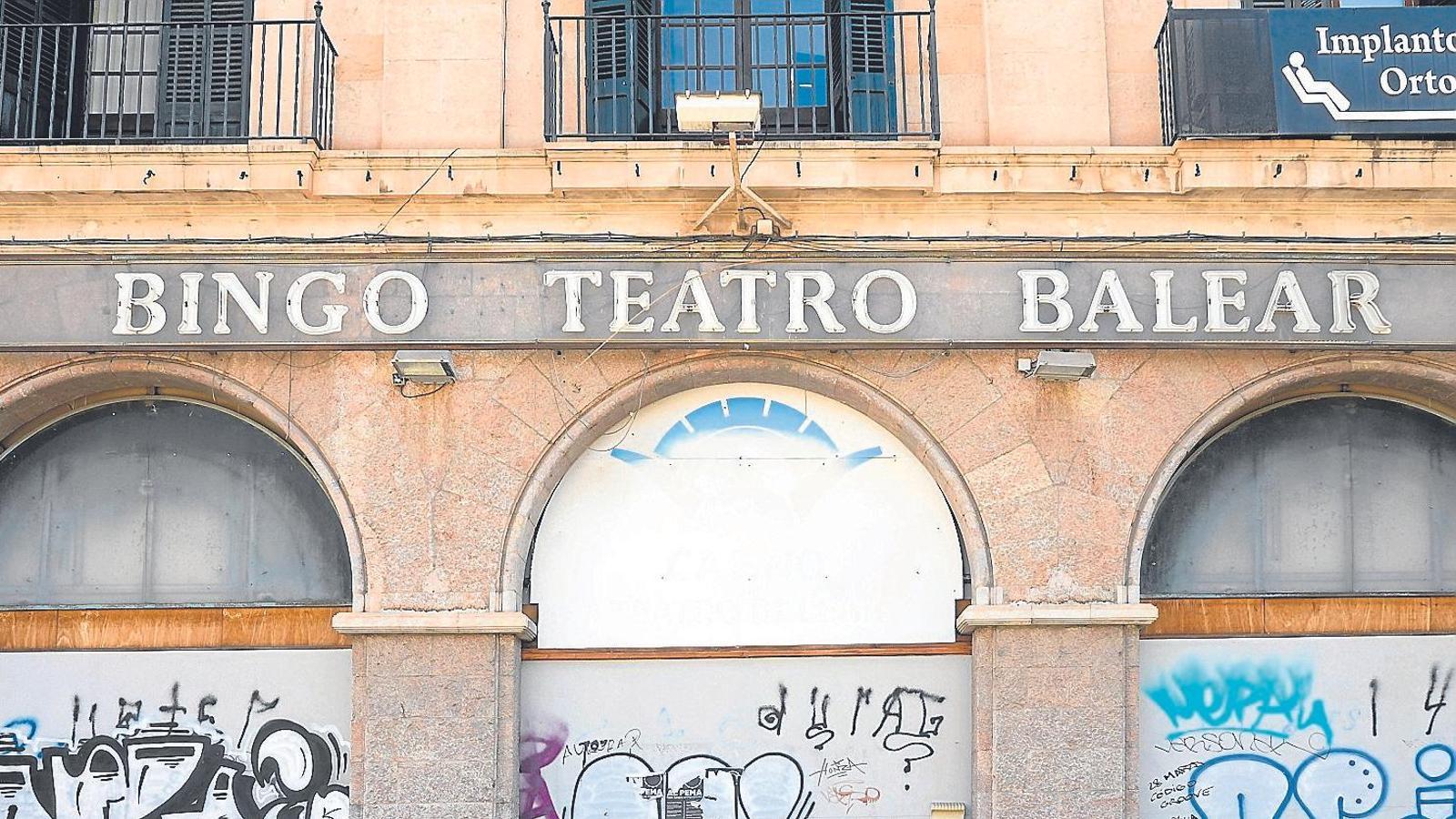
The Palmesana Assistance, the Protectora, the Balear Theatre, the Catalina Valls, the Augusta Hall and the old Sa Nostra Centre accumulate years without activity while the projects to recover them continue to be stalled

-
CAT -
CAST -
DE
PalmThey were venues of intense cultural activity and are currently closed, unused. While grandiose projects are announced, such as the transformation of the Gesa building into a major cultural infrastructure, spaces like the Assistència Palmesana, La Protectora, the Catalina Valls theater, the Balear theater, or the old Centre de Sa Nostra, all of them in Palma; the Sala Augusta in Maó; and the Dalt Vila Archaeological Museum, among others, are sleeping the sleep of the just, awaiting recovery.
The Assistència Palmesana, in Plaça del Pes de la Palla, and La Protectora, on the street of the same name in the city, share an origin: a society for the protection and assistance of its members, as the name suggests, which operated when public services with this purpose were not yet regularized. In both cases, these associations expanded their scope of action to cultural aspects and, above all, the performing arts. They were spaces for socialization.
Of the two entities based in Palma, the Assistència is the more veteran and the only one that has survived to the present day. It was created as a mutual aid and recreational society in 1858. The headquarters had a cafeteria, a library, and a theater with a capacity of 350 seats, where stage performances and opera were held, and films were screened. It experienced a period of splendor in the 1970s with the company of the same name, led by Antoni Zanoguera and Maruja Alfaro.
Towards the 1990s, the Assistència Palmesana seemed to revive, serving as the headquarters for the Di Marco Dramatic Center theater school and as a general base for the Teresetes festival. However, it did not recover the exhibition of shows. The registry of stage spaces published in 1989 by the Government describes its availability as "poor": without showers or hot water for actors, nor workshops, storage, heating, or cooling. Currently, the entity created in 1858 still exists, although it has no activity. The only area in full use is the Cafè Es Pes de sa Palla, on the ground floor with a terrace, managed by the organization for the care of people with disabilities, Esment.

A flagship missing
La Protectora was established in 1869 as a mutual and recreational entity and became very important in Palma, with more than 16,000 members from its foundation until 1944. Regarding cultural and leisure aspects, the dances became famous. In the theatre, with even more capacity than that of l’Assistència, for about 800 spectators, theatrical plays, operas, and concerts were programmed.
The entity lost its foundational objectives with the assumption of social benefits by the Administration, so it was dissolved in 1993. The theatre was transformed into a cinema screening room, named cinema Jaume III, and later into a gym and squash court. For a time, the cafeteria and restaurant on the ground floor of the building continued to operate.
In 2020, the newspaper Última Hora reported that the Capuccino Group, with restaurants in Mallorca and abroad, took over the building to transform it into a commercial space, demolishing the interior and building two floors. To make this a reality, the Urban Planning Department of the Palma City Council had to modify its use, which was sociocultural, as was done. But this project did not come to fruition: around 2022, the Capuccino Group sold La Protectora to another company, which is its current owner.
The now-defunct Caixa de Balears, Sa Nostra, with an essential social and cultural aspect, turned a mansion on Carrer de la Concepció in Palma into its cultural center, as part of a network with facilities that extended to the rest of the Islands. This space experienced incessant activity, with exhibitions, conferences, concerts, screenings, and all sorts of activities, in addition to the publication of a film magazine, Temps moderns. It was one of the flagship cultural institutions in Mallorca, as were its centers in Menorca and Ibiza. Part of its programming, such as regular screenings of non-commercial films, has never been recovered for the general public.
With the subsequent banking merger and the disappearance of Caixa de Balears, the property on Carrer de la Concepció became the responsibility of the current Caixabank. By then, it already belonged to the company Atela Inversiones. Caixabank, according to the savings bank, continues to pay the corresponding rent until the deadline, set for 2030. Activities have not resumed, as this would require the execution of the necessary works. The Sa Nostra Foundation, however, has continued its activity since 2023 at its new headquarters in Can Tàpera, in the Sant Agustí area of Palma. It offers outreach courses, concerts, and conferences, and programs in education, social action, and the environment.
Future of Sala Augusta
If the Assistència and the Patronat stopped being used as stages decades ago, the same happened with what was the Teatre Balear, in Plaça del Rosselló in Palma, next to the Olivar market. This space should not be confused with another practically with the same name, the Teatre Circ Balear, which existed until 1900 in the current Hort del Rei, until the existing buildings were demolished to recover the space as a green area.
The Bingo Teatro Balear, the name indicated on the facade, was inaugurated as a stage in 1909 and was owned by Josep Tous Ferrer, a multifaceted businessman, just like the also disappeared Líric theater, in that same area of Hort del Rei. Its programming was also very varied: theater in Catalan and Spanish, Mallorcan and foreign companies, and after the Civil War, stars of the era like Mary Santpere, Juanita Reina, Lina Morgan, and Sara Montiel. A peculiarity of the Balear was the circus performances, which took place coinciding with Christmas.
The theaters were transformed into cinemas, and the cinemas, with the advent of home video, into gaming spaces: at the beginning of the 80s it became a bingo hall. A new project was its reconversion into the Gran Casino Teatro Balear, but the Palma City Council denied permission for the works, and that ended up in court. Very recently, Christmas 2025, Última Hora announced the acquisition of the property to recover its stage functions, albeit as a café-theater.
The Teatre Municipal Catalina Valls, on Passeig Mallorca in Palma, on the ground floor of the Miquel dels Sants Oliver building or Palau de la Premsa, has been closed since September 2022, when, Cort points out, "deficiencies in the fire prevention system" were detected. It was built in the first half of the 60s, as compensation to the municipality for having ceded the land to the Press Association. It was used as a cinema, until, in the 80s, it underwent renovation and was re-inaugurated in 1994, as a municipal theater. At that time, it was the only council-owned venue and was dedicated, above all, to the performances of Mallorcan companies. With the addition of two more municipal venues, each was named after a personality from the island's stage: Catalina Valls, Xesc Forteza – in La Calatrava – and Maruja Alfaro, El Mar i Terra, in Santa Catalina.
The Palma City Council put out to tender, this same 2026, the remodeling proposal, with a base budget of 199,901 euros and a duration of 31 months, in three phases: the drafting of a preliminary draft, the preparation of the basic project, and the tender for the works. But the concession was left vacant. Now, Cort plans to "restart the process in the shortest possible time".
The Augusta Hall, on Arraval street in Maó, has been inactive for 23 years: since 2003. It dates back to 1947. It was a catechism center and cinema until the City Council acquired it and renovated it. It is a relatively small space, with a capacity for 230 spectators, although, according to the Census of scenic spaces, it has the necessary equipment for theatrical and musical activities.
For 15 years – since an ideas competition called in 2011 – the planned transformation of the Augusta Hall into the headquarters of the Maó Conservatory of Music and Dance, which does not have its own, has been dragging on. For the moment, however, classes are taught in the cloister of El Carme, which it shares with other cultural and educational entities. In 2019, the execution project was made public, with a budget of 7.9 million euros. Although the space is municipal, musical education is a competence of the Government.
However, as reported by ARA Balears, in 2022 the Ministry of Education had already opened two tenders, which were left vacant. Finally, it was ruled out that the Conservatory would be located in this space, so a new unknown has arisen: what will be the definitive destination of the Augusta Hall.
They are cultural spaces, in their entirety, with significant heritage value, whose past is part of the memory of the islanders, who attended shows or dances there, discovered artists there and shared experiences there. Some of the consulted voices believe that it would be advisable to consider giving them back life, before embarking on new adventures.

Sixteen years have passed since its closure, since 2010, the flagship of the spectacular prehistoric and ancient heritage of the Pitiuses, the headquarters of the Archaeological Museum of Ibiza and Formentera, in Dalt Vila: what would be a scandal in any city on the mainland, here it is a verifiable reality.Just a few days ago, on Tuesday, June 23, during a visit to Madrid, the Government once again brought up the situation of this museum. The Executive has agreed to take charge of the restoration of the building, but sources from the Ministry of Tourism and Culture assure that “the lack of drafting of the new works project by the Ministry prevents its reopening”.Created in 1907, the Museum depends on three institutions. The Ibiza Town Hall owns the buildings: the old seat of the University – the self-government institution –, the chapel of El Salvador, and the Santa Tecla bastion. The museum is state-owned and its management is the responsibility of the Government. The City Council has requested to recover these spaces. The Government proposes “a provisional opening this summer and a formal response to the request for the recovery of the space requested by the City Council”.In 2022, as published by ARA Balears, an investment of 1,200,000 euros was announced from Madrid. Four years later, not only does the Dalt Vila headquarters remain closed – with the occasional parenthesis of the exhibition *When the walls speak to us* – but the need to renovate the facade of the second headquarters, in Puig des Molins, has been added.
