50 years of Mata de Jonc, a different school in Catalan
The project of the center was conceived between the months of April and May of 1976 and was carried out with the will to break with the traditional educational model and normalize the own language
-
CAT -
CAST -
DE
PalmaMata de Jonc, a school promoted by idealistic and brave families and teachers, was the first to conduct all teaching in Catalan in the Balearic Islands. It began to be formed in April and May 1976, 50 years ago. It was born with the will to become a new school, breaking with the traditional model, with active teaching, rooted in its environment and, above all, in Catalan. It took its name from the "Crònica" by Ramon Muntaner (1325-1328) from a paragraph that exemplifies how unity makes strength: "If the whole bunch of reeds tied together with a strong rope and you all want to pull it up together, I tell you that ten men, no matter how much they pull, will not pull it up, nor even if more were to join. And if you remove the rope, a young man of eight years will break it from reed to reed, so that not a single reed will remain".
Mata de Jonc began the 1976-1977 school year and sought a different school model, one that took into account the needs of children – including disabilities – and the cultural and linguistic reality of Mallorca. It was born around an association of parents of students and a workers' cooperative, among whom we must make special mention of Conxa Vidal Oliver and her decisive drive. It was born as a private center, but with aspirations to become state-subsidized or public, driven by a group of people who moved in progressive circles and who shared a marked cultural interest and a concern for the education of their children.
‘Parish nursery’
Following the lead of professors Josep Casasnovas and Francisca Comas, who have investigated it, and speaking with some teachers from the early days, it can be said that Mata de Jonc began as a Nursery school, in Plaça de Santa Pagesa, in a small premises of the parish of Santa Catalina Thomàs that had previously been a parish ‘nursery’. The following academic year, the older students had to start General Basic Education (EGB) and they did not have enough space. The preschool students remained in the Plaça de Santa Pagesa premises, while those aged 3 to 6 moved to a house in the Son Anglada estate, lent by Antònia Bonet and Pere Jofre. The following academic year, everyone moved to the current building, the old educational center of the Sacred Heart nuns, on Son Espanyolet street, which the cooperative bought in the late eighties. A space that has allowed for the necessary extensions as the number of courses increased.

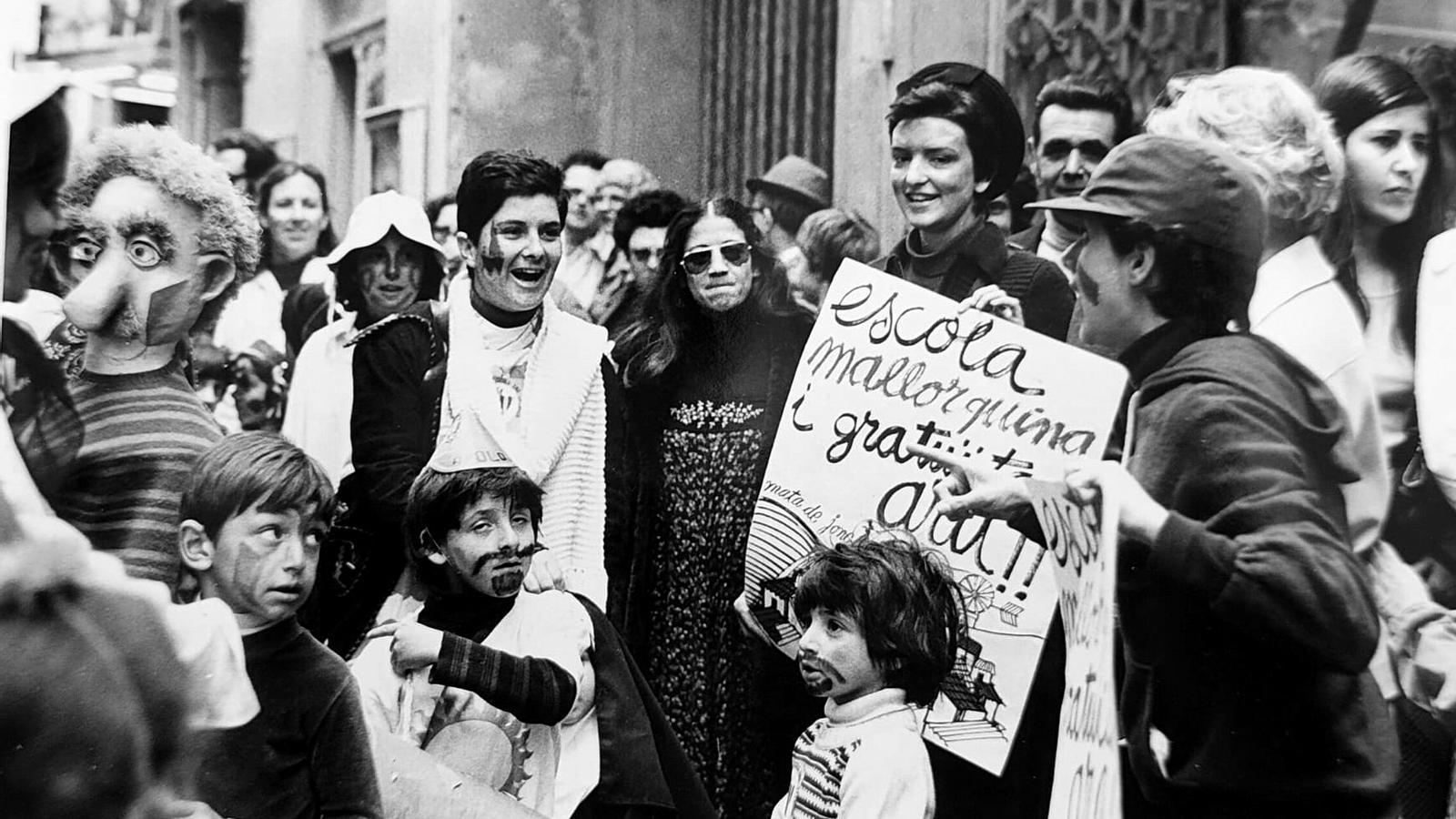
Economic problems, space issues, and official recognition were very present during the early years. At the end of the first academic year, a commission of teachers and families met with the mayor of Palma, Paulí Buchens, appointed after Franco's death. With banners, balloons, and stickers, they peacefully occupied the waiting room of the town hall. They hoped to obtain a subsidy from the City Council that would guarantee that educational experience, in order to pay for the works and adapt the Son Anglada building and reduce the fees paid by families. They also requested that the City Council intercede with the Ministry of Education delegation to legalize EGB in Catalan and obtain furniture that had been left over from public schools in Palma.
They did not want Mata de Jonc to be a private entity for the privileged. To legalize the school, there was a proposal to turn it into a pilot center, of a municipal or regional nature. Steps were taken in Palma and Madrid. There, specifically, with Josep Melià, who was then Secretary of State for Information. As Casasnovas and Comas rightly state in their article, they already had 105 students at that time – 55 in the early years of EGB and 50 in kindergarten –, with 14 educators, 2 cooks, and 2 cleaning staff, all of them earning the same salary, around 28,000 pesetas per month, much lower than in public and private schools.
To make themselves known, a public event was held in the Plaça Major of Palma, with a parade and puppets. However, there was a political will that was not fully materialized: Mata de Jonc did not become a pilot center. After serious problems in obtaining recognition, on May 8, 1980, the school was legalized, and in the 1984-1985 academic year, it was requested to be a state-subsidized school.
A different center
Mata de Jonc was a different center from the rest of the schools in many aspects. Already in a manifesto distributed in 1978, the creation of a "new, very new school" was proposed, neither reformist nor revolutionary, which was to "break the established molds and refuse to be the transmitter of the societal models that revolt us". A new school directed differently, managed jointly with the students' families and workers in an assembly manner. A consequence of the progressive ideas that the center's promoters believed in.
Teaching in Catalan from the start of Mata de Jonc was another characteristic that differentiated it from the rest of the schools, which taught in Spanish. They adapted materials to the Majorcan reality or created their own, such as the reading and writing method Ansa per Ansa, by Elisabet Abeyà, Maria Fortuny and Assumpta Mascaró. Very soon, Mata de Jonc received the Baldiri Reixac prize in recognition of the promotion of Catalan in school and for being a center that was at the forefront in the creation of adequate materials to extend the teaching of Catalan, starting from the dialectal forms specific to Mallorca.
In a research on graphic materials from those beginnings, as published by the pedagogues Josep Casasnovas and Francisca Comas, we can see teachers like Conxa Vidal and Margalida Munar, with children from 0 to 3 years old, and we can imagine the case of an active children's school with the use of pedagogical materials, many of which are made from repurposed products. An example of an advanced school, where families did not leave their children 'parked' and which contrasted, at that time, with the set of 'nurseries' that existed in Mallorca. There is also an educational video, Escola Mata de Jonc: work in the classroom, produced by the Audiovisual Resources Service of the University of the Balearic Islands, which showed active teaching-learning methodologies. This is significant, as it shows that very early on, the UIB took notice of Mata de Jonc to have a good model for the initial training of teachers.
As can be seen, it was and still is, even now, an interesting case for the study of the history of education in the Balearic Islands. The daring example of Mata de Jonc fifty years ago should be valued –“it is possible to provide quality teaching in Catalan”– which served as a mirror for other centers in the Balearic Islands. To evaluate, fifty years on, the results of the experience, nothing is better than looking at its former students. From Mata de Jonc, renowned professionals have emerged, architects, engineers, mathematicians, administrators, professors and internationally recognized artists, and many people, whether well-known or not. Children of brave parents who opted for the use of Catalan in teaching, without fear that this would mean a decrease in the quality of education their children would receive in an innovative school with difficult beginnings, where the complicity between fathers, mothers and workers was decisive.
