Balearic future teachers master Spanish more than Catalan
A report from the Faculty of Education reveals that the native language maintains academic weight, but loses presence in the social uses of students
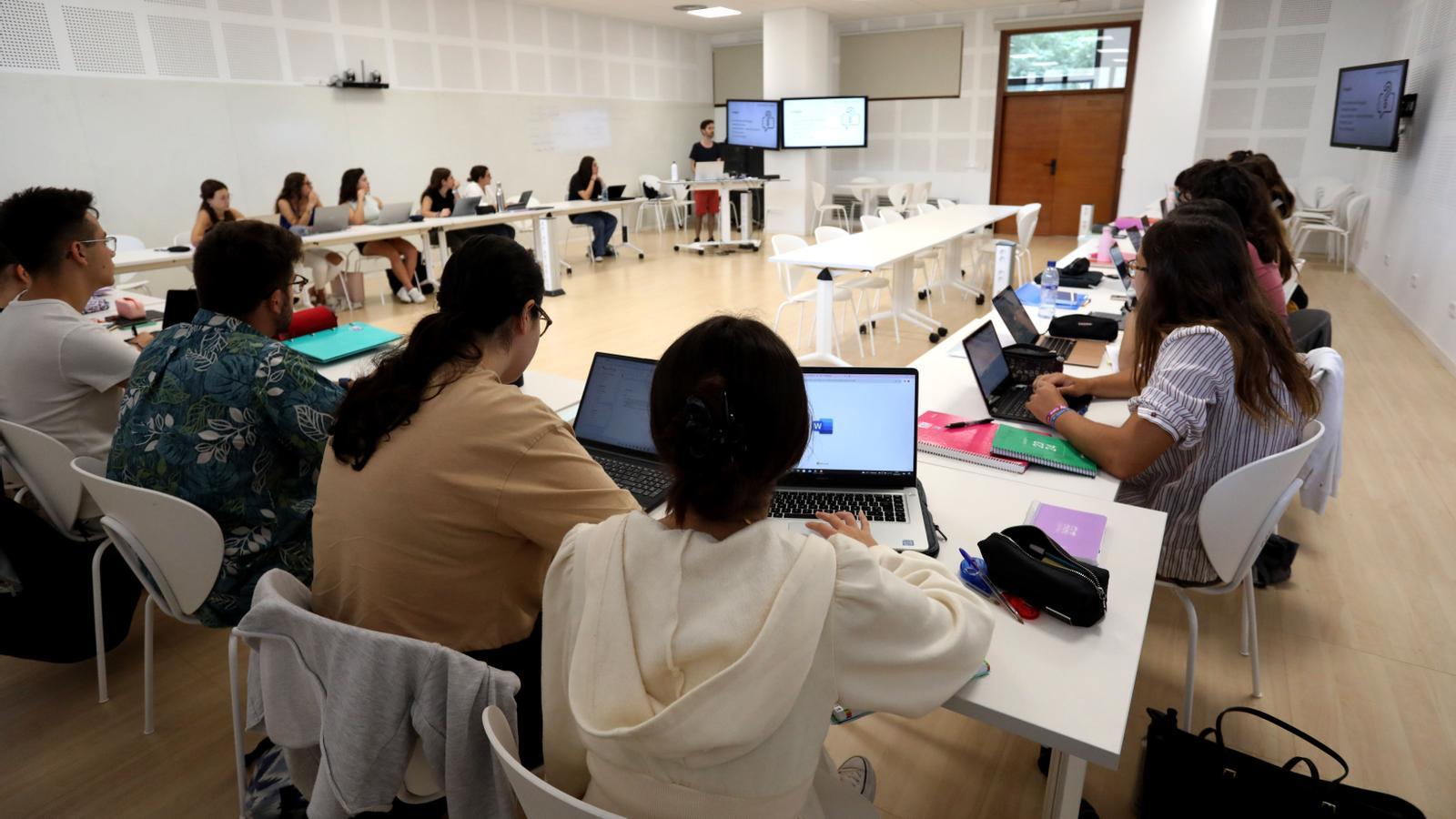

PalmThe Faculty of Education is a linguistic oasis within the UIB and also in relation to society as a whole. Despite this, Catalan is also receding within it: students predominantly use Spanish in personal relationships and two out of three believe that the language will be spoken less in five years' time. This is confirmed by the first report prepared by the center to analyze the linguistic uses of the student body. The situation is approaching diglossia: Catalan maintains its hegemony in teaching and in relations with administrative services, but is losing presence in informal spaces among students. Professor Ivan Solivellas, a member of the linguistic model commission, summarizes the situation with a clear idea: “Catalan is becoming residualized in very specific areas”.

The study is part of a broader project driven by the Faculty of Education to understand linguistic dynamics within the academic context. The dean, Carme Pinya, explains that the objective was to have "a framework document with solid evidence, a rigorous methodology, and consistent data" that would subsequently allow for pedagogical and curricular decisions to be made.
Regarding the initial language, bilingual students predominate (34.95% among men and 38.19% among women). Following them are Catalan speakers (31.07% and 32.23%), followed by Spanish speakers (29.61% and 24.04%), and English speakers (4.37% and 5.53%). Regarding the language of identification, bilingualism also leads the results (39.15%), ahead of Catalan (30.60%), Spanish (23.51%), and English (6.74%).
Academic language
The Vice-Rector for Linguistic Model and Cultural Activities, Llorenç Gelabert, frames these data within “a sociolinguistic context marked by a regression of Catalan usage”, a situation that, he assures, is also perceived “in the context of corridors and daily university life”.
One of the most striking data is that, despite there being more Catalan speakers than Spanish speakers, students consider that they have a better command of Spanish. Out of 40 points, Catalan obtains an average score of 36.21, while Spanish reaches 38.9. Much further behind is English, with 24.93 points.
Solivellas highlights that the data show a clear “asymmetry in self-declared linguistic competence”, as “the self-perception of competence is better in Spanish”. In fact, Spanish leads in all oral and written competences and prevails in all degrees offered by the faculty.
The difference between academic and personal uses is one of the main conclusions of the report. “In personal spheres, Spanish predominates”, explains Solivellas. Catalan maintains more presence in relationships with godparents, but it recedes among friends, partners, and often, also within the family sphere. On the other hand, within the university, Catalan continues to occupy a large part of the academic space. This predominance, however, is not homogeneous. According to the researchers, there are subjects taught in Spanish, especially when the teaching staff comes from outside the Islands. Nevertheless, Solivellas points out that the administrative sphere continues to be “a bastion of linguistic survival” for Catalan.
Bleak future
The report also reveals a very pessimistic view on the future of the language. 67.7% of students believe that in five years Catalan will be spoken less, while only 6.4% think the situation will improve. In parallel, the majority consider that both Spanish and English will increase their presence.
In line with these perceptions, 56.07% of students are in favor of reinforcing Catalan within the Faculty of Education. Even so, when asked which languages should be promoted, there are more students who call for reinforcing English (19.92%) than Spanish (16.63%).
The concern is especially intense because the faculty trains future teachers. “If we have initiated this sociolinguistic study, it is because all general studies on languages indicate a regression of Catalan”, states Gelabert, who warns that today “students overwhelmingly recognize that the common language is Spanish”.
For Solivellas, one of the major issues is the role of the teaching staff as a linguistic model. “We are concerned if the figure of the teacher as a reference in Catalan is lost”, she states. According to the professor, for decades linguistic normalization rested in large part on teachers, but this awareness “has been relaxing” in a context of deterioration of the figure of the teacher and political tension.
Faced with this scenario, the Faculty of Education wants to take action. Pinya assures that the center will make “a clear commitment to generate an action plan” and recalls that they already work with a network of Infant, Primary, and Secondary schools so that students “see Catalan as a useful and also necessary language”. The general university context, however, does not help. Gelabert recalls that “only 30% of the subjects at the UIB are in Catalan” and regrets that, outside of Philology, “in many other areas there is a lack of bibliography in this language”.
