Advanced teaching exams in May: "A teacher with a young daughter has given up"
The date change shortly before the call has put pressure on candidates and courts, while the ratio of candidates per position consolidates at minimums

-
CAT -
CAST -
DE
PalmThe new schedule for teacher entrance exams in the Balearic Islands –moved forward from June to May– has made the 2026 call a turning point that generates divided opinions among applicants: some view the new integration within the school year favorably, but others question that the decision was announced in February and applied in the same year, instead of planning with more leeway for 2027. What had been for years an accepted routine within the educational system has been altered by a reorganization that, according to applicants and tribunals, has intensified pressure (and caused dropouts), altered preparation, and brought the sustainability of the model to the forefront.

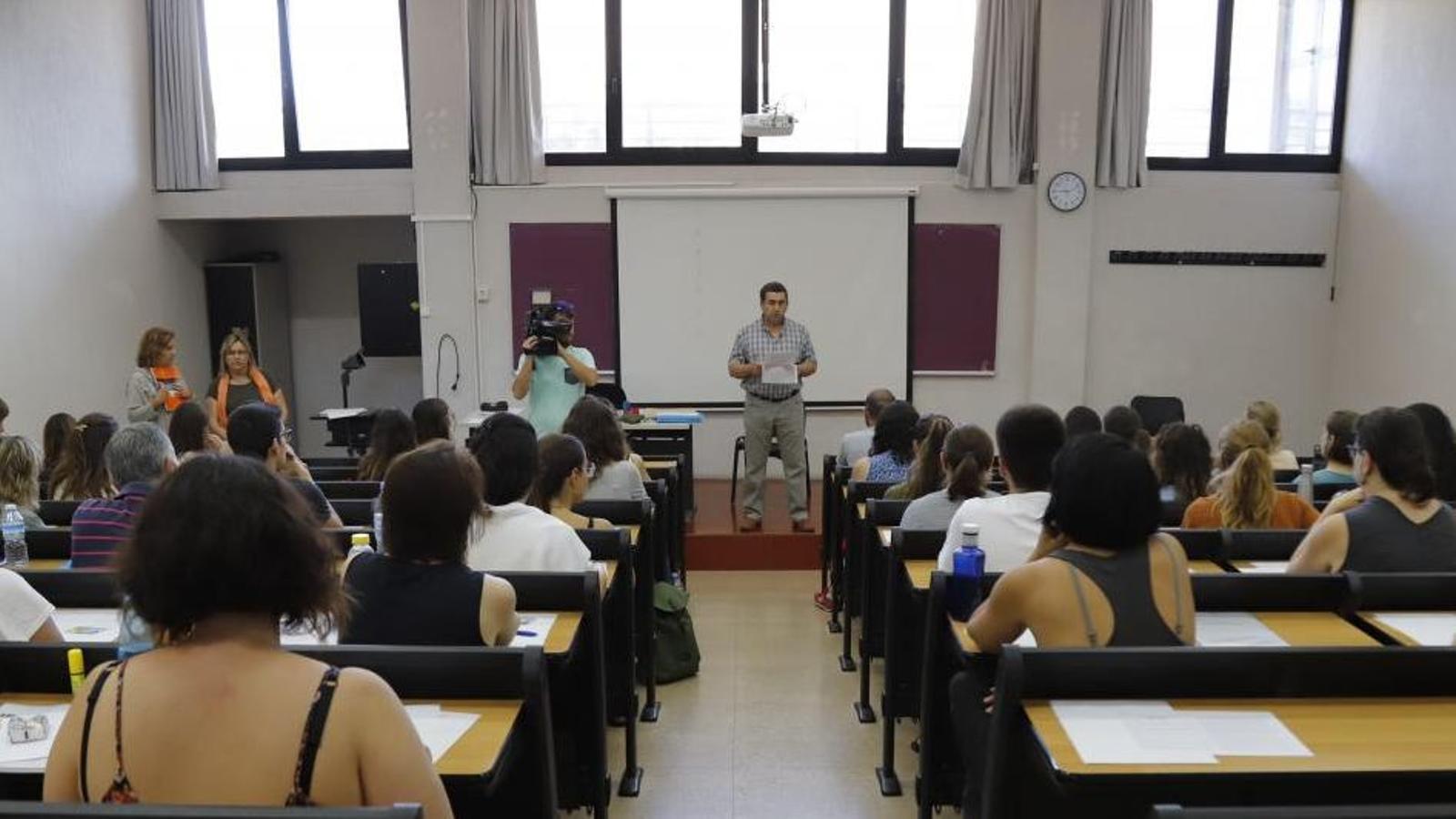
The first test of the opposition phase –the development of the theoretical topic– took place on May 9 and 10, at the very end of the school year, a particularly sensitive time due to the teaching workload. The date change was decided unilaterally by the Department of Education, after the unions boycotted the meeting that was supposed to choose between May or October, annoyed by how the whole matter had been managed. The Department's reason is that it wants to avoid the concentration of administrative processes in the summer and also to ensure that the faculties are covered by September 1st.
The change has not only affected the calendar, but also the way of preparing. “It has been complicated by everything, there is no other way to put it”, explains a candidate for Secondary Spanish, who thus summarizes a feeling shared by many applicants. Both she and the other testimonies have preferred to preserve anonymity, for protection or for public neutrality.
The advancement has forced the acceleration of processes that usually extended until summer. “I've had to give my all when I didn't think I'd have to yet,” he adds, in addition to emphasizing that the administrative decision was communicated with little notice. Even so, among the applicants there are also those who positively value the change for better course organization, albeit with critical nuances regarding the way it has been implemented. The general feeling is that the problem is not just the 'when', but the 'how', especially because it was announced so late for the same call.
Work-life balance, complicated
The intensification of the calendar has fully impacted work-life balance and test preparation. The same Castellano opositora describes situations of maximum tension in the day-to-day in the classroom. “It’s the first time in my life I’ve had to tell some students I wouldn’t grade an exam until a month from now,” she explains. She had to say it because the preparation for the opposition exams had left her little room to maneuver and she needed to concentrate all available time on studying. “I couldn’t grade, prepare for opposition exams, and live at the same time,” she summarizes.
Along these lines, she also points out that the pressure of the process has caused some professionals to have to give up on participating. "This is the case of a Biology teacher I know, with a young daughter, who has ended up giving up on participating in the call due to the impossibility of reconciling all her responsibilities. She couldn’t manage it," she says.
This reality is repeated in other specialties. A young applicant for English in Primary acknowledges having had to prioritize content due to lack of time: she has set aside programming (second test) to focus on the topic. She also admits that the change has caused dropouts: “I have a friend who signed up to take the tests and didn’t show up on the day of the exam,” she says.
In parallel, a recurring criticism emerges regarding the content of the opposition syllabi. Applicants question that part of the syllabus is outdated or poorly connected with the reality of the classroom, with materials that, as they explain, contain nomenclatures or content far removed from the current curriculum.
The tribunals: the invisible piece under more pressure
The change of calendar has also strongly impacted the courts, which are assuming an intense and sustained workload for weeks, and now at the most demanding time of the year: the end of the academic year. A member of the Performing Arts court explains that the process begins long before the exams with the formation of teams and the definition of evaluation criteria: “The work dynamic of a court begins when you are summoned”, he explains.
The preparation of rubrics and criteria is one of the most demanding tasks, especially because they must be public and solid against possible claims. Added to this is the immediate correction of tests, often in very concentrated working days. “In our case, we have already corrected, because we only had two candidates. The exam lasts three hours and the other three hours are dedicated to correction”, he details. "But in larger tribunals there can be many people and many days", he adds. The intensity of the work is a recurring element: long working days, busy weekends, and complicated compatibility.
It is explained by a member of one of the educational guidance tribunals, who describes a particularly tough and sustained routine, now in full swing. The teaching staff who are part of the tribunal have chained their teaching day with tribunal work, with no real rest for days on end. “We have to do our working day and then we have to go and examine and correct”, she explains. This implies working in the morning and in the afternoon continuously: “Morning work, afternoon tribunal… this weekend too. And on Monday continue all day, with an accumulation of days that stretches for many days in a row,” she summarizes. The result is a feeling of sustained exhaustion that directly questions work-life balance: “Where does personal life, family life, and rest time fit in?”, she wonders.
Data consolidating a trend change
The figures for the 2026 call for applications, provided by the STEI, confirm a structural change. With 630 places offered and a global ratio of 2.10 applicants per place, the system remains far from the competitiveness levels of just a few years ago (in 2024 the ratio was 4.76). In 2025 there had already been a drastic drop to 2.03, and in 2026 this new reality is consolidated. Territorial differences are significant: Mallorca (2.47), Menorca (2.03), Ibiza (1.46), and Formentera (0.67), where there are more places than applicants in some specialities. This scenario is accompanied by an increase in registered candidates, but also by unequal participation. According to data from the Ministry of Education, registered candidates have grown to 1,449 in 2026, as has the proportion of those who sat the exam.
The collection of testimonies and data points to a profound transformation of the teacher examination system. The change in calendar has opened an immediate debate about its implementation, but the figures reveal a broader trend, characterized by lower competitiveness and difficulties in filling places.
