

The cyclist battalion of Tomeu Ferriol Bergas was also made up of Moroccans whom the insurgents had recruited for the cause. “It was – assures the son– the first time he had contact with the so-called ‘Moors’. He said they always sang in Arabic”. The presence of Muslims within the rebel ranks has been studied by the Aragonese historian Miguel Alonso Ibarra, a professor at the UNED. In 2025, he published the book Cruzados sin gloria. El ejército de Franco en la Guerra Civil (Editorial Pasado y Presente).“The North African soldiers – points out Alonso– came from the Spanish protectorate in Morocco, which was where the military uprising began on July 17, 1936. The insurgents did not hesitate to incorporate them into their ranks. They did so in an exercise of totally precarious propaganda. From considering them the historical enemies of Christian Spain, they presented them as the noble savages who, as believers in their god Allah, helped to combat the ‘reds’, who were seen as ‘godless’. However, as a result of Spanish racism, these soldiers occupied the lowest rung within the military hierarchy”.During the three years of war, in an army of approximately one million 200 thousand men, there were about 60,000 North African recruits, representing 5% of the total. “Unlike the soldiers of the Republican and Rebel sides – states the historian–, they signed up for the war voluntarily. They went in exchange for a payment that was very useful for them to support their families, who lived in absolute precariousness. In order to encourage their recruitment, the insurgents respected their customs, such as breaks and fasting during Ramadan. They never tried to convert them to Catholicism”.It is estimated that of the 60,000 Muslim soldiers, 20,000 died on the battlefield. Others died from illness. They were buried haphazardly in mass graves, without following the precepts of Islam. In 2006, the testimony of some of the survivors was collected in the documentary Los perdedores, by Driss Deiback from Melilla. “They put us – recalled one of them who returned mutilated– like cats in a bag, they dropped us off in Spain and told us: ‘Shoot or die!’”.The communist leader Dolores Ibárruri spoke of “savage Moorishness, drunk with sensuality, which spills into terrible rapes of our young women in the villages that have been trodden by the fascist boot”. Meanwhile, Franco never tired of making promises to those sons of Allah. “You will return to your villages with golden slippers”, he told them. The truth, however, is that they ended up receiving ridiculous pensions. The dictator had his own praetorian guard made up of North Africans, the well-known ‘Moorish guard’. From 1980 onwards, some of their sons and grandsons ended up in Mallorca to work in the rice fields of sa Pobla, which had been abandoned with the tourist boom.
The Majorcans who fought the war on bikes
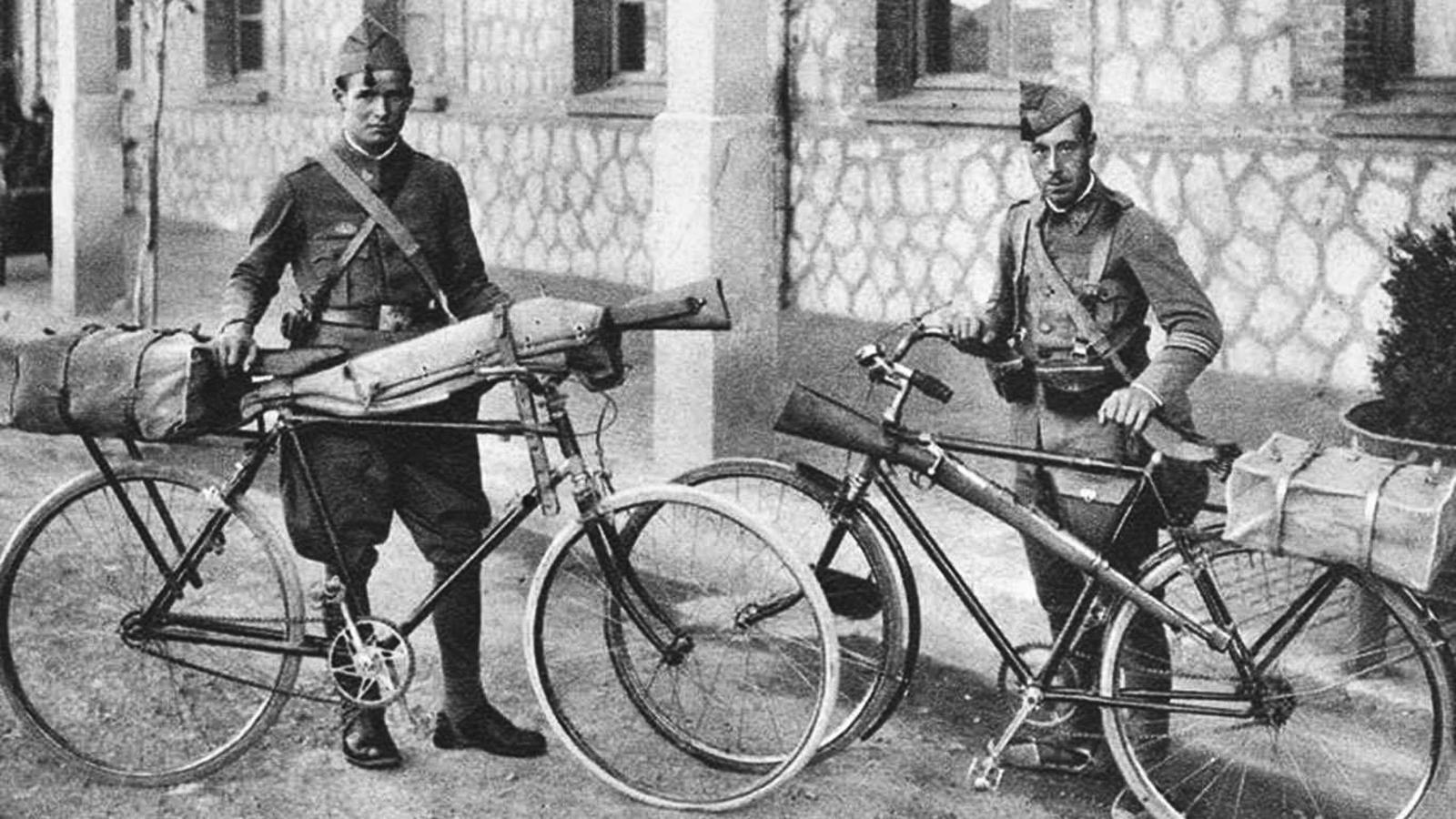
During the Civil War, Mallorca hosted the only cyclist battalion of the rebel army in the entire State, with nearly 700 soldiers. The insurgents created it by taking advantage of the strong fondness for two wheels that in 1903 generated on the island the inauguration in Palma of the Tirador velodrome. In July 1937 the unit departed to fight on the Peninsula

-
CAT -
CAST -
DE
PalmaThe retired Miquel Ferriol Estrany, 81, has very fond memories of the summers of the late 70s. “It was when TVE began to broadcast the Tour of Spain live and in color. With my father, I would sit in front of the television to watch it after lunch. He was particularly interested in the landscapes. He always told me: ‘I already rode many of these stages when I was young during the war’. It was one of the few occasions when he spoke about the Civil War. Later I learned that he had fought in the Peninsula with a cyclist battalion”.
Cyclist battalions were already formed in the First World War (1914-1918). At that time, they did not want to waste a completely revolutionary invention that had been born in France in 1861, twelve years before the appearance of the first automobile. Besides being light, cheap, and not requiring gasoline, the bicycle was a means that did not make noise, unlike those that went with engines. Nor did they bolt like horses, which always needed fodder. The ones initially known as velocipedes also served to carry mail and telephone lines and even to evacuate the wounded. To transport ammunition, there were auxiliary vehicles (vans and motorcycles).

Fighting for the opposing side
In 1931, with the arrival of the Second Republic, Manuel Azaña, President of the Council of Ministers and Minister of War, created the first cyclist battalion within the Spanish army. The general headquarters was established in Palencia (Castile and León) and in May 1936 it would move to Alcalá de Henares (Madrid). It was a unit integrated into the light infantry corps, with nearly 900 soldiers. Its role in the Civil War has been studied by the Madrid historian Juan Carlos Diz Monje, a professor at the UNED. "In July 1936 - he says - the majority of the officers of the cyclist battalion joined the military coup. Although they surrendered immediately, the leaders were executed and the rest were imprisoned. In this way, that battalion ended up being dissolved. However, there were detachments of workers' militias that reconstituted them in different parts of the country, some with the presence of women. Mallorca, which immediately fell into the hands of the insurgents, was the only place in the entire State where the rebel army created its own cyclist battalion. The strong passion for two wheels on the island, following the inauguration in 1903 of the Tirador velodrome in Palma, weighed heavily."
With a capacity for more than 3,000 people, Tirador would be known as the ‘cathedral of cycling’ in Spain. It was the breeding ground for the first sports idols, before footballers. Among the outstanding figures were Simó Febrer from Felanitx, Josep Nicolau from Llorità, Rafel Pou from Algaida, Bartomeu Vaquer from Artà, and Miquel Llompart from Llucmajor. Miquel Ferriol's father, Tomeu Ferriol Bergas, was born in Maria de la Salut in 1911 amidst that passion for pedals. In 1932 he had to leave his work in the fields to do his military service in Inca. “Years ago –his son recounts– his older brother had been stationed in North Africa. He had such a bad time that he asked his parents to do everything possible to prevent that ordeal for the youngest. Thus, my godparents did not hesitate to pay 1,000 pesetas so that my father could do his ‘mili’ (military service) close to home”.
Much like one of his admired heroes, Ferriol used to cycle the 20 kilometers round trip separating Maria from Inca every day. He covered them for six months. However, in 1936, four years later, he had to put on a soldier's uniform again. “The first ones called up by the insurgents were those who had paid the well-known fee for a more favorable ‘mili’. In August, he was sent to Manacor to repel the landing of Republican troops led by Captain Bayo, coming from Catalonia. My father was a sympathizer of communism, but, due to the circumstances, he had no choice but to fight for the opposing side”.
Reprisalised cyclist
In Mallorca the repression intensified with the arrival of the Catalan expedition, which after three chaotic weeks opted to re-embark. In Algaida the fascists would be cruel to one of the cycling stars of the moment, the Algaida native Joan Bibiloni Capellà, Monet. In 1935, together with his compatriot Rafel Pou, he had been one of the first Mallorcans to participate in the first edition of the Tour of Spain, which, due to the war, was suspended until 1940.

Bibiloni, 31 years old, was arrested a month after hiding on a farm in Sant Jordi. At the end of August 1936, he was already murdered at the neck of La Grava, between Montuïri and Sant Joan. “That day – notes the Algaida historian Catalina Martorell Fullana – his fourth son was born. His death was for personal reasons, as he was not affiliated with any political party. Popular memory recalls how a falangist commented that Bibiloni would never beat him in a race again. His wife had her shop confiscated, which they had in Algaida and which directly competed with the rich, right-wing merchant families of all time”.
In the Diccionari vermell, Llorenç Capellà provides details of the cruelty suffered by the Algaida resident: “A group of crazed men took another man with his hands tied out of a car – was it Joan Monet? – and threw him alive into a bonfire. The crackling of the woodworms, the groans of the condemned, and the howling of the executioners, gloriously, for a few moments, recovered the Mallorca of the Jewish revelry. A couple of days later, the pig farmer, a boy with a weak mind, was parading the half-charred head”.
To the Peninsula
Far from that tragedy, Ferriol could hardly imagine that he would have the opportunity to step into the shoes of his two-wheeled heroes. In May 1937, at the age of 26, he was assigned to L'Arenal, where the first cyclist battalion of the rebel army had just been created. "It was known," states Diz, "as the 10th battalion and consisted of about 700 men, according to the documentation consulted. However, perhaps there were fewer. It was formed with bicycles confiscated from the population." On July 3, 1937, the young man had to embark with his new comrades for Cadiz. "There," the son points out, "he was chosen from 40 candidates to be the unit's bugler. He had a good ribcage."
As bugler, Ferriol pedaled behind the officer, who was on a motorcycle. When they stopped somewhere, he was responsible for blowing the relevant signals. "Since he led the procession, he was the one most exposed to enemy attack. More than once he heard bullets whistling, although they never hit him." After being in the Extremadura and Guadalajara area, the island cyclists headed for Catalonia. "Every day they covered many kilometers. They ate what people gave them. In some places, they also helped the elderly farmers harvest, as they had been left without the labor of the younger ones who had been recruited. In Barcelona, my father saw a traffic light for the first time."
Regarding Ferriol's service record, the son can do nothing but trust his word. “He told me that he never shot anyone. One of the priorities of his unit was to reach the Battle of the Ebro. They found themselves in a real disaster.” The Republican offensive in the Tarragona lands began on July 25, 1938, and aimed to stop the Francoist advance on Valencia. 250,000 combatants faced each other. After four months, the Republicans opted to withdraw. That was the longest and bloodiest battle of the war. There were 120,000 casualties between both armies: 30,000 dead, 75,000 wounded, and 15,000 prisoners.
Communist of the winning side
In the Pyrenees region, the Majorcans had a scare. “A Republican squad detained them. Surprisingly, however, they did them no harm. They were sent to the border with France, from where they later re-entered Spain. Then my father fell ill. They gave him a month's leave to return home to recover.” The islanders’ cyclists would participate in the fall of Madrid on March 28, 1939. “Once the war was over – notes historian Juan Carlos Diz–, the Arenal cycling battalion would inspire the creation of three more in El Escorial (Madrid), Jaén, and Barcelona. However, in 1943, all were suppressed, including the one in Mallorca, due to a lack of interest from military commanders.” The island, however, would continue to produce great two-wheeled heroes, such as Francesc Alomar from Sineu, Miquel Bover from Palma, Andreu Trobat from Algaida, and Guillem Timoner from Felanitx.
Returning to Maria, being of communist ideology, Ferriol found himself part of the winning side. “Immediately –recalls his son– he married my mother. I was born six years later. She always said that after two years of cycling around the Peninsula, my father was stronger than ever. He never stopped cycling to go work in the fields. In the 1960s, along with other cyclist soldiers, he received a tribute in Palma. He died in 2000, at 89 years old.”
