"Classrooms are burning and teachers, too": STEI warns of an unprecedented crisis in public education
The union demands to reduce bureaucracy and ratios, reinforce inclusion, recover purchasing power and withdraw the linguistic segregation plan, and does not rule out mobilizations
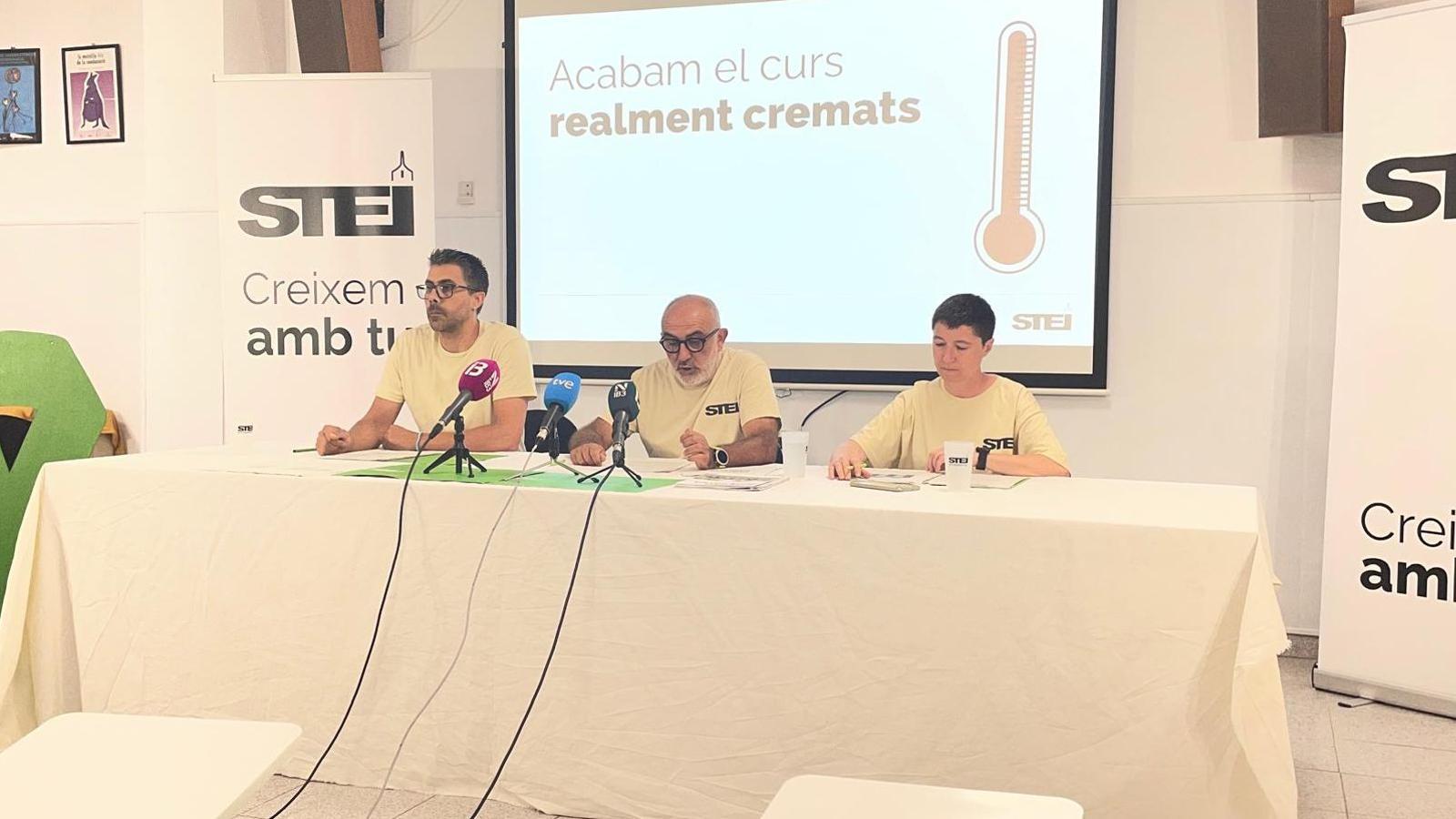

PalmaSTEI has reviewed the 2025-2026 academic year and has criticized the management of the Ministry of Education, which it accuses of having failed to comply with part of the agreements signed in 2023 and of not addressing the main problems of the educational system. The union has warned that, if its demands are not met, it will plan mobilizations during the next academic year.
The secretary of Public Education of STEI, Vicenç Garcia, has summarized the end of the academic year with one word: ""heat". "The classrooms are burning, and so are the teachers. Teaching is no longer like it used to be, there is a lack of staff, too much paperwork, and teachers feel overwhelmed. The teaching profession is no longer attractive," he stated.

Garcia has framed this situation within an international crisis of teaching staff and recalled that, according to Unesco, the profession faces "an unprecedented crisis". "This abandonment is a symptom that teaching staff are truly burnt out", he warned, before arguing that "only better conditions for teaching staff can lead to public and quality education". The union representative also criticized the lack of negotiation with Education. "The Ministry's negotiating dynamic has been absent", he stated. While acknowledging that there have been "relative improvements", he maintained that "the red light of the traffic signal outweighs the green and orange lights".
Among the main criticisms, Garcia highlighted the language segregation plan promoted by the Government. According to his complaint, affiliated schools register "20 points less in Catalan level than in Spanish", a fact that, in his opinion, evidences the need to strengthen the native language. He also censured the advancement of the opposition exams to May and the decree on strategic projects, because, as he said, "a new blow was struck to the Catalan language" by "shortening the deadlines for reports from the Consell Escolar de les Illes Balears". "Saving public school means building a healthy climate, for real inclusive education, for a decent salary and a school in Catalan", he advocated. "Teaching staff demand a new social contract that listens to their voice and faces the challenges to come", he added.
Bureaucracy, conflicts and burnout
The head of the list of the Teaching Staff Board of Mallorca in the upcoming 2026 elections, Dani Carmona, has presented the results of a survey on the reality of educational centers. According to the data presented, 96% of teachers believe that bureaucracy takes time away from teaching; 91% state that ratios prevent adequate attention to diversity; 74% believe they do not have the necessary resources to guarantee quality education; 78% define the work environment as conflictive; 79% perceive an increase in verbal aggression from students; 75% an increase in aggression from families; 77% believe that excessive working hours harm work-life balance and 87% assure that society does not value the teaching task and that the salary is inadequate.
"Public education has always been defined as a key instrument of social cohesion, equal opportunities, and collective progress. The social function is in danger," warned Carmona. He also denounced that teachers are "suffocated," with high ratios, lack of resources to address diversity, and an increase in classroom conflict. As he explained, this situation leads many professionals to consider abandoning the profession. "Colleagues' inquiries are no longer about labor rights, but also about requesting early retirement or possibilities to change jobs," he lamented. Therefore, he called for "political and financial commitment" and raising educational investment to 6% of GDP.
More support, fewer ratios, and a plan against heat
The president of the Teaching Staff Board of Mallorca, Catalina Bibiloni, has detailed the union's main demands for the next academic year. Regarding coexistence, she assured that 78% of teachers perceive an increase in violence in classrooms and requested that teachers have easy access to legal services, that the Administration supports them when they file complaints, and that the recognition of pedagogical authority be strengthened.
Regarding labor well-being, she asked to reduce bureaucracy through an external audit to determine which administrative tasks are dispensable, as well as to implement a labor health plan with free psychological support, measures to prevent professional burnout, and a digital disconnection plan so that teachers do not have to be pending WhatsApp groups or respond to emails outside of working hours. She also requested measures to facilitate access to housing for teaching staff.
Regarding ratios, STEI denounces that the 2023 agreement is not being met. For the 2026-2027 academic year, it demands a maximum of 20 students in the second cycle of Infantil, 22 in Primària, 28 in ESO, and 32 in Batxillerat, with the aim of reaching 17 students in Infantil, 20 in Primària, 24 in ESO, and 28 in Batxillerat in the 2027-2028 academic year. The union also requests that students with specific educational support needs count as three places when calculating ratios and that, if exceptional increases of up to 10% are authorized, the Ministry guarantees the necessary professionals.
In the area of inclusion, Bibiloni has called for a review of the criteria used by Education to assign support professionals, because, as has been denounced, schools are not receiving the necessary resources. It has also advocated for an improvement in the professional recognition of teachers. It recalled that, according to the union, in the last 16 years, teaching staff have lost 23% of their purchasing power and has called for the recovery of full extra payments, the equalization of professional careers with those of other civil servants, the elimination of the five-sexenio limit, and an increase in educational investment to 6% of GDP.
STEI has also denounced the high temperatures recorded in educational centers during the last weeks of the academic year. According to Bibiloni, temperatures between 27 and 33 degrees have been detected in classrooms, a situation that causes "lack of attention, dizziness for students and teachers" and prevents teaching and learning in conditions.
For this reason, it has called for a thermal comfort plan that includes the renovation of old buildings, more shade in courtyards, and the creation of climate refuges.
Defense of Catalan
Finally, the union has accused the Government of having "systematically attacked the language" and has called for the immediate withdrawal of the Linguistic Segregation Plan. According to Bibiloni, the students participating in it present a "very low" level of Catalan. The STEI also proposes strengthening reception programs, increasing language facilitators, and incorporating a professional Catalan module in all vocational training cycles.
Regarding a possible strike, given the problematic context explained, the union representatives have pointed out that the situation in the Islands presents similarities with that of Catalonia and the Valencian Community, but have remarked that "the situation is not exactly the same". In any case, they have warned that they will first submit their proposals to the Ministry and that, "if they are not met, we will activate mobilizations".
