The privatization of the Tramuntana mountain range due to the eclipse: When paying for a hotel gives you more rights than living next to it
The exceptions to the circulation device reopen the debate about who has priority of access to an increasingly tense territory

-
CAT -
CAST -
GER
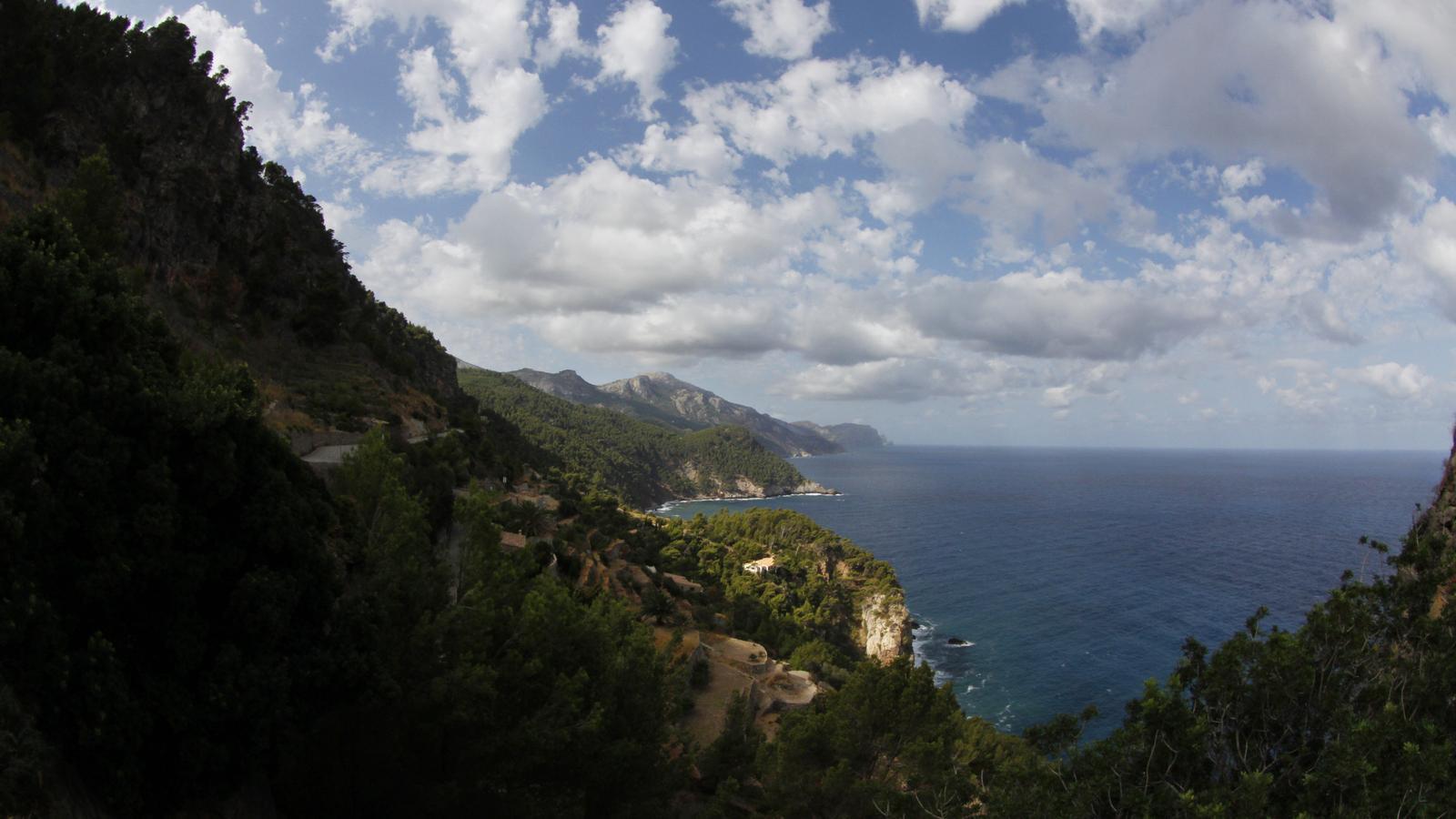
PalmaThe forecast that the Serra de Tramuntana will be one of the most crowded areas in Mallorca during the total solar eclipse on August 12 has led the Government to prepare an exceptional traffic restriction device. The objective is to avoid a collapse, but the foreseen exceptions have generated much controversy. While thousands of residents of municipalities located a few minutes from the Serra will not be able to access it by vehicle, tourists who have paid hundreds or even thousands of euros to stay in a hotel in the area will be exempt from the limitations. Thus, the exceptions set by the Government project, once again, the idea of a privatization of the territory of the Balearic Islands and reinforce the perception that those who pay have more rights to transit this territory than those who live there. "Once again, the rights of tourists who pay are above those of the residents who live on the island," remarks Joan Moranta, president of GOB.
The device will restrict access to the Serra de Tramuntana from Andratx, Esporles, Valldemossa, Sóller, Fornalutx, Pollença, and Caimari between 3 PM and 9 PM. During this time slot, only residents of the affected municipalities and people who can prove a reservation at a hotel or restaurant located within the restricted area will be able to pass the checkpoints. For the rest of the Majorcans, the alternative will be to arrive before the restrictions or find another place from which to observe the eclipse.

However, both GOB and the platform Menys Turisme, Més Vida insist that the debate is not whether restrictions should be applied, but how they have been designed. "Restrictions are necessary and have been correctly planned," acknowledges the platform's spokesperson, Dani Comas. The problem, he adds, is that "the regulations do not reach everyone." "We see once again that limits are only placed on residents," he summarizes. A reflection shared by Terraferida's spokesperson, Jaume Adrover, who maintains that "the problem of overcrowding and privileges for tourists is not new." "For many years, free rein has been given to build and create more tourist places. Capacity limits have been exceeded and we live overcrowded. And when there is a major event on the island, the resident is always the one who is harmed," he states.
According to Comas, the exceptions "are not accidental," but rather a further demonstration of the priority that institutions continue to give to the tourism industry. "They have turned the eclipse into another tool for tourist promotion and the restrictions are designed not to affect the tourists who have paid," he states. Therefore, he considers that "the planning and restrictions have been made only for residents, not for tourists," and accuses the Government of being "willing to do anything not to bother hoteliers." Adrover agrees that this situation is not an exception, but a constant: "Once again, it is the population that has to adapt, and the great victim is the neighbor, while tourists enjoy the island without restrictions.
This is a perception shared by some of the residents who had been preparing for months to observe the astronomical phenomenon. This is the case of Laura Muñoz, who assures that the measures "only serve to prohibit residents from being able to see the eclipse on their island." In her opinion, the restrictions demonstrate that the Government continues to prioritize visitors over the local population. "On July 26, with the demonstration, it became clear that residents are fed up with overcrowding and the Government's response is to " continue thinking about tourists and harming residents," she laments.
Why do the restrictions start at 3 p.m.?
The Government defends that closing access to the Serra from 3 p.m. responds to security and mobility management criteria. According to the Executive, after analyzing different scenarios and attendance forecasts, this time slot was chosen because August 12th "is a working day, but also in the middle of the holiday month, when many people finish their workday at noon".
For Muñoz, on the other hand, the very operation of the device evidences this different treatment. "They close the island from 3 p.m., but they don't close it for everyone. It only bothers residents. A tourist is always welcome: if they have a hotel they can enter, and if not, since they don't work that day, unlike us who live here, they enter before three and that's it," he states. "The one who pays 1,000 euros to sleep in a hotel does not cause overcrowding; the resident who wants to leave work and enjoy the eclipse on their island causes overcrowding," he criticizes.
Lack of planning
The criticisms also point to the planning of the operation. Moranta believes that the conflict was predictable for a long time. "The problem is improvisation and lack of foresight. If a year ago, or more, when the 'eclipsic fever' began, the relevant measures had already been taken, prioritizing residents, we wouldn't be talking about this now," he assures. In this regard, he denounces that "the measures have arrived a few weeks before the eclipse and with residents as the only ones affected." However, Adrover adds that "we are always late." "The rules and restrictions arrive when everything is already out of control and they always end up affecting the same people, the neighbors," he laments.
Beyond the astronomical phenomenon, environmental organizations and groups critical of the tourism model interpret this episode as a new reflection of a debate that has accompanied Mallorca for a long time: who has priority of access to an increasingly saturated territory. "Restrictions are essential to avoid the collapse of the Serra," they admit, but they consider that "exceptions again place tourist consumption ahead of residents' right to enjoy their own homes." For Adrover, this case is just another example of a model that has been consolidating for years. "The resident seems to no longer have the right to even live in their own home. We live in a tourist set where visitors are always the beneficiaries and privileged, to the detriment of the neighbors," he denounces. Thus, the spokesperson for Terraferida concludes with a reflection that summarizes the discontent of a part of Mallorcan society: "Mallorca is an experiment in how far human patience goes."
Environmental consequences
The impact of mass tourism also particularly concerns environmental organizations, which warn that the effects on the Serra de Tramuntana could go far beyond traffic collapse. Moranta warns that promoting the Serra as a great viewpoint to follow the eclipse "is a new way to destroy the territory" and believes that "for a minute and a half of astronomical spectacle, we could take years to recover from the environmental impact." While positively valuing the restrictions announced by the Government, she insists that they will only serve to reduce some of the effects and calls for access to the most delicate areas to also be prohibited. "Erosion of the ecosystem cannot be avoided, but it must be minimized as much as possible," she argues.
Adrover agrees that the Serra will experience a situation of extreme vulnerability. "The pressure it will withstand will leave terrible consequences," she assures, and warns that any emergency, especially a forest fire, could become "an extremely big problem." Furthermore, she warns that the pressure will not be limited to the Serra, but will also affect natural resources such as water. "In the end, those of us who will pay the consequences will be the residents who live here all year round, not the visitors," she concludes.
Given this situation, they are demanding stricter limitations and controls to prohibit access to the most vulnerable areas. "Restrictions should be imposed as is done with the 312, where all of Mallorca is closed off, and no one can pass even if they want to. If it's done for a private event, it should also be done for a public event where our territory is at stake," concludes the president of GOB.
