The Government will pay the salaries of the teachers of the subsidized nursery schools
The decree-law also creates a supplement to equate salaries and updates secondary education for adults and healthcare teaching at the UIB
-
CAT -
CAST -
GER
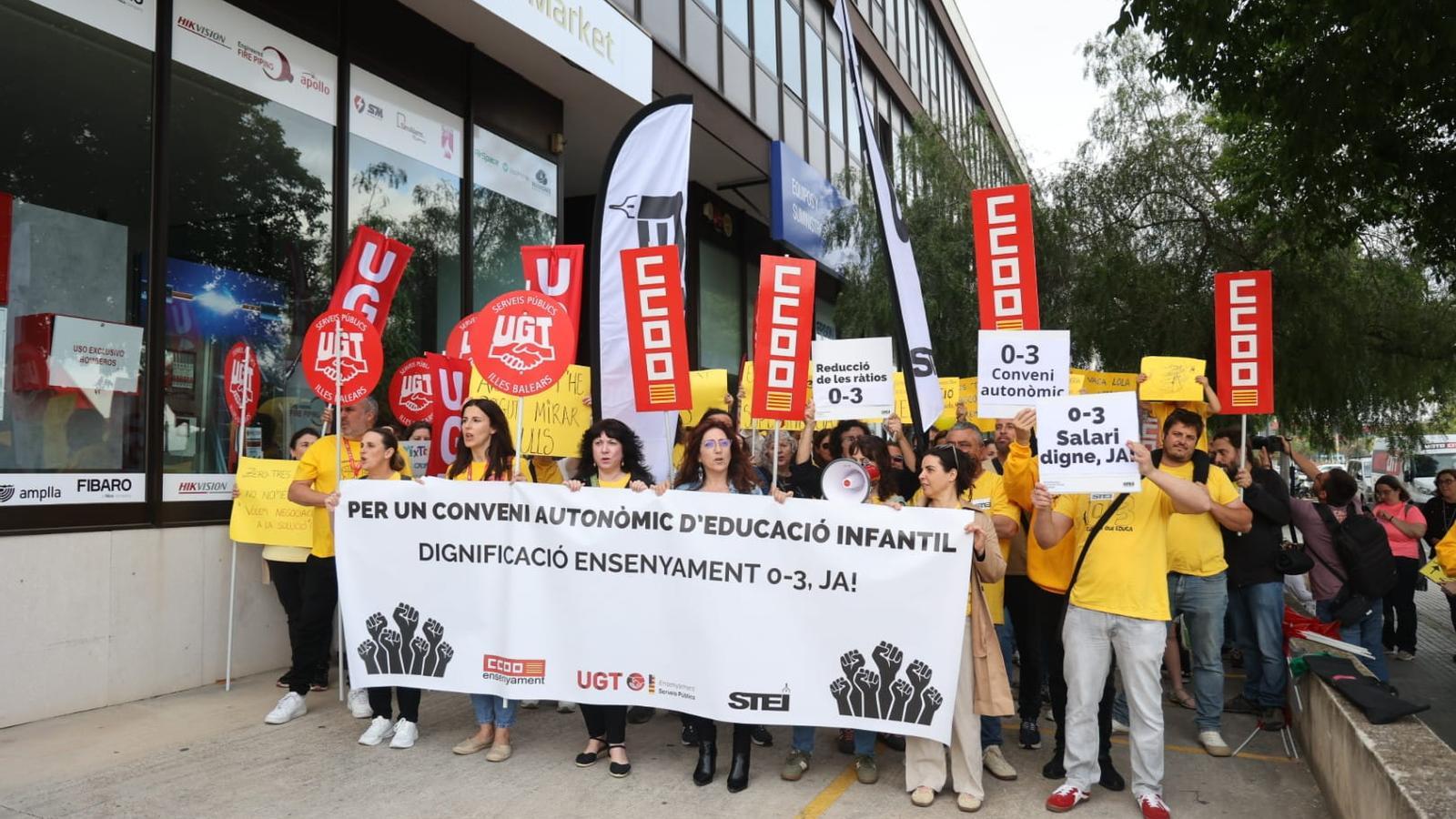
PalmaThe Government will ensure that teachers and technicians of Early Childhood Education in subsidized centers of the first cycle, from 0 to 3 years old, are incorporated into the delegated payroll payment system from January 2027. The Governing Council approved this Friday the decree-law of urgent measures in educational matters, which modifies the financing model of the stage launched in 2023 with free schooling. The Department of Education and Universities will promote the necessary actions during the second half of this year so that the new system can come into operation in January 2027. In the case of cooperatives, the regulation provides for the possibility that they directly receive the full financing module.

The decree-law also creates a salary equalization supplement to improve the remuneration of professionals in the sector and reduce salary differences between workers who perform equivalent functions in centers supported by public funds. This supplement will not modify the employment regime or the applicable collective agreement.
The norm also reinforces the mechanisms for control and transparency in the management of public resources allocated to the first cycle of Early Childhood Education. The Government considers it urgent to approve these changes so that the new framework is operational before the 2026-2027 academic year and the centers can prepare the procedures and necessary contractual modifications.
New curriculum for Secondary Adult Education
The Governing Council has also approved the new decree regulating the organization and curriculum of Secondary Education for Adults (ESPA) in the Balearic Islands. The regulation replaces the 2019 decree, which had become outdated due to legislative changes derived from LOMLOE. The new curriculum will come into effect at levels I and II starting from the 2026-2027 academic year and aims to facilitate adults in obtaining their ESO graduate diploma by adapting their studies to their personal, family, and work responsibilities.
ESPA will be organized into three areas – communicative, social, and scientific-technological – divided into two levels and four quarterly modules each. This way, studies can be completed in two academic years, without a time limit for completion.
The decree maintains the in-person and blended learning modalities and reinforces attention to students with specific educational support needs. Access is primarily aimed at those over 18 years of age, although exceptionally, young people from 16 years old may also access it in certain situations, such as having an employment contract, being a high-performance athlete, or being in personal circumstances that prevent them from continuing with ordinary schooling. The evaluation will be continuous and oriented towards competency development. Passing the three areas will allow obtaining the diploma of Secondary Education Graduate.
A new framework for healthcare professionals who teach
The emergency decree-law also modifies university regulations to consolidate the participation of professionals from public hospitals and health centers in teaching at the UIB, especially in Health Sciences studies. The reform establishes a more stable legal framework for collaboration between the UIB and IB-Salut and regulates three issues: teaching staff with linked positions, the participation of healthcare personnel in teaching activities, and agreements between health institutions and the university.
Thus, healthcare positions from IB-Salut can be linked with different university teaching figures, with the aim of facilitating clinical professionals to combine healthcare and teaching tasks. The UIB will create a supplement for these professionals.
The reform also recognizes the work of healthcare professionals who participate in student training through supervision of practical sessions, tutoring, seminars, and clinical sessions. These professionals will maintain their contractual relationship with IB-Salut and may receive a teaching collaboration supplement.
Agreements between the Government, IB-Salut, and the UIB must specify the linked positions, teaching and healthcare activities, coordination mechanisms, and monitoring and compensation systems. The objective, according to the Executive, is to strengthen the quality and continuity of clinical training for Medicine students and other Health Sciences studies.
