"It is necessary to pursue Ithaca": the challenge of not 'losing' the new teachers who want to transform the school
The UIB stands out in educational research, but transferring this knowledge to the training of teachers and to practice in the classrooms is a pending subject
-
CAT -
CAST -
DE
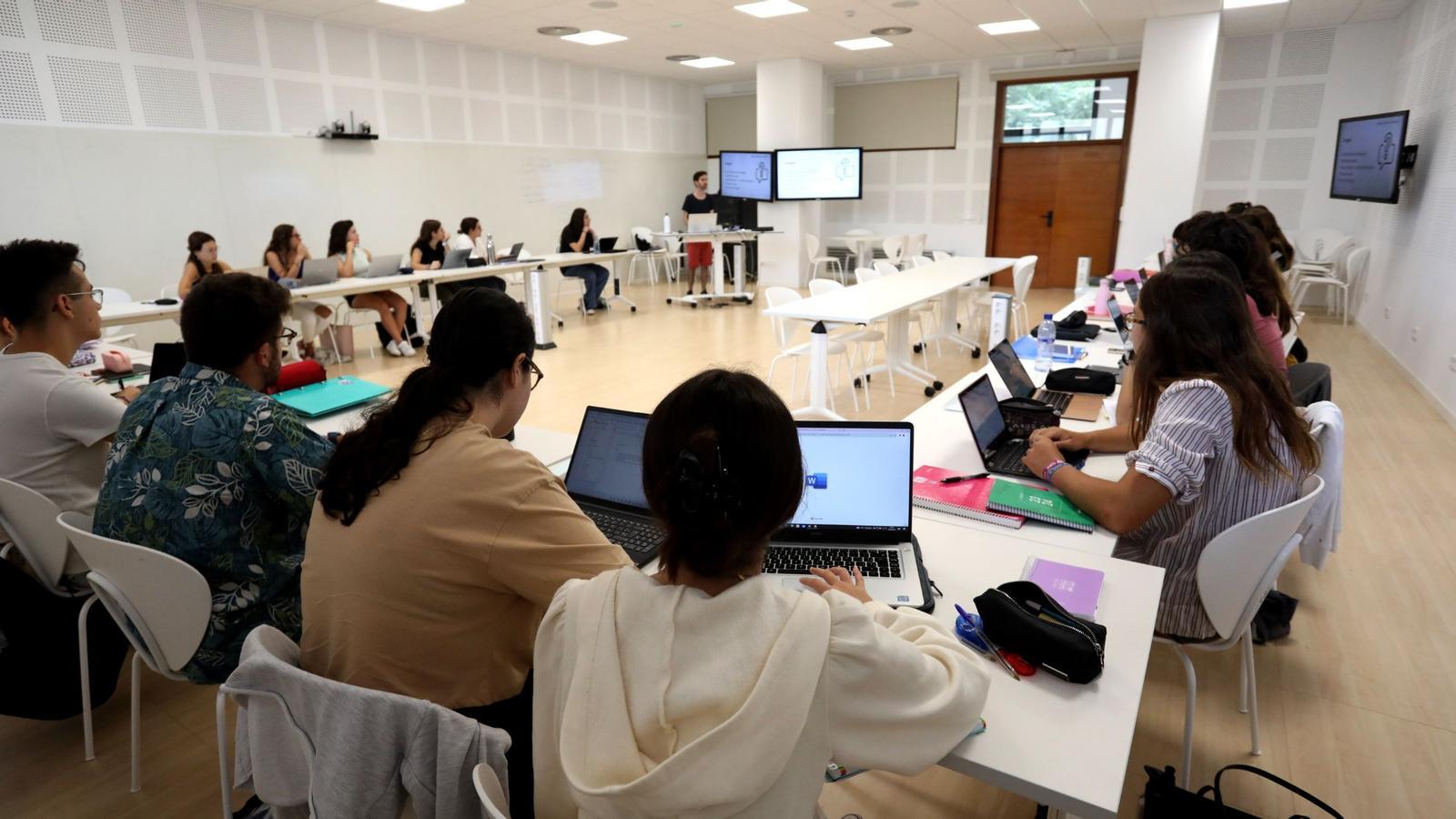
PalmaA future teacher may graduate from university prepared to promote cooperative work and assess in a different way. But, when they arrive at school, they may find desks in rows, a blackboard, and deep-rooted routines. Between training and practice, there is a system that often imposes its own way of doing things. The challenge is for research to reach the classrooms and for new teachers to maintain the will to transform them.
The UIB has placed its educational research among the 500 best in the world in the latest Shanghai ranking, even though the institution has remained outside the top 1,000 in the general classification. The Institute for Educational Research and Innovation (IRIE), which celebrated its tenth anniversary last year, has contributed to consolidating shared work among research groups. Its director, Eva Maria Aguilar, highlights that the UIB's educational research remains high. It is a meritorious achievement, she points out, because the index primarily values the quantity of publications, a criterion that disadvantages smaller universities.

But this recognition only makes sense if the knowledge reaches the schools. Aguilar considers it necessary to reinforce research training for future teachers, not because they have to become researchers, but so they know how to distinguish methodologies backed by evidence. "This means that when someone proposes a practice to them, they can say: 'Show me the numbers that demonstrate that this will benefit the child'," she explains. Current study plans do not include specific research subjects, but the Faculty of Education plans to incorporate them. Meanwhile, the IRIE tries to shorten the distance between research and classrooms with pilot projects promoted with the Ministry of Education. A mathematics methodology has already been extended to about thirty centers and, at IES Can Balo, an educational center for minors who have offended, work has been done on inclusion and work protocols. There is also an artistic project with the Es Baluard museum, among others.
The Dean of the Faculty of Education, Carme Pinya, argues that this process cannot be limited to initial training. "A teacher is not trained in four years," she reminds. It is necessary to continue learning and reviewing one's own practice, even if teachers often do not have the necessary time. This continuity is especially important because, as Antoni Salvà, a retired teacher and former director of the College of Teachers of the Balearic Islands, warns, university training does not always survive contact with the reality of schools.
University vs. reality
Salvà explains this through the concept of pedagogical isomorphism: future teachers should learn with the same methodologies that they are subsequently expected to apply. If they are to foster cooperative work, they must also have experienced it during their training. The problem arises when they join centers where these practices are not part of the daily culture and they end up reproducing the models they experienced as students in school.
"No matter how good our educational training was, everything gets corrupted once you arrive in the classroom. Because you enter a context that is very difficult to change, one of collapse, newcomers, social problems, and questioning of the profession," warns Salvà. In this scenario, methodologies backed by research, such as cooperative work, often fail to take root: in many classrooms, traditional lectures still predominate, along with a way of studying oriented toward getting a grade. Salvà particularly locates this resistance in secondary education, where, he believes, there are also teachers who arrive at the profession without any vocation. "Teachers may have training based on research, meaningful activities, and the creation of learning situations. But even if that translates into good initial training, when they are incorporated into the educational system, the system ends up consuming them," he summarizes. He also points out that not all responsibility lies with the system: there are teachers who arrive at schools without the aptitudes or attitudes necessary to face daily work.
In Formentera, the generational turnover has a concrete translation. The CEIP Mestre Lluís Andreu, in Sant Francesc, receives many young teachers with little experience every year because the island is a destination that teachers with more points often avoid. The director, Santiago Rodríguez, maintains an optimistic view: he ensures that young people usually arrive eager to work. Some interim teachers accept positions in Formentera to earn points and be able to later opt for a destination in Mallorca. Rodríguez considers that enthusiasm, flexibility, and the ability to adapt are fundamental. Students, furthermore, spend months doing internships there before joining the profession.
Involved students?
But arriving with a desire to work does not guarantee that the drive will be maintained once you come into contact with the reality of the schools. Pinya would like to find more involvement among future teachers. "I do have involved students, but not all that I would like, and I identify them very quickly by the type of demands they make, by the type of questions and approaches," he explains. The faculty tries to instill a critical attitude in them. "Would we like to have a more combative student body? Well, of course," he admits.
The perspectives on young people are not unanimous. Aguilar also identifies very motivated students, although not all arrive at their studies for the same reasons. Salvà considers that among new teachers there is less willingness to question the system and that often adapting to it to avoid conflicts prevails. Rodríguez, on the other hand, recalls that there have always been more combative teachers and others who prefer to limit themselves to doing their job.
University education cannot guarantee on its own that research will transform schools. It can provide tools and prepare teachers willing to question established practices, but it is also necessary for the Balearic educational system, among all the problems it drags along, to allow them to put them into practice. "Any teacher needs a little bit of utopia, a horizon to pursue, an Ithaca, some idealism, because, if not, where are we going?", suggests Pinya. The challenge is for this utopia not to fade away when teachers move from the university to the classroom. And that, if reality shows them that the utopia was just that, a utopia, they know how to reinvent themselves and roll up their sleeves like the rest of their colleagues.
