An electoral campaign that does not speak of education: "We are the great forgotten ones"
More newcomer students, high ratios and lack of teaching staff strain the centers, while educational improvement remains outside the great electoral proclamations to mobilize voters

-
CAT -
CAST -
DE
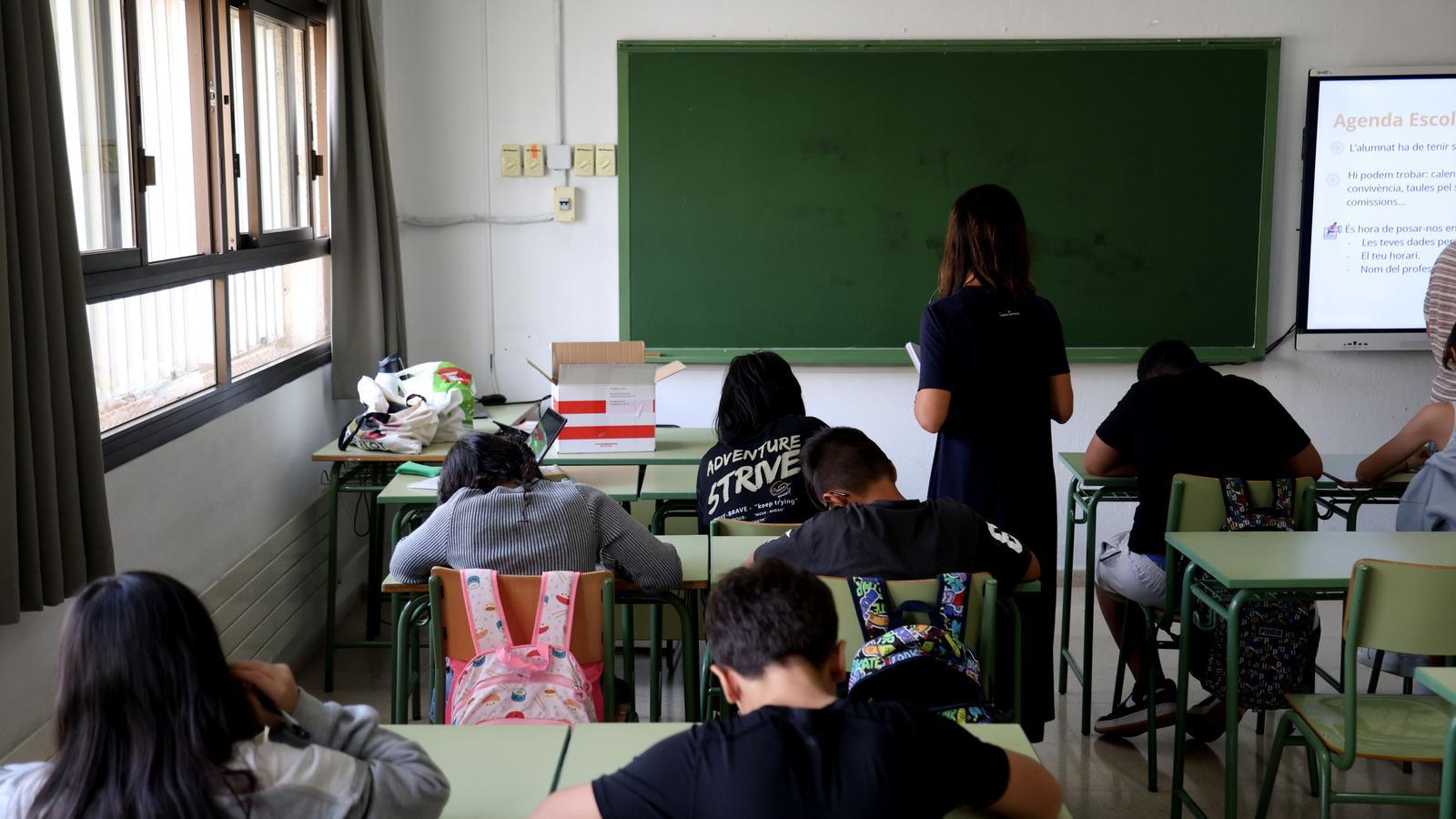
PalmaSchools in the Balearic Islands are accumulating more newly arrived students, more vulnerability, high ratios, a lack of teaching staff, pending infrastructure projects, and classrooms that burn in the summer and freeze in the winter. While schools try to sustain an increasingly complex reality, the state of education is going unnoticed in the November 29th election campaign. This is the contradiction that permeated the debate organized by ARA Balears with representatives of the main educational unions, who agree in describing a “perfect storm” in the schools and in demanding a political response that meets the needs. “We are the great forgotten ones,” it was said during the meeting.

Vicenç Garcia (STEI), Biel Vives (UOB), Joan Crespí (SIAU), Azahar Tortonda (UGT), Mario Devis (CCOO), Miquel Àngel Santos (Alternativa) and Víctor Villatoro (ANPE) participated in the debate, held with an eye on the union elections on December 2nd. The diagnosis they share goes beyond labor demands: the educational system has changed, the needs of the students have multiplied, and resources have not grown at the same pace. The historical underfunding is becoming increasingly evident.
On the other hand, large rallies and electoral proclamations have placed issues such as the repeal of the LOMLOE, which the PP and Vox are demanding, at the center of the debate. During the face-to-face with Sánchez, Feijóo harshly criticized the law, while the President of the Spanish government and socialist candidate defended the multi-million investment in the scholarship system. At the rally in Mallorca, PSIB deputy Amanda Fernández championed the work of early childhood educators and the need to guarantee a "public, inclusive, and quality" education. The 'Front Ampli', meanwhile, proposes, among other measures, to raise investment in Education to a minimum of 7% of GDP by 2030 at the national level and to guarantee free and universal school lunches for Infant and Primary school students.
The material conditions of the centers, the inequalities between the public and subsidized school networks, and the system's capacity to attend to the most vulnerable students, however, have had less prominence in campaign events, despite the fact that they do appear in electoral programs. It is true that education is a regional competence and that this conditions its weight in a state campaign. But this circumstance should not leave the structural deficits that the educational system carries out of the political debate.
A school that assumes everything
The unions identify the increase in newly arrived students and vulnerability among the main pressure factors. The Balearic Islands recorded 3,801 student enrollments with the 2025-2026 academic year already underway. The number of late-enrolling students registered by Education went from 1,297 in the 2021-2022 academic year to 6,814 in 2025-2026, an increase of 425%, while the total student body only grew by 4.9%. This demographic shift demands more reception resources, linguistic reinforcement, and individualized attention. Some children arrive without knowing any of the official languages and with personal situations marked by migratory grief. Teachers must accompany them in their integration, while simultaneously attending to the rest of the group, often with high ratios and without enough support staff.
The lack of teaching staff aggravates this situation. Organizations warn of the difficulties in recruiting professionals in a labor market that offers alternatives in the private sector, often with better conditions. They also denounce the loss of prestige of the profession, the loss of teaching authority, and the lack of support from some families. The work in classrooms no longer consists only of teaching content: centers must also face coexistence problems, emotional needs, and situations of poverty that condition learning.

Ratios are another obstacle to responding to this reality. A report by ARA Balears documented in the 2025-2026 academic year that 84 public centers exceeded the maximum ratios in Primary Education groups and 22 did so in Preschool. Overcrowding reduces the time each teacher can dedicate to each student and particularly hinders the attention given to children who need more support. Unions link this situation to the deterioration of academic results reflected in the PISA and IAQSE tests.
Vulnerability, moreover, is not a statistical abstraction. At IES Son Cladera, the center created a canteen after detecting students who arrived at class without having eaten, and the same has occurred at other high schools. At Son Cladera, the secretary would buy milk and cookies for the children who arrived fasting, and the institute assumed the costs of materials, field trips, and glasses that families could not afford. “If a student comes to class without eating and falls asleep, how are you supposed to scold them? It makes no sense,” explained the director, Manuel Blanco. This is an example of how the school ends up covering social needs that go far beyond its educational function.
Inequality between centers
This burden, however, is not distributed in a balanced way. Unions denounce that public centers assume a higher proportion of vulnerable students than subsidized ones, a distribution that concentrates social needs in certain schools. They point to the single school zone, especially in Palma, and the criteria of the former student as factors that can favor families with more resources and perpetuate differences between centers. They also question that some subsidized schools do not respect the reservation of places for late-entry students.
The CEIP Escola Graduada and the Sant Francesc school, in Palma, are two examples of very different realities separated by less than two minutes on foot. The public center serves a high proportion (almost total) of students with social and educational needs, while the profile of the students at the charter school is more advantaged. For teacher representatives, this distance shows that equal opportunities are not guaranteed only by offering school places: responsibilities and resources must also be distributed fairly. Now, in Palma it is not like that because the charter schools oppose it.
The criticism extends to the expansion of state-subsidized private schools. Union representatives believe that this network has benefited from a very significant increase in financial and personnel allocations, while the public system continues to assume a disproportionate share of the most complex needs. They also question the subsidization of thousands of places for zero to three-year-olds, which, they warn, reinforces a model in which employers' associations can accompany families from early childhood education through to Baccalaureate. The discussion, therefore, is not only how many resources the system receives, but how they are distributed and which educational model is prioritized.
Defending Catalan without enough tools
The Catalan language is another of the shared concerns. The unions denounce that there are centers that do not comply with the minimum decree and consider that the regulations have become obsolete. They defend a public school system in Catalan, but warn that linguistic integration is especially difficult when students arrive who do not know the language and join groups where there are also no other children who speak it.
The responsibility for integrating them falls largely on the teachers, who must ensure the learning of Catalan, while attending to the social and curricular needs of each student. Thus, the defense of the language clashes with a material reality: without teaching staff, reception resources, and funding, linguistic integration is left in the hands of the schools and their teachers.
In this campaign, Vox has lowered the prominence that the debate on Catalan had had in other contests, a fact that has precipitated that the rest of the parties do not speak about it directly. Sources close to the party point out that this lesser insistence could respond to the interest in not damaging its electoral strategy in Catalonia against Aliança Catalana. This lesser presence in the electoral discourse does not hide the daily reality of the Balearic centers, where linguistic integration continues to be a challenge that requires resources and planning. The situation is one of linguistic emergency. The school is the last bastion of the language, as admitted by the Minister of Education, Antoni Vera, even though the measures he has taken go in the opposite direction. But this bastion is shaking severely.
Contained discomfort
Infrastructures are another sign of the distance between announcements and needs. In 2024, the Government presented a plan of nearly 600 million euros to promote 300 actions over a decade. The Ministry clarified, however, that this did not imply that all works would be finished in ten years, but rather that the projects would have to be initiated. Meanwhile, climate control remains a problem: at IES Can Peu Blanc, 34.7 degrees were recorded inside the classrooms, and at IES Berenguer d'Anoia, families contributed 20 fans. In some centers, teachers and families end up assuming expenses that should have an institutional response.
The unions also acknowledge that they have not managed to mobilize the teaching staff enough to call a strike. They consider that the collective is not sufficiently activated and some engage in self-criticism for not having known how to transform the unrest into mobilization, despite the moments of tension. They also point out that the Minister of Education, Antoni Vera, has managed to contain part of the discontent with salary increases, new supplements, and measures such as the incorporation of educational psychologists into the centers. Although they value it, they consider the reinforcement of support staff insufficient. Wages, despite being among the highest in the State, do not compensate for the cost of living in the Islands.
The December 2nd union elections will measure the support of teachers for the different organizations. But the problem they describe is not solved by a dispute between acronyms. Public schools are taking on more and more functions: they teach, welcome, integrate, and try to compensate for inequalities that arise outside the classroom. They do so, all too often, with high ratios, a lack of staff, and insufficient infrastructure.
This is the reality that is left out of the November 29th campaign. While parties debate laws and models in general terms, centers have to resolve the consequences of structural deficits and an unequal distribution of resources every day. Education may not provide immediate electoral profit, but its deterioration has consequences that do not disappear when the campaign ends. It no longer depends on whether education is a regional or state responsibility, because investment in education is past, present, and future.
