Single school zone: apparent equality, real inequality
The change planned for the 2026-2027 academic year will unify the score for residence in most municipalities, with unequal effects depending on social origin
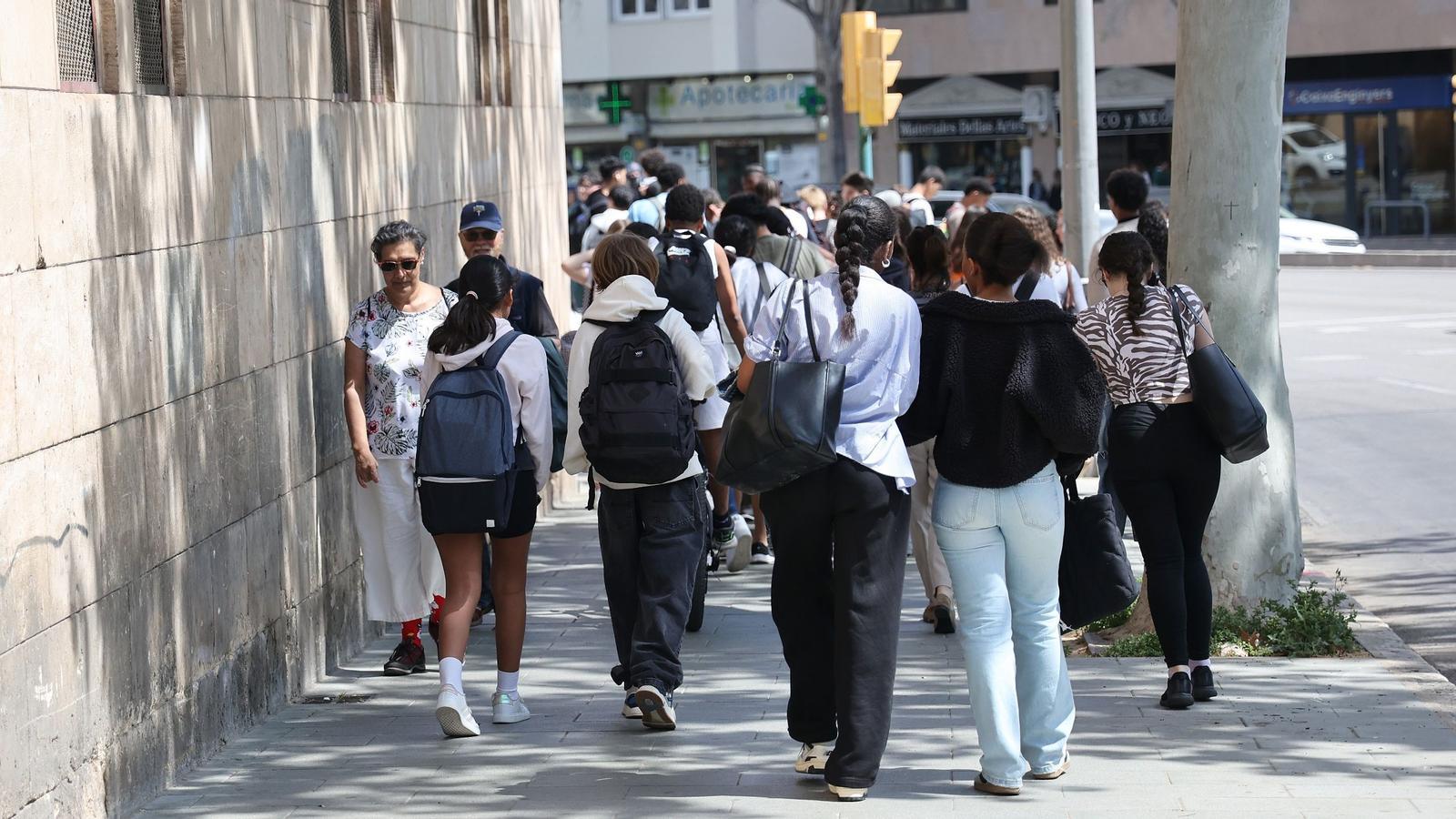

PalmaThe single school zone, which will be implemented in most municipalities in the Balearic Islands, The Ministry of Education will apply the single zone starting in the 2026-2027 academic year to all municipalities in Mallorca, except Selva, Calvià, Santa Margalida, and Andratx; to those in Menorca (Maó will maintain a separate zone for Sant Climent) and to Formentera. The towns of Ibiza will maintain diverse areas, at least this academic year.

The measure is not pleasing to centers or many families, but the Government defends it firmly in the name of the so-called "free choice of center." "It is democratizing education," in the words of the Minister of Education, Antoni Vera. But this freedom is more formal than real when the starting conditions are not the same. In fact, an increasingly widespread idea within the educational community is that the single zone, combined with the former student point, tends to predominantly benefit the subsidized school, which has historically accumulated more social capital and family continuity networks.
Regarding the rest, the usual admission criteria are maintained, such as having siblings enrolled in the center, income level, and being a large or single-parent family, among others. However, in most cases, these are criteria that do not affect all families. The same is not true for proximity to the home, a key factor in the final calculation and which, with the new zoning, loses its original meaning of favoring proximity schooling.
A clear example is Palma. During the left-wing pact era, the city was divided into eight zones. Students requesting a place in a school in their area could obtain up to 5.5 points for living nearby. On the other hand, if they resided in an adjacent zone, the maximum score was reduced to a maximum of 2.75 points. With the implementation of the single zone, this difference disappears: the majority of students in Palma can reach 5.5 points to opt for any school in the municipality, while the bordering zones become part of the municipalities surrounding the city. The principle of proximity is diluted and transforms into a mechanism that, rather than ordering, increases competition between schools.
A similar dynamic applies to the proximity of the parents' workplace. In this case, up to 5.5 points can also be obtained if the center is within the zone of influence, and up to 2.75 points if it is in a neighboring area. In no case, however, can the points corresponding to the home and the workplace be accumulated, so families must choose which criterion is more favorable to them. This choice, apparently neutral, favors profiles with more information and strategic capacity.
Displaced students
The functioning of the system is better understood with a specific case, in a center with more demand than places. A family has lived in Son Rapinya for five years, is middle class, and the parents work in Santa Maria. They do not receive any additional points for other criteria. Another family, with a similar socioeconomic situation, lives in El Molinar. Both want to enroll their children in Monti-sion (Son Rapinya) and, thanks to the single zone, they obtain exactly the same score for proximity of residence: 5.5 points.
The apparent equality is broken by another criterion. The Molinar family is entitled to the former student point, as the mother studied at this same subsidized center. This factor tips the scales. Thus, the student who will end up obtaining a place is not the one who lives closest, but the one who has the additional advantage. The mechanism, far from being anecdotal, consolidates dynamics of social reproduction: families that were already within certain educational circuits have more facilities to continue in them, while those who remain outside have more difficulty accessing them.
The former student criterion is voluntary for centers and more than 80% of the subsidized schools in the Balearic Islands, especially in Mallorca, have incorporated it. Both the majority of Catholic centers and cooperatives have adopted it. It is also present in part of public schools, but with a much lower incidence than in subsidized ones. This reinforces the perception that the system, under an appearance of openness, can further segment students according to their social origin and family trajectories.
Cross-cutting rejection
federations of families and municipalities like Manacor
Also opposed have been the federations of families and municipalities like Manacor, which will undertake legal measures to reverse school zoning. All this in a municipality where a system for redistributing vulnerable students among all centers has been in place for years, a model that has helped contain segregation and avoid both 'ghetto' schools and elitist schools.
In this context, the implementation of the single zone not only reopens the debate on freedom of choice, but also raises a fundamental question: to what extent can an educational system be considered equitable if the rules of the game, despite being apparently equal, end up systematically benefiting those who start in a better position.
