Carles Rebassa points out the "subtle enemies" of Catalan and calls not to change language
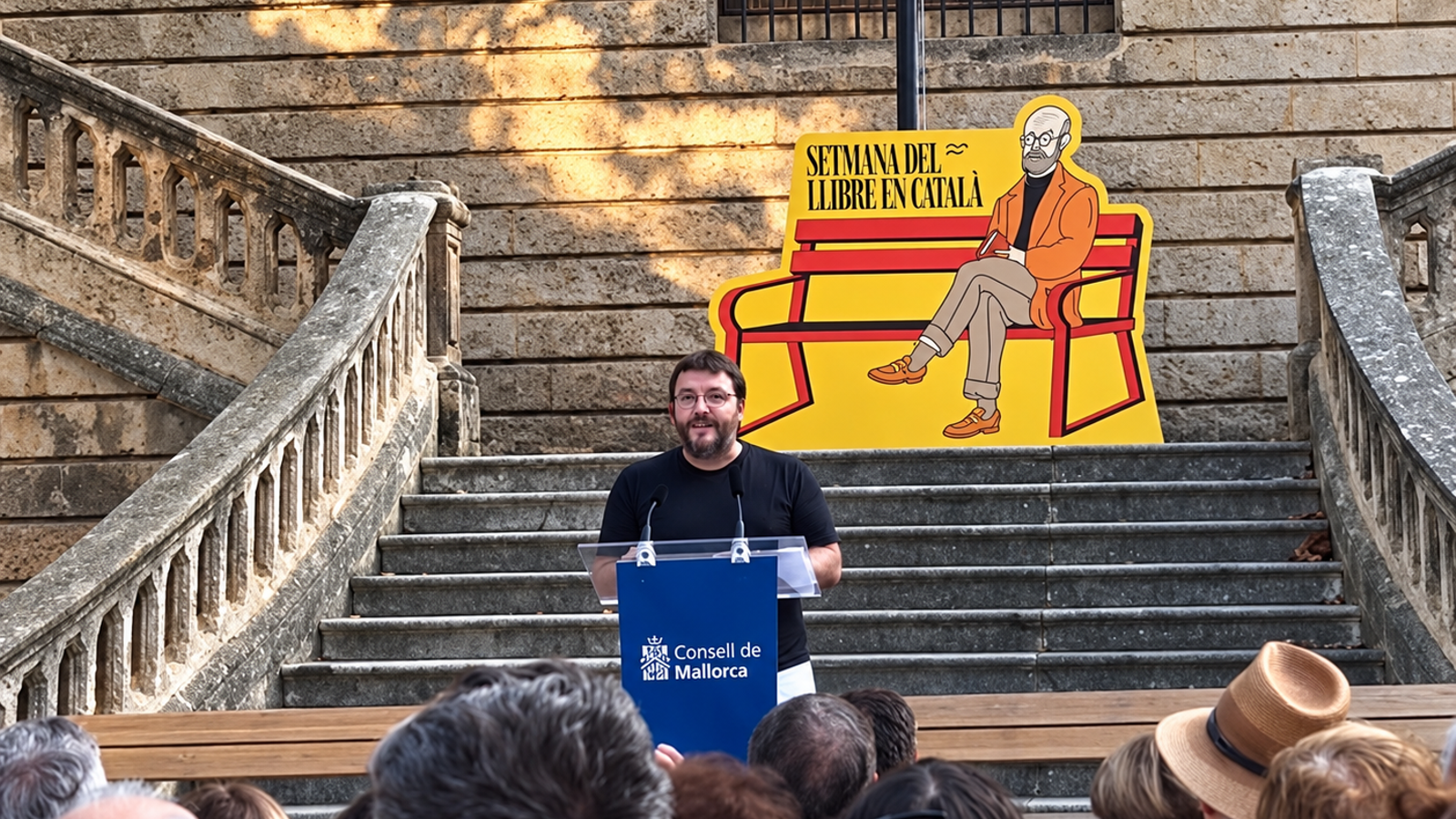
The 37th edition of the Catalan Book Week has been inaugurated this Thursday at the Misericòrdia gardens in Palma with the opening speech by the Majorcan writer
-
CAT -
CAST -
GER
Palma"If we do not have Catalan, we are nothing, we have nothing". This is one of the most forceful statements that Carles Rebassa has made this Thursday in the inaugural proclamation of the 37th Catalan Book Week in Palma. The Mallorcan writer has turned the defense of the language into the central thread of his speech and has made an explicit call not to change language in everyday situations: "The democratic act of never changing language in our country".

Rebassa has defended that the Catalan Book Week is much more than a meeting around books. In his speech, he placed the event in a political, public, and also private space, because, as he remarked, "everything that is public is political" and "everything that is private is political". For this reason, he has claimed the Week as a space of resistance and, at the same time, of centrality for Catalan literature and in the Catalan language.

"If we don't have a language we have nothing," he insisted. And he brought this defense down to the most everyday level: "Let's speak Catalan in the street, always." He demanded speaking it "with the doctor who tells us they don't understand us," with the coworker who "says they understand Catalan but don't speak it," and with children, regardless of the neighborhood or the vicinity. "Let's open the language to everyone, for everyone and for ourselves," he said.
At this point, Rebassa also criticized those who, in his own words, understand the Islands as a self-service linguistic" model. "If someone refuses to understand Catalan and thinks that this land is a linguistic self-service, it is their problem. But it is also ours," he stated.
The herald also dedicated a significant part of the speech to those he defined as the "subtle enemies" of the language. He pointed them out as those who "destroy our institutions," "disintegrate our schools from within," and "marginalize us and expel us from cities and towns to please the highest bidder." And, in one of the harshest expressions of the proclamation, he described them as "viceroys, puppets, cowards, submissive, and traitors."
For Rebassa, however, the defense of Catalan cannot be separated from the defense of literature. He has championed books as a way of explaining "who we are", but also "who others are", "where we are" and "where we want to go". He has recalled authors and writers who have been part of his own journey, from Blai Bonet and Miquel Bauçà to Maria Mercè Marçal, Llorenç Villalonga, Salvador Espriu, Ovidi Montllor and Guillem d'Efak. "Literature is shared thought," he affirmed.
The speech also had space for a critique of the literary market. Rebassa has railed against "the unbridled sadism of the market" and against the transformation of literature into "a tool of entertainment", "a commercial product" and a competition between best-selling authors. In this context, he reminded that the author is not the one who directly sells the book and that the percentage they receive from each copy is 10%.
The Week that Rebassa inaugurated will be there until Sunday at the Misericòrdia gardens in Palma. Organized by the Mallorca Booksellers' Guild, this 37th edition brings together around thirty participants and twenty literary activities, including presentations, recitals, conversations and other cultural proposals.
