Young people, facing the polls: housing, immigration and an ideological battle that also divides friendships
Five voters who are debuting in the November 29 elections explain what worries them, how they have built their political ideas and what role social networks have in an increasingly polarized generation
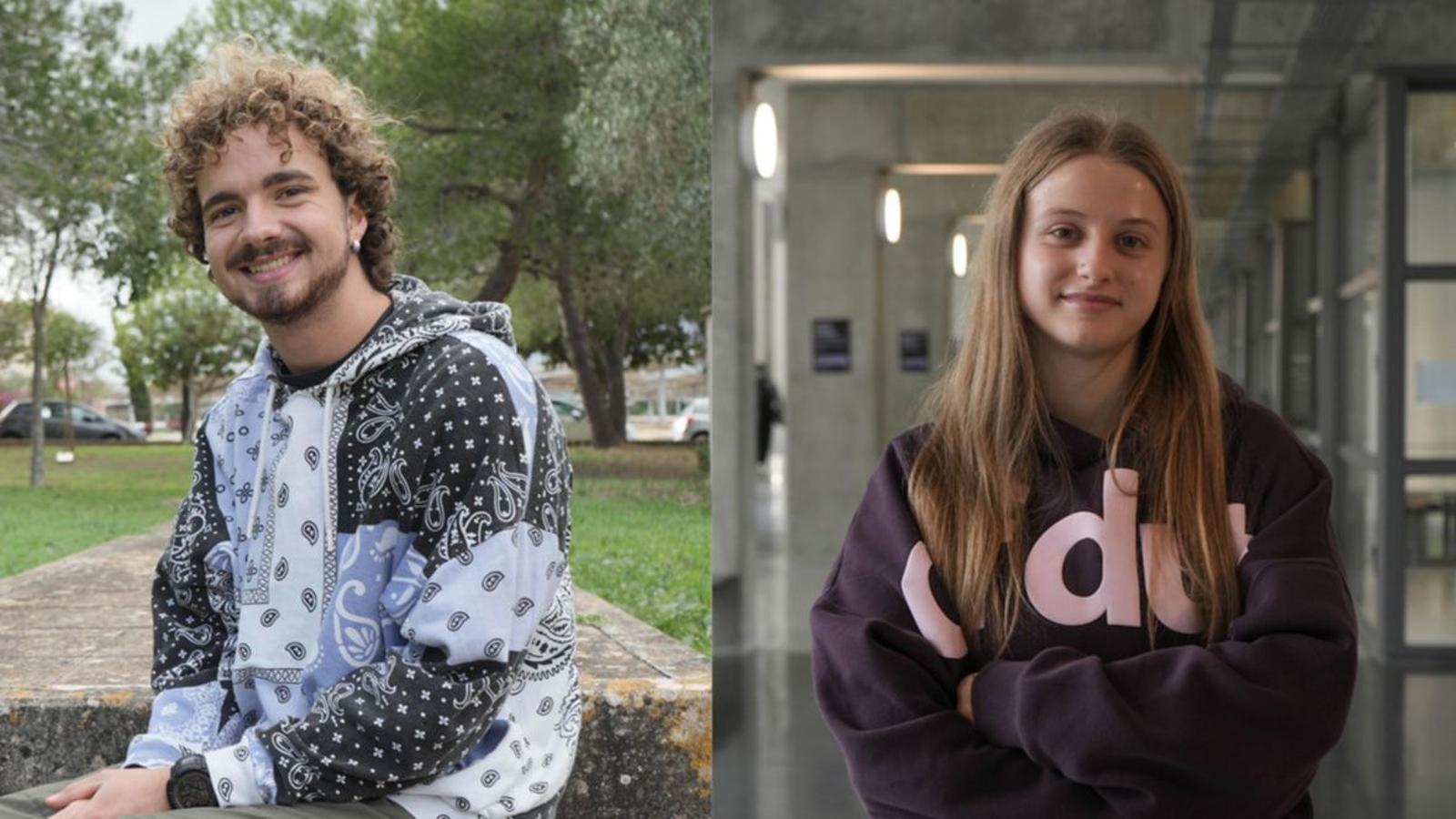

-
CAT -
CAST -
DE
PalmaNew voters give voice to the concerns, expectations, and contradictions of a generation that gets its political information through social networks. At a time when these seem to turn everyone into a permanent commentator, talking about politics face-to-face is not that easy for them: some young people prefer not to take a stance, and others have difficulty articulating their own discourse about what interests and worries them.
“Immigrants are not to blame for where they were born”
Marta (PSOE/Ara Més-Front Ampli)
Marta Seguí (2006) shares ideals with both the PSOE and Ara Més-Front Ampli, which is why she does not want to identify with either of the two groups. Her ideological position, on the other hand, is more defined: she places herself on the left because she believes that society must evolve and leave behind the practices of the past. “For me, being right-wing is being conservative, viewing ancient practices as normal. The left is the complete opposite: it wants to change things, evolve and progress, attend to diversity, respect it and champion it,” she explains.

One of the issues that worries her most is the rise of Vox and that a right-wing government could cause social rights to regress. In particular, she fears that abortion, the trans law, and the LGTBI law could be modified, as well as that the discourse against immigration could be toughened. "I am very worried about the rise of Vox, because we will go backwards," she states. Regarding migrants, she rejects that they be held responsible for the country's situation or that their right to seek better living conditions be questioned. "Immigrants are not to blame for where they were born. It is natural for them to seek a place to be and live better. Discrimination is not logical," she argues.

Housing is another of her main concerns and she considers that it should be an immediate priority for the new government. The difficulty of accessing an apartment is not an abstract issue for her, but rather an obstacle that conditions the future expectations of her generation. “No one can afford a house,” she laments. And she adds: “I am 23 years old and someday I would like to move out, but right now I see it as impossible.” Seguí also observes important differences among young people regarding political involvement. In her environment, there are both people who are very mobilized and others who have no interest in the elections or who have not yet formed a political opinion. However, she is especially worried about the influence of social media on how the youngest interpret current events. She believes that false messages she attributes to the PP and Vox circulate easily on TikTok and may end up conditioning their positions. “Many young people swallow them hook, line, and sinker with blind militancy.”
He also questions the way some young people evaluate the management of the Spanish president, Pedro Sánchez. He admits that he may have made mistakes, but he believes that, often, opinions are not formed based on one's own assessment: “They see what is said about him on social media and follow it with blindfolds, without much critical perspective. They have been told that Sánchez is the devil and they have made him their enemy without, on many occasions, even knowing why,” he laments.
“Being on the left means seeking the common good”
Arnau (Now More-Broad Front)
Arnau Jutglar (2006) sympathizes with Ara Més-Front Ampli. His political position stems from an idea that he considers fundamental: collective well-being must be above individual interests. "Being on the left means seeking the common good above individual freedom, while the right is more conservative," he explains. He identifies with the left because he considers that "the common well-being must be a priority over economic liberalism".

As a young person, they place housing among their main concerns and demand that it be one of the first issues addressed by the new executive. They are especially worried about the possibility that a PP and Vox government will not adopt measures to regulate tourism and facilitate housing access for residents. They believe that the lack of responses could end up generating a social conflict that goes beyond the difficulties of finding a home. "If nothing is done to regulate tourism and ensure that housing is more accessible for local people, a big problem will be created. Not just because of the problem itself, but also because of the reaction it may generate among the population," they warn.
Another reason why they look at a possible pact between PP and Vox with concern is the possibility that rights considered consolidated will be reviewed. They are referring to the trans law, the LGTBI law, abortion, and euthanasia. "In the end, these are consolidated social advances. And everything the right proposes is very extreme," they state.
Regarding the generational environment, Jutglar perceives a progressive majority among the young people with whom he interacts, especially within the university sphere, although he also identifies a significant presence of right-wing voters. Regarding the latter, he explains that immigration is one of the issues that concerns them most, even if they do not necessarily hold contrary opinions to LGTBI and trans groups. Among the political references of the right-wing youths he knows, he says that the PP and Vox predominate, while SALF has less presence.
Arnau's interest in politics has been fueled mainly by conversations with friends and following some electoral debates. He does not use social media. He is also critical of young people who defend Francoism: he considers that they do so out of ignorance of a historical period they have not experienced firsthand. "These are people who haven't lived through it and say it out of unconsciousness," he maintains. At the UIB, he also observes ideological differences between faculties: at the Polytechnic School, he assures, he sees "a lot of right-wing people with the Spain wristband".
“I don't understand that there are parties that want to divide Spain”
Carlos (PP)
Carlos (2005) is from the PP. He identifies with the right and defends a unitary model of Spain, with a national identity that he believes must be preserved "against invaders." Spanish nationalism is one of the central elements of his political stance. "Spain must be united and we cannot allow our identity as a country to be called into question," would be one of the ideas that define his way of understanding politics. He does not feel close to progressive options and considers that the conservatives best represent his way of understanding the State and the structure of society.
Immigration is one of the issues that most conditions his voting decision. He argues that Spain should toughen its immigration policies and establish more controls over the people who arrive in the country. "I am not against people coming from abroad, but there must be control and the rules must be followed," he summarizes his position. He believes that an immigration policy cannot be maintained without sufficient control and reproaches the left for not giving much importance to this concern.
He is also critical of pro-independence movements and any proposal that, in his view, could weaken territorial unity. “I do not understand how there can be parties that want to divide Spain. We are one country and we must defend it,” he maintains. He believes that the State must maintain authority and that institutions must prioritize the interests of all Spaniards as a whole.
Despite sharing a good part of the right's approaches, he has chosen the PP and not Vox. He considers that the Popular Party has a greater capacity to govern and implement policies. “Vox can say many things, but the PP is a party that can reach the government and make them possible,” would be the reasoning behind his choice. However, he faces a family paradox. His parents are socialist militants and his mother even held a municipal position when she lived in Zaragoza.
“We must speak clearly about immigration”
Lucia (Vox)
Lucía (2007) grew up with the PP as her family's political reference, but she supports Vox. She considers that the left has sidelined important concerns for a part of the youth. "It has been wrong about many things and does not provide answers to the problems that worry some young people," she explains. She does not feel represented by a political space that, in her opinion, leaves aside issues that should have more prominence.
Immigration and the national question are the two priorities that determine her vote. She argues that there must be more immigration control and rejects that this debate can be considered uncomfortable. "It is a matter that must be possible to talk about with clarity. I do not believe it is an issue that should be avoided or that cannot be put on the table," she maintains. She considers that Vox pays more attention to these concerns and that, because of this, it connects better with young people.
She also advocates for the unity of Spain and shows herself to be opposed to the independence claims of Catalonia. "I want a unified Spain and I am not comfortable with what is happening in Catalonia nor with the way this issue is treated," she states. Furthermore, she defends that the country should maintain its roots and identity, including the Catholic tradition.
In the social sphere, she does not agree with abortion, euthanasia, or many of the issues related to the LGTBI community. However, she introduces a nuance regarding the party she votes for: she does not understand why Vox has to place these topics so centrally in its discourse. “I am mainly concerned about immigration and national issues. These are the matters I consider most important and I would like the party to focus more on these priorities,” she explains.
The rejection of Pedro Sánchez also distances her from progressive options. She does not like the Spanish president nor does she feel identified with his way of governing. Nor does she find in the Broad Front an alternative that represents her. “They are communists,” she says.
“Now it seems that it is shameful to be on the left”
Rocío (PSOE)
Rocío Belinchón (2006) leans towards the PSOE. She is clear that one must vote for progressivism and argues that the left better represents the interests of the working classes. "The right seeks the benefit of the upper classes, while the left seeks equality for all social groups," she summarizes. However, she observes with concern that many young people in her circle are leaning towards conservative positions: "In my circle, very few people are on the left; most of my friends are on the right."
The possibility of a PP and Vox union in government is one of the issues that worries her the most. She believes their policies will especially harm women and migrants. She also tries to explain the ideological shift of young people based on identification with a patriotic sentiment. "I think they don't agree with everything the right says, but because they feel united by being patriots, they vote the same," she considers. She also sees in it a component of rejection towards the most disadvantaged social classes.
This political difference has also ended up affecting his personal relationships. Belinchón explains that, in his environment, right-wing youth express their ideas openly, while left-wing youth tend to go more unnoticed. “Before it was more embarrassing to be right-wing and now it seems it is embarrassing to be left-wing,” he observes. The disagreements with friends have been frequent enough that they have decided to avoid political discussions: “We have agreed not to talk about politics because we end up angry and pulling our hair out.”
Beyond ideological differences, he places housing among the urgencies that the next executive should face, whoever it may be. The difficulty of accessing an apartment conditions his generation's expectations of emancipation and makes him view the future with uncertainty. “Young people will suffer to find housing. I don't think I can move out even by the age of 30,” he laments.
