Why police charges benefit the Prohens Government
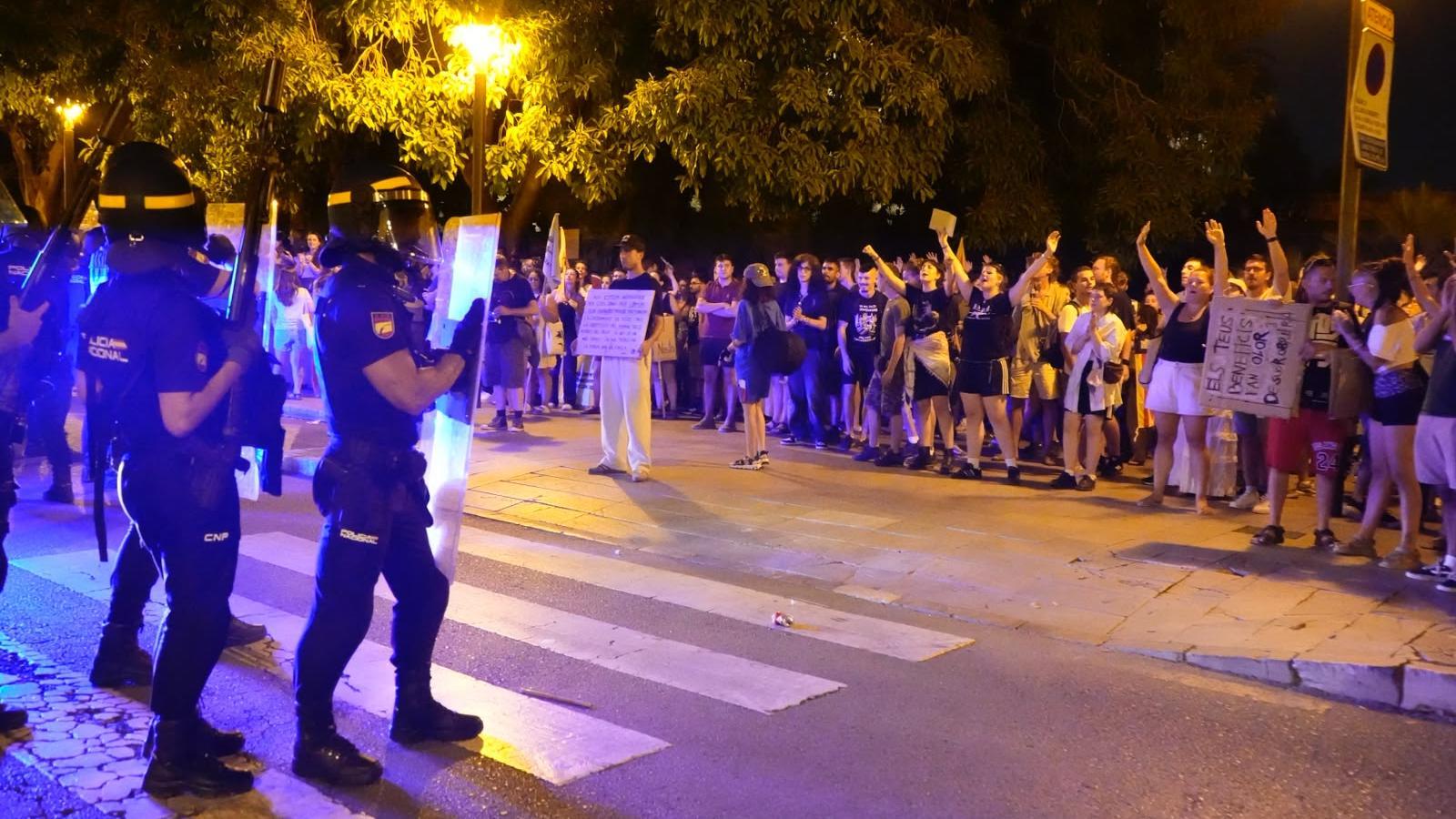

PalmaDemonstrations are not only held in the street. They also contend with the aftermath, when a media and political narrative is imposed about what happened. And, after the police charges of 26-J, the narrative of tourist saturation has been sidelined in the media by another debate much more comfortable for Marga Prohens' Government. It is important not to lose focus, because the president is one of the main people responsible for responding to the problems that the tourism model generates in the daily lives of the citizens of the Balearic Islands. The day after one of the most massive protests ever seen in the Islands, Prohens has not felt the need to face the situation, nor to give explanations about the lack of management, nor to confront her unfulfilled promises. The president has spoken about the charges, has demanded explanations from the Spanish government delegate, Alfonso Rodríguez, and has remarked that she respects the right to demonstrate, as if that were not a given.
This situation is the result of various factors. On the one hand, the situation of activism in the Islands is not conducive to joint organization, which would allow us to take advantage of the extensive experience of entities such as the GOB and the young impetus of new platforms, such as Menys Turisme, Més Vida. It is time to resolve discrepancies, set aside personalisms, and find common ground that allows for collective action. A problem as transversal as the perverse effects of the Islands' tourist economic model deserves this, out of respect for a citizenry that needs to express its unease beyond Cainite disputes. It cannot be overlooked that there was a lack of planning that took into account the risks involved in bringing together tens of thousands of people.
On the other hand, it must be said that the Police's arguments are childish. The duty of security forces is to maintain calm and face situations of certain tension without having to assault citizens exercising their right to protest. Meanwhile, Alfonso Rodríguez has evaded his political responsibility and has limited himself to pretending that all this has nothing to do with him, in a dialectical exercise that is more about partisan politics than institutional. Of course, the PSIB's position is not at all simple: the socialists have state competences in tourism and security, and at the same time they try to pretend to be fighting against a system of which they are a part.
The Government would not have imagined this situation a day before the protest. But, if it has a minimum of concern for the deterioration of citizens' living conditions, it should drop the alibi of altercations, acknowledge that the word given has not been transformed into facts, and act accordingly. It is reasonable that a large part of society doubts that this will ever happen, because, after three years of legislature, cameras are still to be installed to count bathers on the beaches and cars on the roads, the Pact for Sustainability has been transformed into a kind of mythological being, and the PP's tourism policy is like that series called "Cuéntame": a constant reminder of the recent past of the Islands with the Pact at the Consolat de Mar.
The only one who has not failed in this complex story has been the citizenry, who demand solutions until exhaustion and who now not only have to suffer police aggression, but also have to contemplate how the political fight diminishes the dimension of their requests. Each of the people who marched through Palma on 26-J and also those who did not go out, but who feel that the Islands are increasingly less their home, deserve respect.


