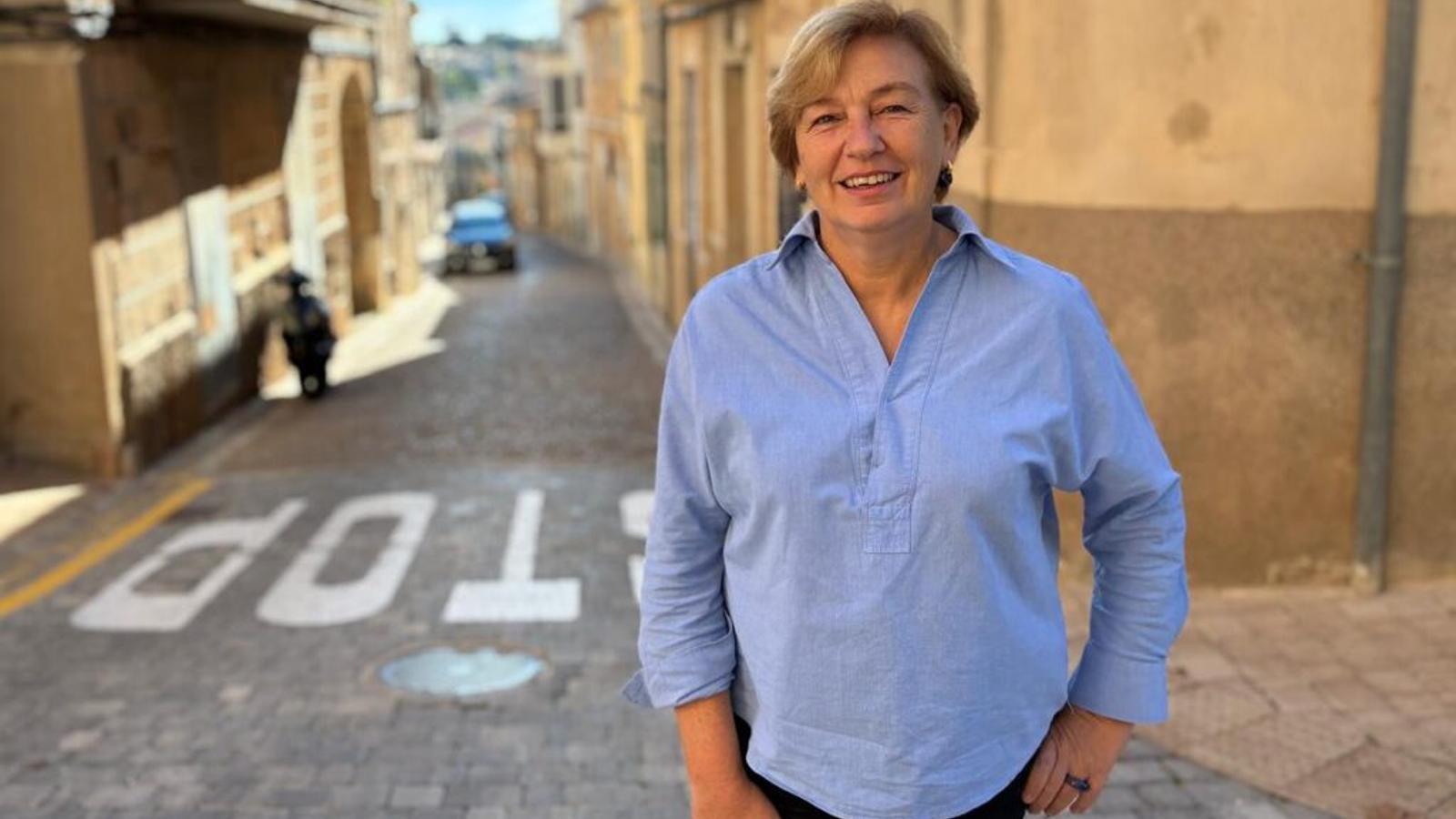
Magdalena Perelló Frontera: "I need to recover the dinners with friends and with my partner"
Mayor of Llubí
-
CAT -
CAST -
DE
LlubíAfter the 2027 elections, Magdalena Perelló Frontera from Can Coramet (Llubí, 1966), will cease to be the mayor of her town after 12 years. These have been three terms in which, as her party, MÉS per Llubí, recently published, investments worth 12 million euros have been executed. She is leaving naturally and, in fact, she is leaving calmly because the person who will replace her at the head of the candidacy has experience at City Hall, enthusiasm, and passion. She leaves things pending that she would have liked to do, but she is clear that the farewell comes at the right moment. She also does not hesitate to talk to us about her future in the world of politics.
You have eight months left to finish the term, how do you feel after so many years of coming to City Hall every day?
— The truth is that I already feel a bit of nostalgia because I will not forget these twelve years at the Town Hall. It is true that there are times when you think "what have I gotten myself into," but if we take stock, it is positive. During these twelve years, I have learned a great deal about management, about living with all the people of Llubí, and I take away many friendships and very positive things. But whether you like it or not, twelve years is twelve years; I have to make way for other people and I need a break to attend to my family, which is one of the things that weighs on the balance I mentioned, and it is not that I have neglected them, but there are many things you don't do because you are in a public office and the City Council always comes first and, for example, you leave aside going out to dinner with friends, with your partner... and I have to recover that.
So are you already quite decided or have you had moments of doubt?
— No, I have had no doubts, I know that I have to leave it because it has been many years. This does not mean that I did not have the enthusiasm to continue, because there are many things to do. Not everything is done with these three terms and I have many projects. In fact, I still turn things over in my mind and tell the councilors "we should do this and that" and they have to tell me to slow down.
And which projects are they?
— One, for example, is that I would have liked to have seen the Day Center finished and there are also projects that I will have started, but that I will not see finished, and that this would also be an incentive to continue, but my body and my head are also telling me that I need to take a break.
Of the projects you have carried out over these years, is there any that you are particularly excited about?
— I believe we have carried out many projects. For example, we did not have a nursery school and now we do; back in the day, Ca ses Monges had to be bought and no one gambled on doing so, but we bought it and, in fact, there is already a remodeling project underway so that it can house the new Day Centre, the Library, and the Youth Centre. We have built the Sa Farinera cultural centre, a place that was abandoned. Now we have bought the plot for a new school, because ours has already become too small. The sports centre has changed, because we have built a new swimming pool, we have renovated the changing rooms that were there, now we have a new changing room, a covered court, we have renovated the tennis court... We have also remodeled squares and streets and we have built an entire rainwater network that has not yet been finished, which is an improvement to which many towns do not dedicate even a cent and they are expensive works that do not show because they are not seen, but they are very necessary. The town has grown and that means you have to provide solutions to the problems that the new housing has created for you. We have also changed all the public lighting to LED, among other things.
And what projects are these that you would do?
— So, fighting for the new school, as I have said we have already bought the plot, and then converting the old school into a cultural center for the municipality's associations. This is long-term because we depend on the Department of Education to build the new school, and although they have placed the Llubí one in the medium term, I believe that is about 10 years. We have planted many trees, but we want to plant more, because it will get hotter and hotter and we need more shade. Remodeling the parks and making them more naturalized, that is to say, removing cement and such materials; also making more dissuasive parking lots at the entrances to the town because in the center we have asked the owners of some plots, but they prefer to build housing rather than parking lots and I understand that perfectly. The islands should not be a place only for the rich, they are also for the Majorcans who were born there
What has been the best moment and what has been the worst of these 12 years, if there are any?
— Worse, there isn't any; difficult ones, yes. I believe that all the mayors who have lived through the Covid-19 pandemic will surely tell you the pandemic. That uncertainty kept your heart in your mouth because we didn't know what would happen, nor how long we would be locked down, nor how we would resolve situations that might arise. This, I believe, was the period I lived through with the most anxiety. And then, the good moments are very simple and come at the moment when someone thanks you for anything you have solved, that is what gives you the most satisfaction. Or going out into the street and seeing those children who know who you are, that also gives you a lot of encouragement.
You mentioned that you cannot find plots to build parking lots in the town center because people prefer to build homes, as is the case in Llubí and Pla?
— I see it as terrible, I see it as very bad. Because from a municipality you do not have tools to regulate housing. The only thing you can do is official protection housing and this has also become extremely expensive and I believe that young people have difficulties accessing it because any young person has a payroll of a thousand and a few euros and would have to take out a loan of 200,000 euros. Young people are only saved, in principle, if they have some inheritance from their parents, that their parents have two houses that they can give them or that they have a plot of land. Because, if not, it is very difficult. And if this is not regulated in some way, I see a bad solution. In Llubí we have houses that one would never have said were worth a million euros here in the village. In the countryside there are even more expensive ones, but here there are some that are worth a million euros and nobody would have ever imagined it. And they are houses that you look at and if you had to buy them it is evident that they do not have this value that has been given to them now. Are there people who pay for them? Yes, but they are not locals from Llubí.
How do you see the impact on the towns of the Pla with immigration, new residents or second-home owners, and the tourism model? Do you think the essence of the town, of traditional Mallorca, is at risk?
— I think so, but above all when we talk about immigration we only talk about immigration from the south, which are those who come to do the jobs that no one wants to do here. But no one talks about immigration from the north. They are people who come here for a month, two months, they don't integrate. Later these people use this housing to leave it to cousins or siblings, etc. And they don't integrate and there is a lack of housing here but these houses are only inhabited in the summer or for Christmas, and then they remain empty. This also affects the essence of the town because housing should be for people to inhabit all year round and lead a village life, taking children to school, integrating into the language, etc. It is very complicated to find solutions, but there are islands that have managed to do so. First the solution should be at a state level and then at a European level, but something must be done because there are territories that can no longer take any more and it should not be an island of the rich, the islands are also for the Majorcans who were born there.
Another of the consequences that the Pla suffers every summer from filling private swimming pools, but also those intended for tourists, is the lack of water? How is it in Llubí?
— For now, we in Llubí have drinking water, but that does not mean that next year or in two years' time Llubí will not suffer from a lack of water due to nitrates or whatever else. In El Pla, there are villages that are having a very hard time, and the Mancomunitat assumes it all. If the high-pressure network is not built soon, continuing with water trucks is unsustainable over time. But governments come and go, everyone tells us "yes, yes" and they see the idiosyncrasy and the needs of El Pla, but there are other projects that take precedence, and El Pla is also important, because the entire coast is overcrowded with people coming from outside who consume water, and those of us who live in El Pla, which is a stronghold, will eventually reach a point where we will not have water.
On a personal level, how have you experienced being a woman and a mayor? How has the situation evolved in these twelve years? Have there been any uncomfortable situations?
— It has changed... Well, it is not that it has made a 180-degree change, but it is true that when I started there were some slightly uncomfortable situations. For example, I would assign a task, and it had to be revalidated by a councilor. For example, I would say 'we have to do this', and the person I had asked would go to a councilor to ask him. And that, yes, not anymore, although there are still some flare-ups. This will be very difficult, because it seems that there are some who think that because we are women, we still do not know how to carry out certain tasks or we do not know how they are done. But well, little by little it is being overcome, but we always have to prove it.
And the reasons?
— There are many, but the issue of work-life balance is important. Everyone must find the balance between their position and their home. I have been lucky to have a husband who knew that I was the mayor and has taken on responsibilities, but responsibilities that fell to him, yet there are women who, after dedicating many hours to the Mayor's Office, then have to do many chores at home and that is exhausting. In Llubí, there are houses that are worth a million euros and no one would have ever imagined it; there are those who pay for them, but they are not Llubí locals
Talking about regional solutions, are you saying a definitive goodbye to active politics or do you have the door open to go to the City?
— No. It is a final farewell. What happens is that I will always belong to the MÉS per Llubí group. I will help in everything possible, in whatever it may be, as long as they ask me for help... but I will not run for mayor again, nor will I go to other places.
How do you see the upcoming elections?
— In the national elections I see that as always many people will cast a tactical vote for fear that the right wing might get in and all that, and this here is what often happens to us as a party. Except for 2015 when we got some good results that nobody expected. I see it as difficult, although it could be that results come about that you don't expect and that people vote tired of the two-party system. But one of the problems is this so-called tactical vote. But it often happens that even your party's supporters tell you that so that the other one doesn't get in they will vote for the other.
Speaking of the future, what will you do after leaving the Mayor's office? Because you like gastronomy and you had a catering company, right?
— Yes, we had this business with a cousin of mine and we enjoyed doing it a lot. In fact, she continued with the catering for a while but then she quit and now she continues with the 'Taula posada' blog. What I have to do now is close this political chapter, rest, and then we will see where I head next. I need to take some vacations that I haven't been able to take for twelve years and then we'll see. For twelve years I lost being Malen from 'Can Coramet' to be the mayor and I would like to be remembered by my name and not by the position
You held the handover ceremony at the head of the party with substitute Xisca Bauçà who will be the candidate for Mayor in May 2027, what can you tell us?
— I am very happy. She is a councilwoman who has been with me for eight years on the government team and now she is taking over, and I am happy not only to leave the town with a successor and that we already have her now, because I know how complicated it is to find someone who wants to head a list in an election. Finding a person like her who has enthusiasm and wants to be there is as if I had won the lottery, because I leave more at ease knowing that there is a substitute person. I am not leaving everything up in the air without knowing who will be there. Furthermore, it is a very natural handover because she has been on the government team for eight years and knows everything we have done.
How would you like to be remembered in the village?
— I don't know, to tell the truth. Because we are not much for recognition. In fact, we haven't inaugurated anything we have done. My work has been the work of a team, not a mayor, it has been a team that has done everything possible to reform or revitalize the town... I don't know, but I think that since during these twelve years I have lost being Malen from Can Coramet to be the mayor, I think I would like it more if over time they remember me as Malen from Can Coramet and not as mayor, because in the end your identity is a name and not a political position.
