After the eclipse comes Apophis, the asteroid that will “graze” the earth
The asteroid will pass at little more than 31,000 kilometers from the surface of our planet
-
CAT -
CAST -
DE
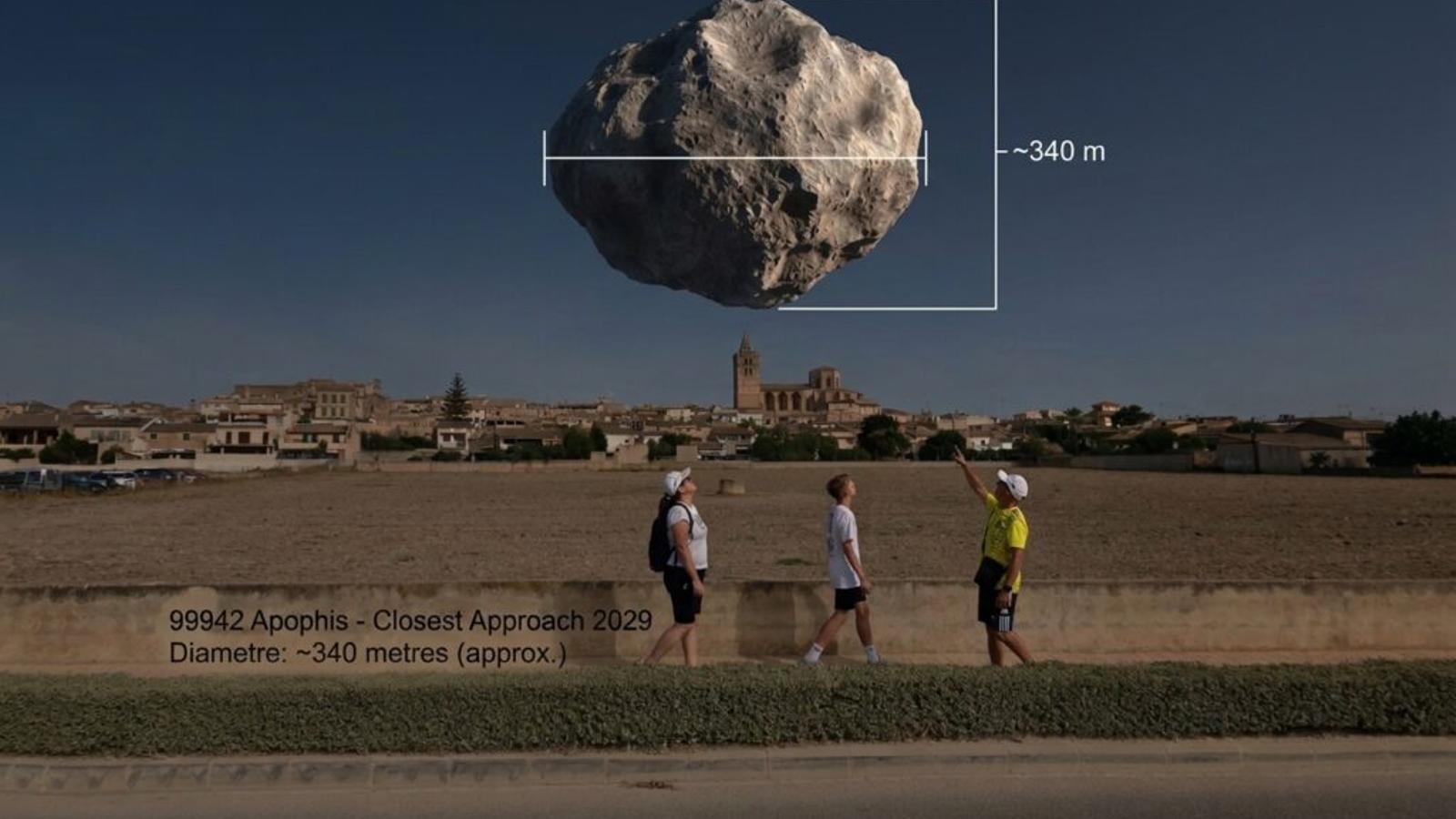
SineuIf last summer many neighbors of our towns climbed the hills, viewpoints, and rooftops of the Pla to contemplate the historic total solar eclipse of August 12, 2026, the night sky is already preparing a new appointment of those that make history. Next Friday, April 13, 2029 (12 days after Easter), the asteroid Apophis—a large space rock 340 meters in diameter (the Puig de Sant Nofre is 254 meters high)—will pass extraordinarily close to the Earth and everything seems to indicate that it will be visible with small telescopes or binoculars from Mallorca.
After years of monitoring and speculation since it was discovered in 2004, the scientific community and agencies like NASA and the ESA have wanted to send a message of absolute tranquility: there is no risk of collision with Earth. The asteroid will pass at just over 31,000 kilometers from the surface of our planet, a distance so short in astronomical terms that it will even be located below the orbit of many communication satellites.

Look at the sky
The entire Pla de Mallorca and part of abroad will not easily forget the afternoon of August 12, 2026, when the sun was completely hidden before the gaze of thousands of people. However, the visit of Apophis in 2029 will offer a very different, yet equally fascinating phenomenon.
Unlike usual phenomena, Apophis seems that it will not need large telescopes to be observed. From the rural paths and areas with low light pollution in the region, the asteroid will be seen as a point of light similar to an average star. The big difference is that its movement can be appreciated live as it crosses the constellations. And who knows if it will collide with any of the satellites that humanity has out there.
The asteroid
The person who knows about the subject is the astronomical communicator, Pep Marcús. As the man from Sóller explains, “the asteroid Apophis owes its name to the Egyptian god of death and destruction, and we gave it this name on purpose when it was first detected in 2004. At that time, it reached a fairly high number of impact options with Earth —there was a one in 28 chance of colliding with Earth—, which set off alarms and gave a significant value on the Palermo scale, which is the tool we use to measure the possibility of an asteroid impact”. “Later, with more observations and orbital recalculations, this risk was drastically reduced,” explains Marcús.
“Apophis will pass at about 30,000 kilometers away from Earth. This is approximately one-tenth of the distance between the Earth and the Moon; that is to say, it will pass very, very close. In fact, it will do so inside the radius of geostationary satellites, directly crossing the technosphere that we have put into orbit. It is unusual for an asteroid from the solar system to cross a place where humanity has already put things”.
That is why Marcús explains that “It could even take some satellite with it on the way, but, even so, there is no danger of impact against the Earth nor against the Moon. Not even in the next planned passes like the one in the year 2036. Mind you, it will offer us a spectacle worth seeing”.
While it is true that Apophis approaches the Earth every 7 or 8 years in its orbit around the Sun, such an extreme and visible approach to the naked eye as that of 2029 is an exceptional event. According to NASA data, the frequency with which an asteroid of this size (340 meters) passes so close to the Earth is estimated at once every 5,000 to 7,500 years. Furthermore, the 2029 close encounter will be so intense that the Earth's own gravity will alter the asteroid's orbit forever, so there will not be another similar opportunity for many generations.
Marcús points out that “this episode is part of the history of space surveillance. Nowadays, it must continue to be monitored because the population of potentially dangerous asteroids —those that come within less than a million kilometers of our orbit— is growing ever larger. Luckily, today we have knowledge of these bodies thanks to international space agencies and the Space Guard programs, dedicated precisely to controlling them”.
Thus it is expected that astronomical associations will organize activities to talk about Apophis as the date approaches. And on the night of April 13, a Friday, there will be meetings and observation sessions.
There is a little more than two and a half years left until the event, but Apophis has already been added to the agenda of the great natural events that will leave their mark on the region.
