Days counted in the Jovería settlement: "We don't care if we die"
The 130 people, most of them employed Sahrawi men, await eviction in a precarious camp next to the center of Ibiza

-
CAT -
DE
IbizaThe upcoming April 21st falls on a Tuesday; a normal working day for the inhabitants of Eivissa, a day marked in red in the City Council offices, a critical day for the inhabitants of the irregular settlement of La Joveria. The camp is located between the fairgrounds and the first ring road of Eivissa, just a 20-minute walk from the city center. In recent weeks, the Police have visited all the tents in the settlement and have delivered the notice to the inhabitants, one by one: on the 21st, at 10 in the morning, “the entry and dismantling of the settlement is planned, prior to the eviction of its occupants”. The mayor of Eivissa, the popular Rafa Triguero, has spoken forcefully about ‘illegal’ settlements in recent weeks; the word ‘firmness’ has been heard on several occasions.
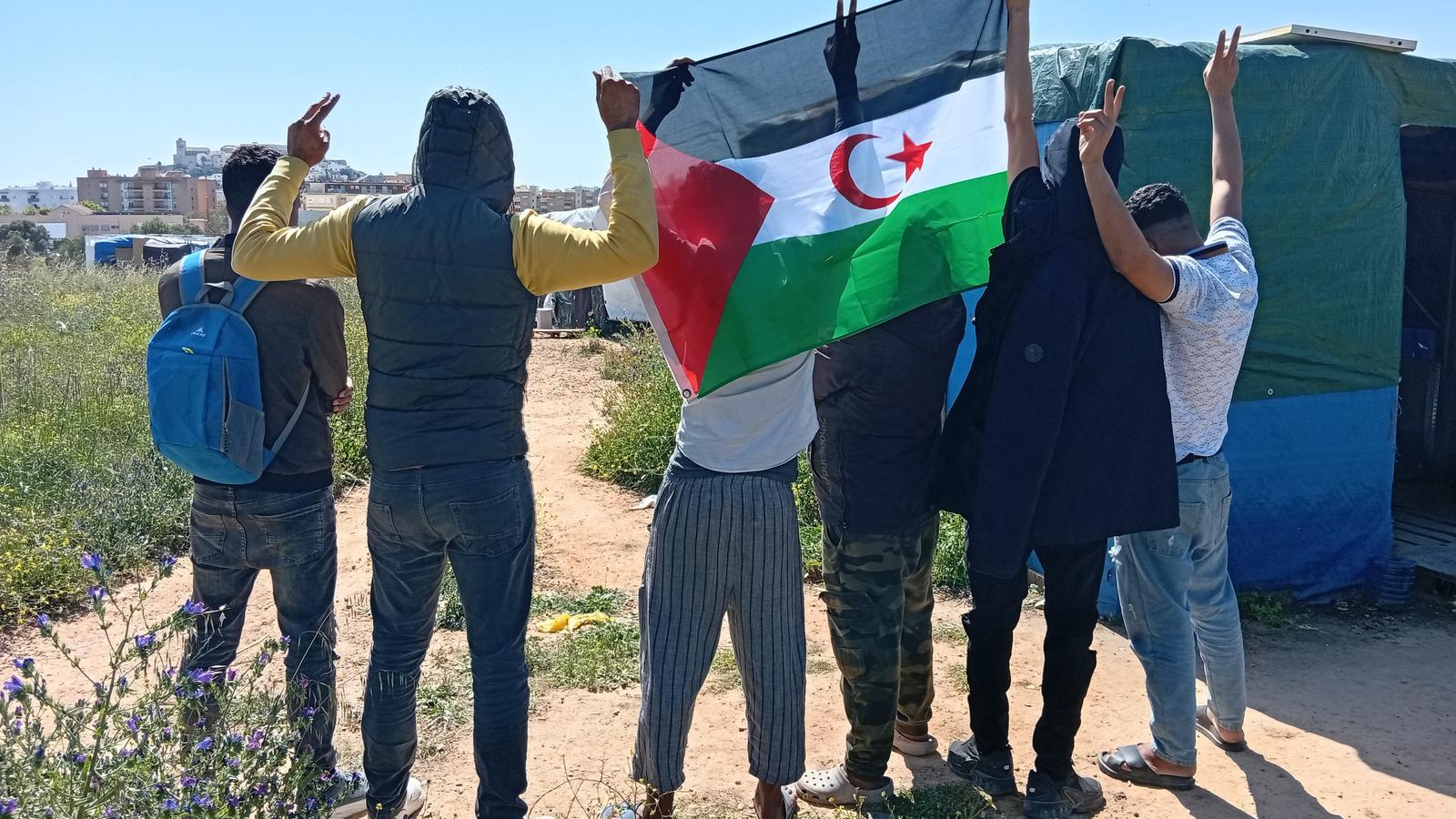
The occupants of La Joveria do not seem very impressed. “We have reached a point where we no longer care about anything,” assures Ahmed, one of the longest-resident inhabitants, who speaks excellent Spanish. “We don’t care if we die,” he says seriously. Quickly, a circle of about a dozen occupants has formed around Ahmed; they are all between 20 and 35 years old, all of Sahrawi origin. In fact, a good portion of the settlement’s 130 inhabitants (an estimate by the Eivissa City Council) come from the former Spanish colony. Unlike in other settlements, there are practically no families here; they are all men, almost all of them have jobs, and those who don’t have them in prospect. Ahmed works all year round “as a gardener, in construction, whatever he can find.” Another of the occupants, Ibrahim, shows us with his mobile phone the website of a construction company, as ‘material’ proof of his workplace; Haydan explains to us that he works “chauffeuring people” – he drives an Uber –; another claims to work in a hotel of the Palladium group...
La Joveria settlement has been much talked about in recent weeks, ahead of the imminent eviction; its occupants assure that the settlement is already four years old, and that, in summer, it has housed up to 400 people.
Forty substandard dwellings
Right now, La Joveria is made up of about forty sub-standard dwellings, shops with a more or less unstable appearance, made from various materials; remnants of awnings, mattresses, fabrics, conglomerates, plastics, pallets... From the outside, the appearance is always precarious, like a fairytale house that the wolf could blow down with a puff of air. When you go inside, you realize that perhaps you have made a perceptual error. In one of the tents, the floor is solidly constructed with pallets, and the interior, divided into different areas; separating the sleeping space from the cooking space. The walls stand straight, covered with fabrics that function as insulation. It's 12 noon; outside, the Ibizan sun has begun to signal that summer and the high season are approaching. Inside, the temperature feels like it drops a couple of degrees. A man is trying to rest in the sleeping area. In the kitchen, the blue gas flames flicker under a small tagine pot, which releases an excellent aroma. When you go to an irregular settlement, the last thing you expect is to get hungry.
Can Misses
La Joveria is only the first of the two evictions that the City Council has planned during this month of April; on the 29th, excavators will also enter the Can Misses settlement, next to the UE Ibiza football field, where it is estimated that about 80 people live. According to UGT sources, at least some are hotel workers.
Ibiza Town Hall wants to prevent the city from being surrounded by settlements and, above all, from large nuclei like Can Rova 2 being created, which last summer housed 300 people. “We cannot allow situations that involve undignified conditions and risks to people to consolidate,” the City Council states in a statement. “The City Council will act with firmness, but also with sensitivity, and will offer support to those in vulnerable situations.”
In the case of La Joveria, the inhabitants – much more cohesive than in other settlements, due to origin and age – do not seem willing to comply with the sentence. “What will happen on the 21st? I don’t know, we have nothing planned,” replies Ahmed. “No one is in this settlement by choice; if they kick us out, we’ll have to find another place to live, if we see an empty house, we’ll have to occupy it...; they treat us like we’re garbage,” he laments. During the conversation, Ahmed brings up the Spanish past of the Sahara several times, “the 53rd province.” “And now Spain treats us like criminals.”
It is difficult to enter and leave the village of La Joveria: the fences put up by the Town Hall block the way on one side; on the other, a tractor – or an excavator – has ‘plowed’ a wide strip of the land as deeply as possible, so that it is practically impossible to walk. But above the furrows, the repeated trampling of shoes has already traced a clearly visible path.
On the road, as he drives back home, a black van with the Uber logo speeds past me. I can easily imagine Haydan at the wheel, transporting the first tourists of the season to his villa with a pool.
