Jovellanos: from minister to prisoner in Bellver
225 years are completed since the arrival of the politician and writer to Mallorca, on April 18, 1801, where he was confined for seven years
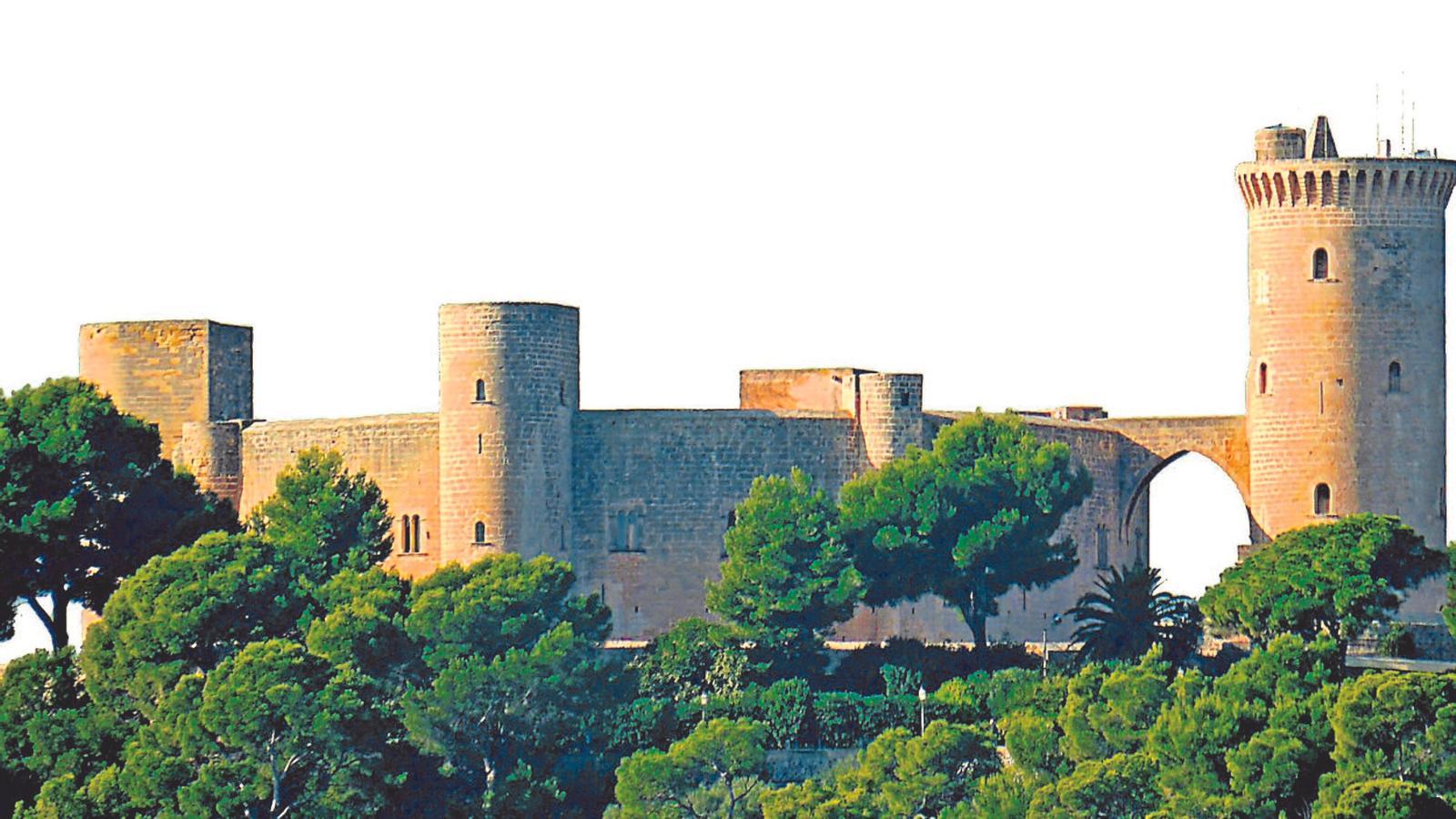

PalmaThose were hard times and one could jump from a ministry to prison. This is what happened to the Asturian Gaspar Melchor de Jovellanos (1744-1811), a politician, scholar, writer, and one of the most prominent figures of the State between the late 18th and early 19th centuries. Now 225 years ago, on April 18, 1801, Jovellanos arrived in a Mallorca that was not then a tourist destination, but a peripheral territory where people who wanted to disappear were sent, and where he was confined for seven years.
At that time, the apathetic Charles IV reigned in Spain, although power was in the hands of his favorite, Manuel de Godoy, about whom gossip claimed united him with Queen Maria Luisa in something more than a good friendship. These were times when the ideas of the Enlightenment, very daring, were somewhat successful, of which Jovellanos was a very prominent representative: reforms, economic and social improvements, education and culture, and even –that already sounded too daring–, people's participation in politics.

Godoy was also attracted to new ideas and in November 1797 he appointed Jovellanos Secretary of Grace and Justice, the equivalent of the current Minister of Justice: the Bolaños of today, indeed. He was not in office for even a year, although he remained within the monarchy's structure, as a State Councilor.
Why did he fall into disgrace? In theory, because in a translation of Rousseau's "Social Contract" – a subversive reading for the time – fervent praise was showered upon him, which was very suspicious. The truth, however, is that Queen Maria Luisa could not stand Jovellanos, nor the most significant enlightened thinkers, not even in paintings: she described him as a "rogue" and a "monster" in a letter to Godoy. The new head of Justice, José Antonio Caballero, was tasked with carrying out the punishment.
The former minister was arrested at his home in Gijón, where he had to suffer a painful humiliation, seeing his beloved library sealed. He was transferred to León and from there to Barcelona, then embarked for Mallorca, where he arrived 225 years ago, on April 18, 1801. He was initially confined to the Valldemossa charterhouse, which was still a convent – it had not yet been confiscated and sold – and later to Bellver Castle. By then he was approaching sixty years of age.
Catalan and sea baths
Jovellanos was hyperactive, as we would say now, and in those seven long years he did everything: he learned Catalan, he rescued and examined old documentation, he studied and translated Ramon Llull, he drafted a paper on the monuments of Palma and another on education, he made observations on flora, fauna and meteorology, he formed a literary salon that was a true center of the Enlightenment lights in that forgotten and peripheral territory and he did not stop reading and writing. This, when they allowed him, which was not always.
During the first stage of captivity, at the Carthusian monastery, it was relatively amiable, in coexistence with those monks, to whom he developed a true affection. He took care of the garden and the library, took notes on botany, took walks around the surroundings, and gave some money to the poor peasants of Valldemossa. One of the first things he did, as soon as he arrived, was to learn Catalan. An initiative, in those times of fierce centralism and monopoly of Spanish, truly unusual and meritorious. His was certainly a mild confinement. Too mild, in the eyes of his enemies. He was transferred on May 5, 1802, to a more rigorous prison: Bellver Castle.

In Bellver, following the minister's instructions, they subjected him to the greatest torture imaginable for someone like the Asturian: forbidding him to use paper, inkwell, pen, and pencil, in addition to subjecting him to close surveillance by Swiss soldiers in the service of the Spanish crown. Locked within the old walls, he thought he saw – he would later write – “a yellowish light, small, but very bright,” next to his bed. They were fireflies. Or perhaps it was hope?
His health suffered: intestinal illnesses and, above all, vision problems. His terror was going blind. The doctors prescribed that sea baths would be good for him, which were finally authorized. He even rented a small house, where he sometimes stayed overnight. His praises for Cala Major beach are worthy of appearing in a tourist promotion brochure: “Clean waters,” “comfort,” “salubrity of its heights,” “sweet rest”...

From mid-1804 and during the time he still remained in Mallorca, Jovellanos's situation improved significantly. He was able to occupy up to three rooms in the castle and had them furnished and decorated, making them more welcoming. The Swiss captain Luis Kenel painted the walls with exotic landscapes, not forgetting to draw a cat, to entertain Picolín, the dog who became the best friend of the illustrious prisoner.
'Can Jovellanos', in Bellver, became a meeting and discussion place, the epicenter of the small Majorcan Enlightenment, in which women also participated, such as the governor's wife. Some of those gatherings were somewhat festive and Jovellanos played the guitar – yes, he also played the guitar – and among the food, of course, there were ensaïmadas.
It seems that Jovellanos also received some very curious visits. One would have been from his friend Posada – 'Posidonio' in a letter addressed to him – who would have snuck into Bellver disguised as a friar: it appears that this is an effective attire; look, if not, at the false priest in the Bárcenas case. Another: that of a supposed ambassador from Tunis, 'Sidi Abderrhaman', who wished to obtain one of the canaries that the confined man bred in Bellver.
Environmentalist and defender of heritage
In Mallorca, Jovellanos became a true pioneer of environmentalism and the defense of historical heritage. Two concepts that we now have quite internalized – well, some perhaps not – but by no means at that time, when it seemed that everything had to be sacrificed for progress. He lamented the fierce felling of the Bellver forest, apparently on the initiative of a corrupt governor who profited from it: “God has wanted to reserve me to be a witness to this desolation”.
Good proof of his interest in Mallorca's historical heritage was the study dedicated to the Cathedral, the Llotja, the convents of Sant Francesc and Sant Domingo – the latter, disappeared – and Bellver itself. All Gothic buildings: Jovellanos was decisive in 'valuing', as it is said now, that style that the Enlightenment disdained. He himself had referred in the past to this technique as “bàrbara”. But he changed his mind.
Even more, the enlightened Jovellanos became a precursor of what was to come: Romanticism, with its vindication of the past and especially of the Middle Ages. In his writings he fantasized about enchanted castles, about knights, giants and necromancers. He also referred to the witch Joana from Bellver cave. More or less, the same can be said of his ideological evolution: as Aranguren observes, the enlightened man, but not a democrat, who arrived in Mallorca left having achieved the status of a citizen.

Jovellanos accepted the challenge launched by the enlightened institution Societat Mallorquina d’Amics del País: to draft a proposal for what was to be an educational center for the local nobility. It is clear that his project envisaged teaching not only for nobles, but for everyone, including women. And that it should be taught in the native language, that is, in Catalan. Over time, his notes would serve as the basis for the future Institut Balear de Palma, the current Institut Ramon Llull.
In March 1808, with the Mutiny of Aranjuez, the hated Godoy fell, and with him Charles IV fell. The new king, Ferdinand VII, had no time to order him to be released. For Jovellanos, however, that was not enough. The liberation was as arbitrary as the captivity had been. He wanted his innocence to be recognized. But he had to resign himself. Ferdinand VII was already showing signs of the nefarious monarch he would later be.
Now Jovellanos could do what everyone does when they come to Mallorca: he stayed for another month, returned to Valldemossa to reunite with his beloved friars, and took some good tours of the island. It wasn't until May 19th that he set sail for Barcelona.
Meanwhile, things went from bad to worse: Napoleon's troops had occupied the Peninsula and that same month the Peninsular War had broken out. Jovellanos refused the ministry offered to him by the new monarch, Joseph Bonaparte, and preferred to join the resistance, as a member of the Central Junta, a kind of provisional government. He died three years later, leaving behind the memory of an upright man and, in Mallorca, that of a person who loved the island's culture: a building on the campus of the University of the Balearic Islands currently bears his name.
There was, at least, an attempt to free Jovellanos from that unwanted stay in paradise. Sureda i Blanes recounts how the Countess of Montijo, a loyal friend of the enlightened man, participated in a conspiracy to free him. To this end, the collaboration of the mythical British admiral Nelson was sought, who was then sailing the Mediterranean with his ships, and with a common connection to Jovellanos: the Majorcan cardinal Despuig. The politician and Hispanist Lord Holland wrote to Nelson to convey the proposal.However, this was in 1805, and at that time the United Kingdom was an enemy of Spain, while it was an ally of Napoleonic France: only a few months later, the French and Spanish navies would be jointly defeated by the same Nelson at the Battle of Trafalgar. The admiral then replied that, while he regretted the fate of Jovellanos, whom he described as an "erudite and good man," that operation could even be counterproductive: he could be executed as a traitor. It seems that, before undertaking a risky initiative, he considered the consequences; unlike many very powerful people today. And I'm not pointing fingers.
Information elaborated from texts by Josep Sureda i Blanes, Carlos Martínez Shaw, Gaspar Sabater, Francesca Tugores, Antoni J. Colom Cañellas i Bernat Sureda Garcia, José Luis López Aranguren, Miquel dels Sants Oliver i Miquel Ferrà i Martorell.
