
The concept of pacifism was born in the 19th century amidst a world ravaged by wars. In 1843, London hosted the first international peace congress. Soon, pacifist feminism would also emerge. It was founded in 1868 by a group of women from Geneva (Switzerland). For many activists of the time, pacifism was consubstantial with 'maternal nature'. One of the great figures of the movement was the Austrian writer Bertha von Suttner. In 1889, she published the novel Lay Down Your Arms!, for which in 1905 she would receive the Nobel Peace Prize, the first awarded to a woman.Feminist peace societies made their voices heard at the First Hague Peace Conference, held in 1899. Their mobilizations continued with greater force in 1914 with the outbreak of World War I. In 1915, more than a thousand women from twelve countries gathered in The Hague to found the Women's International League for Peace and Freedom (WILFP). The organization had an enormous influence on the political leaders of the time. Its first president, the American Jane Adams, was received by the President of the United States, Thomas Woodrow Wilson. In January 1918, almost a year before the end of the conflict, Wilson presented the 'Fourteen Points' to the US Congress, which, according to him, should govern a just, stable, and lasting peace in post-war Europe. Nine of the fourteen points were inspired by Adams.Although that roadmap did not manage to prevent World War II (1939-1945), it did serve to change international policy by advocating for the right of peoples to self-determination and the need to create an organization to oversee world peace – this aspiration would be realized in 1919 with the League of Nations and in 1945 with the UN. In 1919, Wilson received the Nobel Peace Prize. In 1931, it was awarded to the president of WILFP (the second woman to receive it), and in 1946, to her successor, the economist Emily Greene, also American.In 1981, still in the midst of the Cold War, thousands of British women of all ages and backgrounds participated in one of the longest struggles in recent European antimilitarism history. For 19 years, concerned about their children's future, they mobilized against NATO's decision to install nuclear missiles at the Greenham Common base, near Cardiff (Wales). They did so peacefully and imaginatively, through human chains, encampments, and festive events. During the government of conservative Margaret Thatcher, they were accused of being 'bad mothers and wives,' 'terrorists,' and 'witches.' Hundreds were arrested and went to prison. Others died during the protests. In 1991, as a result of treaties between the US and the USSR, the last missiles left the British base. However, the mobilizations continued until 2000. In 2002, a memorial was erected in the area in honor of a feminist revolt that awakened consciences about the warmongering drift of states.
The women's 'no to war'
From the 19th century, amidst a state of permanent war, in the Balearic Islands mothers, sisters and wives did not stop mobilizing to prevent their relatives from leaving to die through the conscription system of the quintas

-
CAT -
CAST -
DE
PalmaWomen have played a key role in the history of antimilitarism. When men were obliged to go to war, mothers, wives, and sisters did not hesitate to mobilize to save their loved ones from certain death. It was during the Modern Age (15th-18th centuries) that the armies of European states became permanent and increasingly large. At that time, the Hispanic monarchy, following what was done in the rest of the continent, had three ways of supplying its troops: with mercenaries (professionals who fought in exchange for pay), with forced levies (generally from marginalized people, prisoners, and vagrants), and with the quintas.
The system of mercenary volunteers would eventually be discarded, as it represented a great expense for the public treasury. The State preferred to bet on the quintas, in which the recruit was chosen by a lottery of one out of every five men –hence its name. During the central decades of the 19th century, service lasted eight years (four active and four in reserve). Initially, those eligible for the lottery were single men between 18 and 25 years old. However, if many soldiers were needed, the range was extended to widowers and married men, up to 45 years old. These levies represented a tragedy for those affected, who were aware that they had a high chance of dying on the battlefield or from diseases contracted in often quite distant destinations (malaria, cholera, malaria...).
Quite revealing is a popular saying from the time: “Fifth son and drawn, dead son and not buried”. Families were not only emotionally affected, but also economically, as they lost an important workforce in times of great famine. The conscription system was totally unfair. As historian Catalina Martorell Fullana explains: “They constituted a blood tribute for the poor and a monetary tribute for the rich. These had the option of freeing themselves from service by paying another young man to replace them or by handing over the so-called cash redemption to the State. Thus, those who ended up fighting for the interests of the powerful were the popular classes”.

‘Against the theft of children’
In 1770, the Bourbon Charles III decreed that the conscriptions should be annual and not sporadic –Catalonia, Navarre, and the Basque Country were excluded. Compulsory military service (the well-known ‘mili’) was thus instituted, although the wealthy continued to have many facilities to avoid it. “To evade the fateful draw –Martorell points out–, some opted to emigrate, others self-harmed or pretended to be the son of a widow or to have a father over sixty years old, which were the exceptions provided for by the rule.”
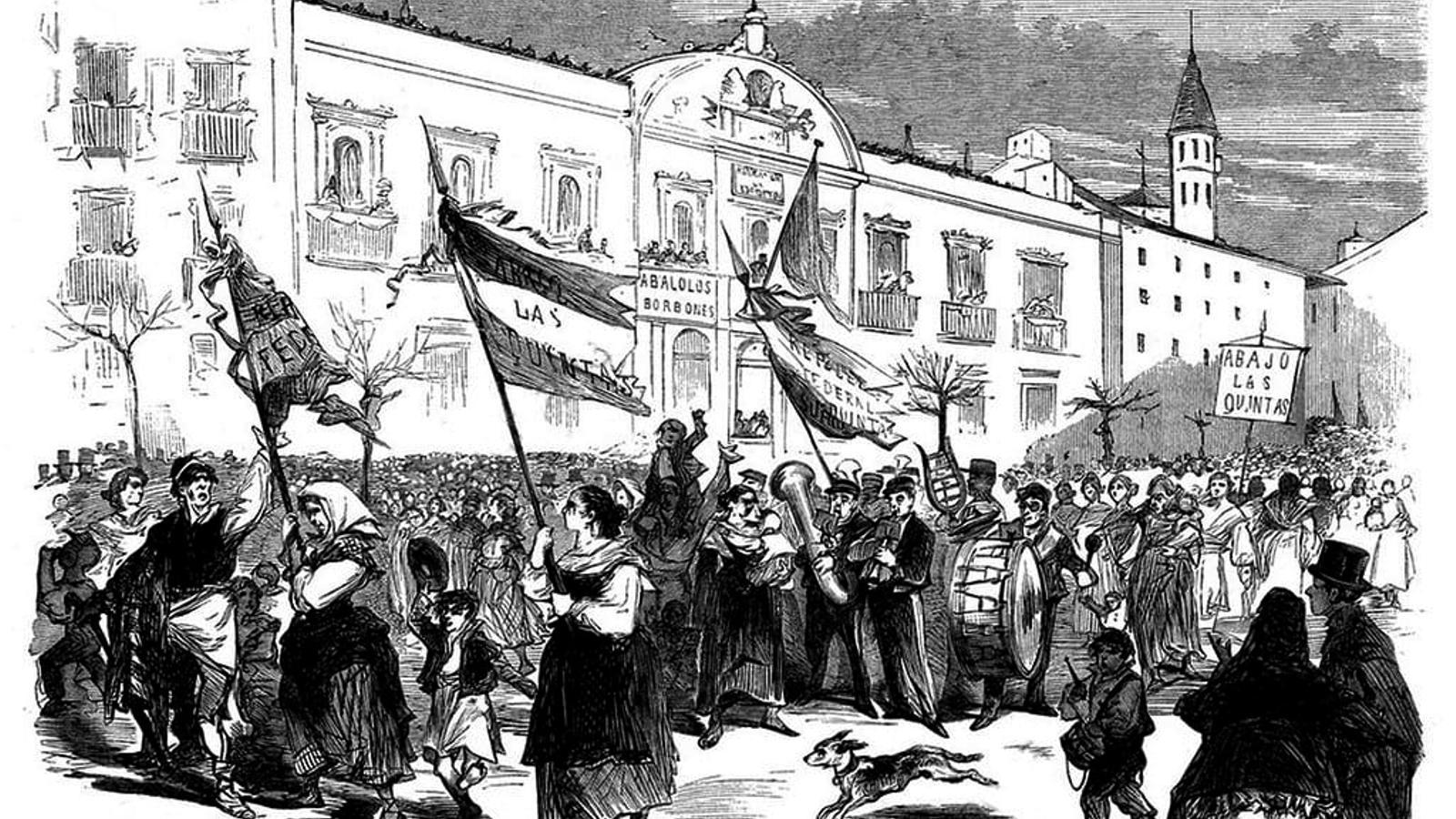
Anti-militarism gained strength particularly during the Democratic Sexennium (1868-1874). “The abolition of conscriptions –the historian states– had been one of the slogans of the Glorious Revolution which in 1868 caused the dethronement of Queen Isabella II. The new political class, however, was unable to fulfill that promise in the face of the open wars that existed, such as the one in Cuba, the Carlist war, and the cantonal uprisings in 1873. The First Republic itself (1873-1974) could do nothing about it either.” On April 3, 1870, a large demonstration against conscriptions, called by the Federal Center of Workers' Societies, took place throughout the State. “In Palma, the mobilization was very numerous, with people arriving from the Part Forana. At the forefront were the seamstresses of the guild La Virtud Social. Within the labor movement, women were more aware of the tragedy that the levies represented. They could no longer bear the pain of seeing their husbands, brothers, and sons leave to die while they remained working for miserable wages, earning half of what their male colleagues did. They displayed banners with slogans such as ‘Against the theft of sons’.” Throughout the Democratic Sexennium, there would be more marches like that one, which were also supported in many towns in Mallorca and Menorca.
Tragic Week
With the approval of the Constitution of 1876, compulsory military service would already be extended to the entire State. From 1895 onwards, a large number of men would be drafted to suppress the independence insurrections in Cuba, Puerto Rico, and the Philippines. At the beginning of the 20th century, Spain decided to compensate for the loss of those overseas colonies with a greater presence on the African continent. In 1909, the Rif War, also known as the Morocco War, broke out near Melilla. At that time, Antoni Maura from Palma, of the conservative party, was occupying the presidency of the Spanish government for the second time. His intention was to send 40,000 men to fight there, mainly Catalans. That call was seen as a vendetta by the Majorcan politician against the rise of Catalan political nationalism.
On July 26, 1909, the workers' forces called a general strike throughout Catalonia with the cry of "All or None" as a denunciation of the privileges that wealthy families had in not performing their military service. Maura immediately decreed a state of war. In Barcelona, the events triggered the well-known Tragic Week, which lasted until August 2. The repression left nearly eighty dead and hundreds injured. There were also about 2,000 prosecuted and five executions, including that of the anarchist pedagogue Francesc Ferrer i Guàrdia, accused of being 'the leader of the rebellion'. His death originated a large international protest campaign that led to the fall of Maura's government and the rise of the liberals to power.
In 1912, three years after the Tragic Week, King Alfonso XIII already abolished the exemptions from conscription for the wealthy classes. However, given the impossibility of economically maintaining soldiers for three years in barracks, the 'quotas' formula was implemented. It was an option that allowed for a shortened stay depending on the money each recruit contributed to the State's coffers. Popular indignation, therefore, continued. "In February 1914 – states Martorell – the women of Capdepera led a signature collection to prevent their men from being recruited again to go to the war in Morocco [the conflict would last until 1927]. About 1,300 signatures were obtained in a town that then had about 3,000 inhabitants". During the First World War (1914-1918) the pacifist discourse was championed mainly by Menorca, the island where anarchism took root the most.
Maria Mayol
With the Second Republic (1931-1936) the antimilitarist movement revived again. The general elections of November 1933 were the first in which women could vote in Spain after the right to female suffrage had been approved in 1931, on the initiative of Clara Campoamor. Maria Mayol from Sóller, 50 years old, was close to winning the seat for Esquerra Republicana Balear. During the electoral campaign, amidst the pre-war climate that prevailed throughout Europe, she asked for women's votes by appealing to their pacifist spirit: “I would like women who know how to inspire peace within the family to know how to inspire it in the street, and that with their conduct they would point out the other path of fraternity that they know how to instill among their children. On this collaboration of yours, women, it largely depends on this quietness being re-established within the great Spanish home, because your hands are hands that appease anger, they are hands that calm and instill gentleness”.
During the Civil War (1936-1939) forced mobilizations of soldiers were continuous on both sides. Initially, only volunteers and 21-year-old youths who were doing their military service went to the front (that was the age stipulated at the time). In April 1938, however, the recruits would be even younger. Among the Republican ranks, they formed the famous 'baby bottle cohort' – some had not yet turned 18. The name was coined by Frederica Montseny, the first female minister of Spain, at the head of the health and social assistance area (1936-1937). Seeing them march, she exclaimed: “Seventeen years old? But they must still be drinking from a bottle!”.

With the restoration of democracy, the drawing of 'quintos' would be recovered through the contingent surplus by which some young people were saved from 'mili'. However, that did not serve to mitigate the anti-militarism led by conscientious objectors and draft dodgers. Very soon that movement became of interest to the female collective again. This is explained by Joan Mas Collet, from Montuïr, 52 years old, former deputy of MÉS. At the beginning of the 90s he was the first draft dodger from the Part Forana. "Upon learning of my case, many mothers asked me for information to prevent their sons from being called up. With my car, I accompanied about twenty of them to Palma to submit the papers for the Substitute Social Service. They were scared by the news coming out about physical violence and drugs in the barracks. Furthermore, they didn't want their sons to stop working for nine months to waste their time." In 2001, after 231 years of existence, José María Aznar's PP government abolished 'mili'.
