From the Menys Turisme manual to police abuses: chronicle of a failed attempt to criminalize protest
The arrests of two activists have turned a case for some graffiti into a political, legal, and social debate about the limits of police investigation and protest against touristification

-
CAT -
CAST -
DE
PalmaIf last week it seemed that part of public opinion had turned its back on the Menys Turisme, Més Vida platform after it published the manual encouraging direct action to protest against tourist overcrowding, the events of recent days have caused a plot twist.
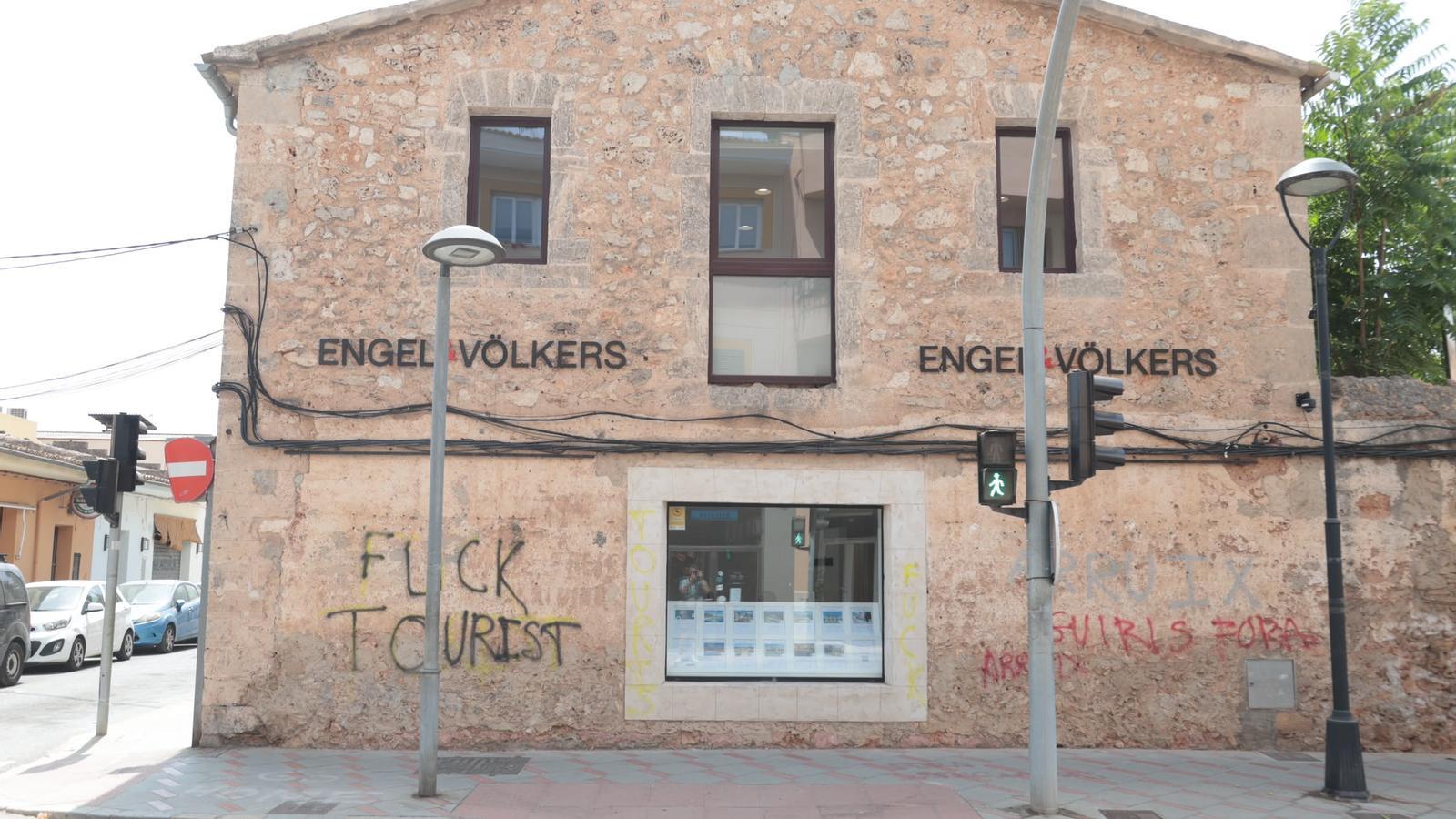
And the situation has not changed because the island society now finds it acceptable to paint real estate agencies while hooded, but rather because if the direct action of Menys Turisme was on the verge of what is acceptable to the majority of society, the response of the Civil Guard, which handcuffed and arrested two young women for some graffiti, has provoked citizen indignation. Right now, many consider that the 'benemérita' has crossed the limits of what a state of law understands as democratic guarantees.
Thus, the investigation into the graffiti against five real estate agencies in Santa Maria del Camí no longer revolves solely around alleged property damage offenses. The arrests of two young activists, the operation deployed by the Civil Guard, the content of the police report, and the public profile the case has acquired have opened a debate that goes far beyond the investigated facts: the proportionality of the police response, the limits of the investigation into social movements, and the possible criminalization of the protest against touristification.

The context in which the arrests have occurred has also contributed to fueling the debate. Just a week earlier, the platform Menys Turisme, Més Vida had published a manual of direct action with recommendations for participating in mobilizations against tourist overcrowding, while the Government delegate in the Balearic Islands, Alfonso Rodríguez, warned that the State's bodies and forces would investigate and prosecute actions against tourist businesses. The arrests have also come a few days before the demonstration called for July 26th under the slogan ‘Mallorca at its limit’, the third major protest against the tourist model in just over a year.
A report that points beyond the graffiti
The report prepared by the Civil Guard, over 116 pages long, dedicates a significant part to reconstructing the alleged graffiti against five real estate agencies in Santa Maria, but also to contextualizing them within the anti-touristification movement. The two young women are being investigated for alleged crimes of continuous damage, damage to historical heritage —because one of the graffiti was made on a Site of Cultural Interest (BIC)— and membership in a criminal group.
The investigation includes personal surveillance, monitoring, photographs, social media tracking, analysis of relationships between the two investigated individuals, and mobile phone interception after their arrests. It also dedicates several pages to describing the organization of Menys Turisme, Més Vida and Arran Mallorca, presented as the main structures of the anti-touristification movement.
Among the elements that have generated the most controversy is the use of ideological indicators. The report highlights, for example, that a banner with the slogan ‘SOS Residents. STOP Overtourism’ was hanging in the home of one of the young women, and goes so far as to state that this fact “confirms without any doubt their criminal activity.” Based on this identification, investigators tracked their social networks to locate a second young woman, on whom they also carried out surveillance to confirm her identity.
The Civil Guard also maintains that the acts were committed by at least three people and identifies a third suspect, who is currently abroad. Among the evidence it incorporates is the presence, around the real estate agencies, of a vehicle owned by the mother of this young man.
Another focus of the investigation is the direct action manual published by Menys Turisme, Més Vida. According to investigators, the recommendations it contains — such as covering one's face and tattoos and selecting certain targets — coincide with the modus operandi of the people who made the graffiti. The platform, however, rejects this conclusion and recalls that the document was published after the investigated events.
“It is impossible for there to be any pattern or link between prior acts and the publication of the manual. What is sought is to create false links to criminalize and repress unfairly,” maintains the group's spokesperson, Pere Joan Femenia. In his opinion, the mobilizations against touristification “have inconvenienced political and economic sectors” and attempts to link them to criminal conduct are not new. He recalls, in this regard, that during the demonstration of 2025 and also after the protest at El Trenc this summer, an attempt was made, according to him, to divert the focus towards graffiti unrelated to the calls.
In this regard, for Menys Turisme, Més Vida the strategy was to criminalize the protest against the movement that questions the tourism model. Along similar lines, the GOB has argued that the institutional response to social unrest "should not be fear, intimidation and repression," while APAEMA has described the police deployment as "hardly justifiable" and warned of the risk that actions of this type generate a deterrent effect on citizen participation.
The legal and media battle
The lawyer representing the detainees, Josep de Luis, also questions the dimension the case has acquired, while avoiding delving into the substance of the investigation for now. He recalls that the Civil Guard does not need judicial authorization to make an arrest, but any action must respect the principle of proportionality. "When all this is over, we will see if this proportionality existed or not," he explains.
The defense insists that its strategy involves exclusively the courts and not public debate. "Right now, our fight is within the courts, not in the streets," he assures. For this reason, he believes that the case's media attention did not originate from the investigated parties. "The ones who have generated this media war are not the detainees," he states. The lawyer also reveals that if the father of one of the young women had not contacted him and the defense had been left solely in the hands of the court-appointed lawyer who was initially assisting them, "today we would surely have a conviction." According to him, the first lawyer recommended they reach an agreement.
The lawyer also maintains that the communication management of the operation does not align with the usual way the Civil Guard works, as he believes the corps does not typically produce these types of reports, a fact he considers more characteristic of the National Police's Intelligence service. "The report really bothered me, because the reports are usually well-done, they limit themselves to documenting the facts and do not enter into assessments or establish any kind of connections," he comments. When asked about the leak of the report, which almost all media outlets had within minutes, he simply replies: "Whoever managed all this was not here during José Ramón Bauzá's time, because they would know that fires are not put out with gasoline," he states.
The protection of heritage as an argument
To understand and place events, it is often necessary to compare them with similar ones. If the greatest crime these young people have allegedly committed is damage to heritage, specifically to a BIC (Asset of Cultural Interest), it is necessary to review what the recent actions in these cases have been. After consulting various sources, there is no record of any recent public precedent in the Balearic Islands where graffiti on a BIC has led to police action of this magnitude: arrests at homes, confiscation of mobile phones, an investigation incorporating personal surveillance, and the accusation of belonging to a criminal group.
One of the most recent precedents that also shares a political connotation is the case of the graffiti ‘Arruix sionistes’ on the facade of Ca n’Oleo, also a BIC, and, moreover, one of the most emblematic headquarters of the Government. Despite everything, the proceedings ended up being archived a few days later. In the case against the tower in the gardens of Nazareth in March 2026, there was a trial, but the investigated person was summoned to testify, not arrested at home, nor were there police surveillance, nor confiscation of electronic devices, nor accusations of belonging to a criminal group.
Clearly, these differences have entered public debate and raise a question: whether the criterion applied in Santa Maria responds exclusively to the protection of heritage or if other elements linked to the socio-political context in which the events occurred converge.
In this regard, sources from the Heritage Department of the Consell de Mallorca recall that the historic center of Palma is declared a BIC. This implies that any graffiti made within this area constitutes, potentially, damage to a BIC. The same sources point out that administrations usually have numerous reports for this type of action and that the police forces have tools to identify the perpetrators, such as signature catalogs and recordings from the surveillance cameras in the historic center. However, it is not common for these investigations to acquire a public dimension comparable to that of the Santa Maria case.
Likewise, consider that the classification of a crime against historical heritage is not, in itself, an exceptional element. Remember that any graffiti on a property included within a historical complex declared BIC can fit within this criminal classification and points out that, if the criterion applied in this case were extended homogeneously, thousands of graffiti that appear every year in the center of Palma would have to be the subject of similar investigations.
Despite everything, the case remains under judicial investigation and the two young women are on provisional release. It will be the criminal procedure that will have to determine whether the evidence collected by the Guardia Civil supports the accusations made. However, the case has already gone beyond the strictly judicial sphere. The more than one hundred pages of the report, the weight acquired by ideological links with the movement against touristification, the temporal coincidence with the call for July 26 and the scope of the operation have turned an investigation for graffiti into a debate about the limits of social protest, the State's response to citizen movements and the proportionality of the tools used to prosecute certain crimes.
