The crickets of the Civil Guard in Santa Maria: Protect the BIC or persecute the message?
The debate is not whether a graffiti is admissible —it is not—, but whether the State's forcefulness can vary depending on the political context of who makes it

-
CAT -
CAST -
DE
PalmaThe historic center of Palma is a Property of Cultural Interest (BIC). Entirely. And in addition to the smell of urine left by many quality tourists, who are often seen urinating in alleyways, there are specific and harmful actions against heritage. Hundreds. Among them, systematic graffiti. In some places, like the convent of Santa Magdalena, there are even signs reminding of its BIC status and encouraging people to behave and not continue painting there. It is truly important that the population understands that heritage must be respected.
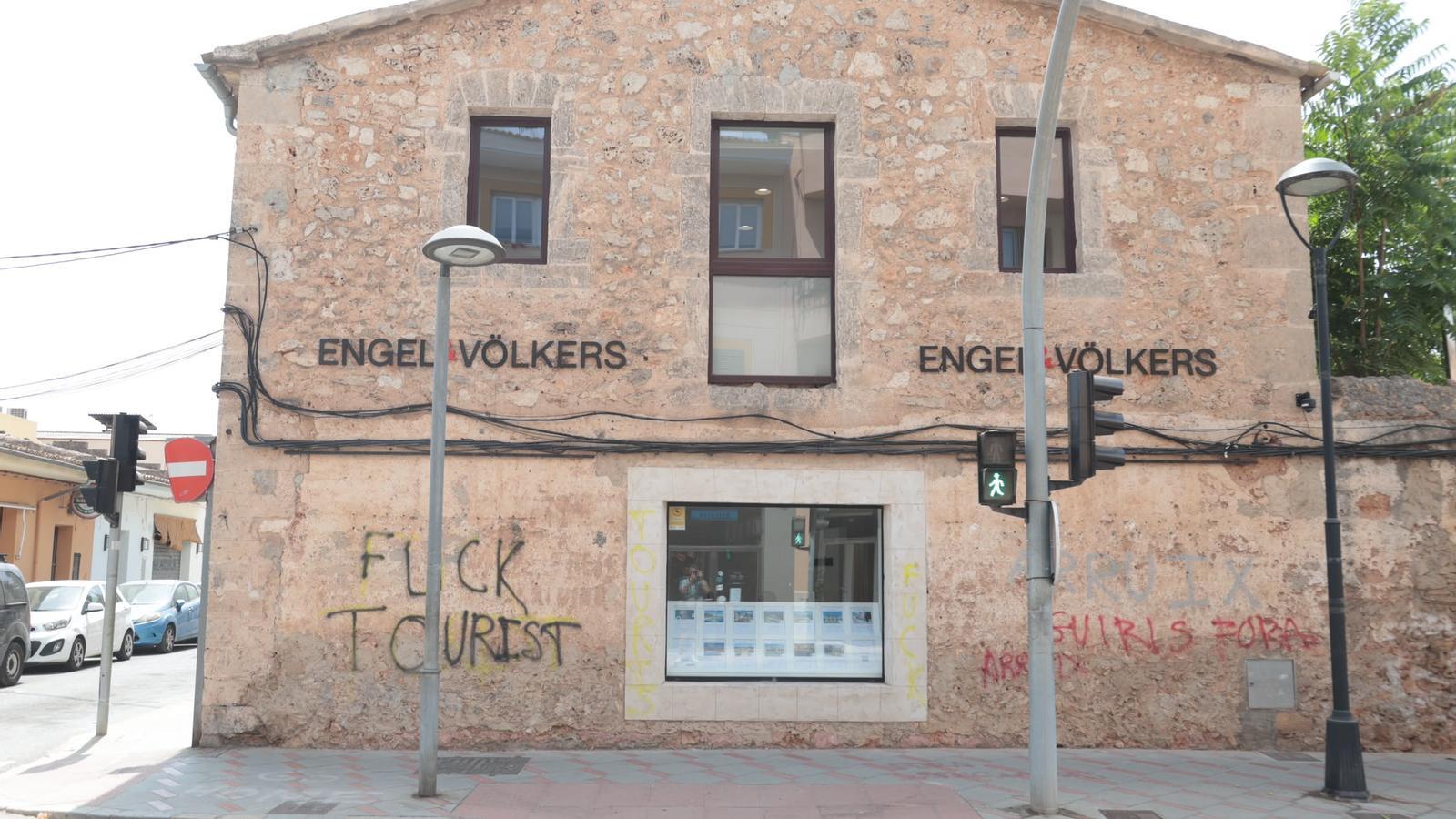
Surely with this purpose, that of preserving heritage declared BIC, the Civil Guard has carried out the largest deployment in the Balearic Islands in Santa Maria due to the complaint of a private individual whose wall has been painted. It cannot, in any case, be defended that anyone paints a neighbor's wall, whether it is BIC or not.
Then, is the action of the Civil Guard questionable in the case of the two women arrested last Wednesday in Santa Maria?
To answer this question, there is nothing better than to look at what has happened so far. For example, in the case of the recurrent graffiti on BIC buildings in the center of Palma. According to municipal data specifically for the historic center, the City Council announced an operation to remove nearly a thousand graffiti from 331 properties, 46 of which were listed buildings. The Local Police, and it must be recognized that since the arrival of Mayor Jaime Martínez it has been a priority, has investigated and even profiled the authors. It is appreciated that the perpetrators, who systematically damage public property, are being investigated, as the Palma Local Police have done. And it is done. Without the same level of pointing out, persecution, or handcuffing.
Some do it recurrently, and for that reason, the police generate files, identify them, and follow them. Because they are repeat offenders, in some cases. And, on the other hand, it is not recorded that at any time they have been considered part of a criminal group, as the Civil Guard has done with two young women who allegedly painted or participated in graffiti on real estate in Santa Maria.
9,282 graffiti in Palma
It is clear that it is a problem. Because also according to data from the Palma City Council, in 2025 Emaya removed 9,282 graffiti in Palma on facades, urban furniture and public roads. So, what is the reason for treating two young women as members of a criminal group, handcuffing them and singling them out as had never been done before, when thousands of graffiti are made annually, hundreds of which are on BIC? And many, by repeat offenders. Why are some simple offenders and the two young women considered criminals?
The Civil Guard has the answer in its report. These young women are connected to a movement that is apparently now also criminal, that of Less tourism and more Life, which is considered practically terrorist by some groups for having committed the naivety and, without a doubt, the reprehensible action of republishing a manual older than the hills on non-violent actions.
Has it ever happened that graffiti on a BIC (Asset of Cultural Interest) has had a political or ideological component? Again, recent history helps us understand. In December 2024, a graffiti appeared at Can Oleo (BIC) with a clearly ideologized slogan: 'Down with Zionists'. The Palma City Council opened a sanctioning procedure against the promoter of the concentration, but later the procedure ended up being archived after the appeal presented. The debate is not whether graffiti on a protected building should be tolerated — obviously not — but whether the criterion applied is coherent in all cases and whether the institutional response also depends in reality on the political context of the moment.
Criminal group
There is no recent public precedent in the Balearic Islands where graffiti on a BIC (Property of Cultural Interest) has resulted in an action of this magnitude: arrests, confiscation of mobile phones, accusation of belonging to a criminal group, and significant public projection of the case. With a staging of the persecution and qualifiers of organized crime.
The question is very evident. What does the Civil Guard want to protect? Because if it is heritage, it turns out that in other cases the shackles do not appear. Nor is it recalled that when someone enlarged the hole in the main facade of the listed building of Santa Maria that now occupies us to put a display of luxury homes there, there was any arrest. Perhaps it was even done with a license. It is known that the Santa Maria City Council does not stand out for its rigor in territorial matters —villa development—, and, therefore, perhaps the heritage part is also a bit weak.
If during the years of rampant corruption, as much camera surveillance and nocturnal tracking had been dedicated to the true actors of urbanistic 'pilotadas' (schemes), today we would not have the panorama of territorial destruction that surrounds us. In fact, it was the tapping of a few phones by, precisely, the Civil Guard and the conversations between Eugenio Hidalgo and his collaborators that formed the script of the film of the destruction of the coastline in the Andratx case in exchange for favors, commissions, and all sorts of irregularities. Or the case of the Manacor road, archived due to delays in justice, in which officials and UM party members even stole construction materials to build villas for themselves. Here, for whatever reason, there was neither time nor, for whatever reason also, budget to track those who pocketed public money. Today, the people of Mallorca are still paying the bill for that indecent overcost.
No one has the right to paint someone else's property to express a protest. But a mature democracy cannot allow the State's assertiveness to depend on the message behind graffiti. If heritage is the excuse, protection must be the same for everyone. And if the problem is the political message, then we are no longer just talking about preserving stones, but about how we manage social conflict. The only appreciable difference is that, in this case, a criticism of the economic and tourism model of the Balearic Islands looms over us. A predatory model that, moreover, generates a lot of frustration among young people. Because they see that any opportunity to have decent housing disappears, while those who deal in the houses and apartments that should be for them become millionaires. Does anyone have the right to paint a wall for this reason? Of course not. Should the facts be investigated? Of course. But if public authorities only respond with repression to criticism because they are incapable of offering a future to young people, we are in trouble.

