"I have fallen in love with their house": the real estate scam of the notes flooding Palma's mailboxes
The messages, apparently personal and handwritten, hide a recruitment strategy of a company seeking homes for large estates, foreign buyers, and investment funds

-
CAT -
CAST -
GER
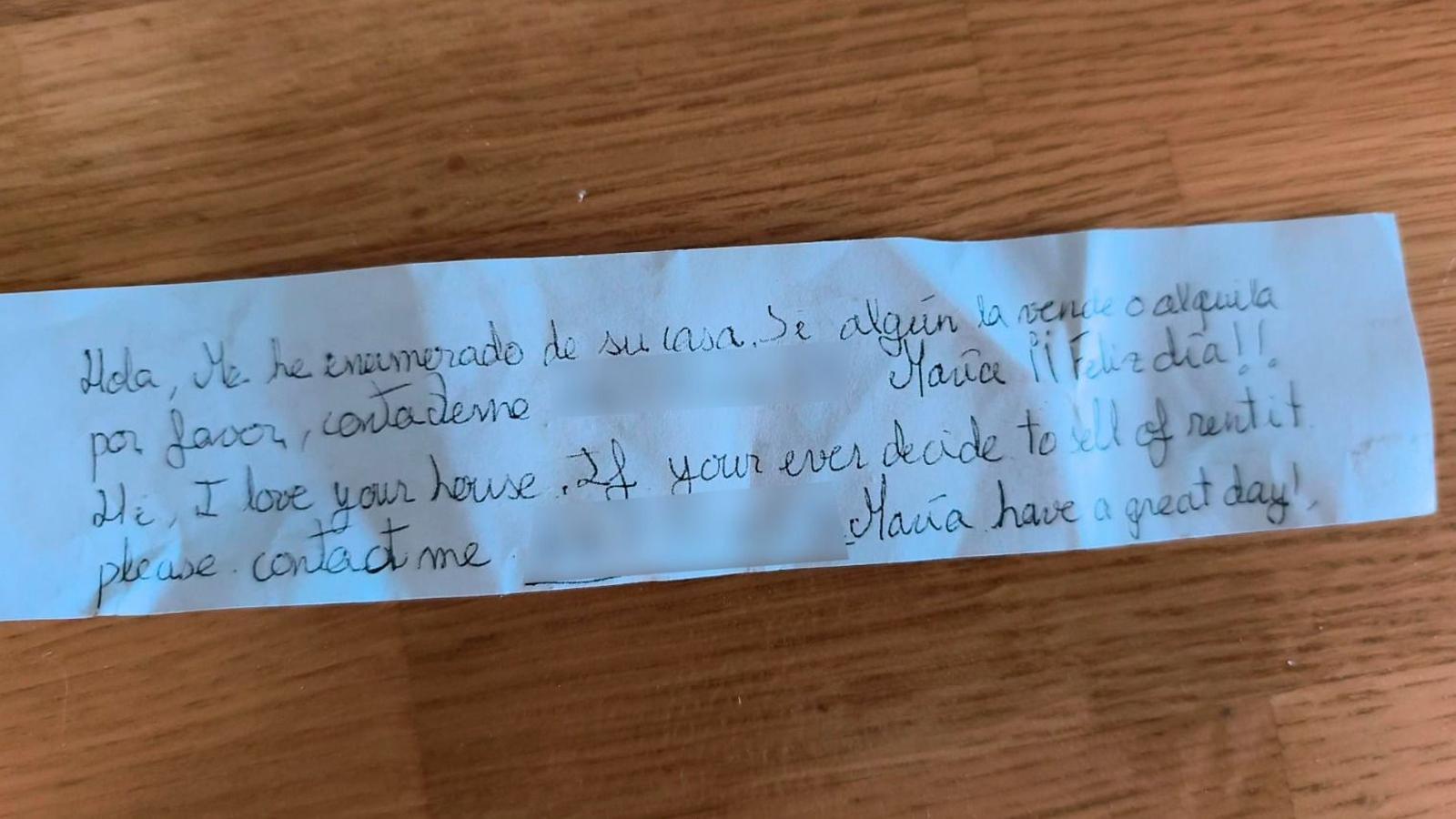
Palma"Hello, I have fallen in love with your home. If one day you decide to sell or rent it, please contact me. Have a good day!". There is no logo. Nor the name of a company. Nor a business card. Just a small piece of paper, apparently handwritten, with this message, a name (María) and a phone number. These days, the note has appeared in the mailboxes of several homes in El Molinar, one of Palma's most sought-after neighborhoods. Everything suggests that whoever left it is a person who has fallen in love with a specific house and is trying their luck in case the owner decides to sell it one day. But a simple phone call reveals a very different reality.

L'ARA Balears posed as an owner interested in selling their home and contacted the person who had left the note. During the conversation, the woman explains that she works for a company specializing in real estate brokerage and investment management that seeks homes on behalf of different clients. According to her, among these are individuals with high economic capacity – "like footballers and bankers" – and real estate and IT investment funds, among others.
On the hunt
In this case, he explains, the search responds to the request of a man residing on the Peninsula who has a boat moored in the area and wants to buy a house in El Molinar to spend time there with his family. But he makes it clear that this is just one of the profiles they work with. "We have clients of all kinds, and many are foreigners," he states.
His job consists of touring neighborhoods where there are practically no homes available (a good part of Palma) and identifying those properties that can fit the needs of his clients. When he finds a house he considers interesting, he leaves a note in the mailbox with the hope that the owner will contact him if he ever decides to sell or rent it. When this happens, he explains, they visit the property, assess its condition, and appraise it to determine its market value. "If you don't know what price to put on it, we'll value it for you," he summarizes during the conversation. From here, if the owner is interested in selling, they try to put him in contact with the specific client looking for housing in the area, to try to reach an agreement.
Asked about the identity of the investment funds or the buyers they represent, she avoids giving details. "We don't say. The name of the funds is only mentioned when the operation is already advanced and there is an agreement," she replies.
A clear strategy
The conversation highlights an increasingly widespread practice in areas with less real estate supply: trying to contact owners who haven't even put their property up for sale. In a market where available properties are scarce and competition is fierce, some buyers with high purchasing power no longer wait for an opportunity to appear on real estate portals. They try to get ahead and reach owners directly.
The way this first contact is made is also revealing. The note does not mention any company, any real estate agency, or any investment fund. It only includes an apparently personal phrase –"I have fallen in love with your house"– written in Spanish and repeated in English, a format that leads one to think that whoever left it is a private individual, perhaps a foreign buyer, exclusively interested in that property. The identity of the person behind it is only discovered after making the phone call.
Unlike conventional real estate advertising, the note simulates a personal and spontaneous initiative, a resource that sparks more curiosity and increases the chances that the owner himself will make the first move.
Market Transformation
The case of El Molinar is also a reflection of the situation in the real estate market. The combination of a very limited supply, constant demand, and growing interest from buyers with high purchasing power has turned this old fishing neighborhood into one of the most expensive residential markets in Palma. Houses that come up for sale often change hands quickly, and in some cases, they are not even publicly advertised.
This context has favored new acquisition methods. Companies working for large estates, investors, or solvent buyers no longer limit themselves to waiting for an opportunity to appear on the market: they go looking for it. They do it street by street, mailbox by mailbox, trying to open a conversation with owners who, until that moment, had not even considered selling.
The phenomenon coincides with a housing crisis that continues to worsen. While more and more families are reporting difficulties in accessing housing due to high prices and lack of supply, buyers with greater purchasing power are cannibalizing an increasingly scarce residential stock.
The president of Consubal, Alfons Rodríguez, explains that the detected practice is not new and that it usually appears in times of strong pressure on the real estate market, like now: "These are tactics of real estate companies when they have a lot of demand for a certain area or type of property. We don't usually have complaints about this, although we are aware that it happens, especially at times like this, when demand is infinitely greater than supply. Denouncing these practices is complicated because, although it is true that in some of these situations the interested party is not initially identified, this does not directly affect the possible commission of an offense," he explains.
It might seem that María's message is just a note left in a mailbox. In reality, it is the reflection of a market where the most solvent buyers no longer wait for houses to go on sale: they go looking for them aggressively. And they do so in a Mallorca where, at the same time, there are people who live in motorhomes, in improvised settlements on the margins of the ring road or who have been evicted from the old Palma Prison without a consolidated residential alternative. Two realities that coexist on the same island and that highlight the extent to which the housing crisis has become one of the major social fractures in the Balearic Islands.
