Health wants to normalize mental health check-ups: 88% of patients improve in Primary Care
The Regional Ministry presents, on the occasion of World Mental Health Day, a campaign with seven conversations with people linked to the Balearic Islands

-
CAT -
CAST -
GER
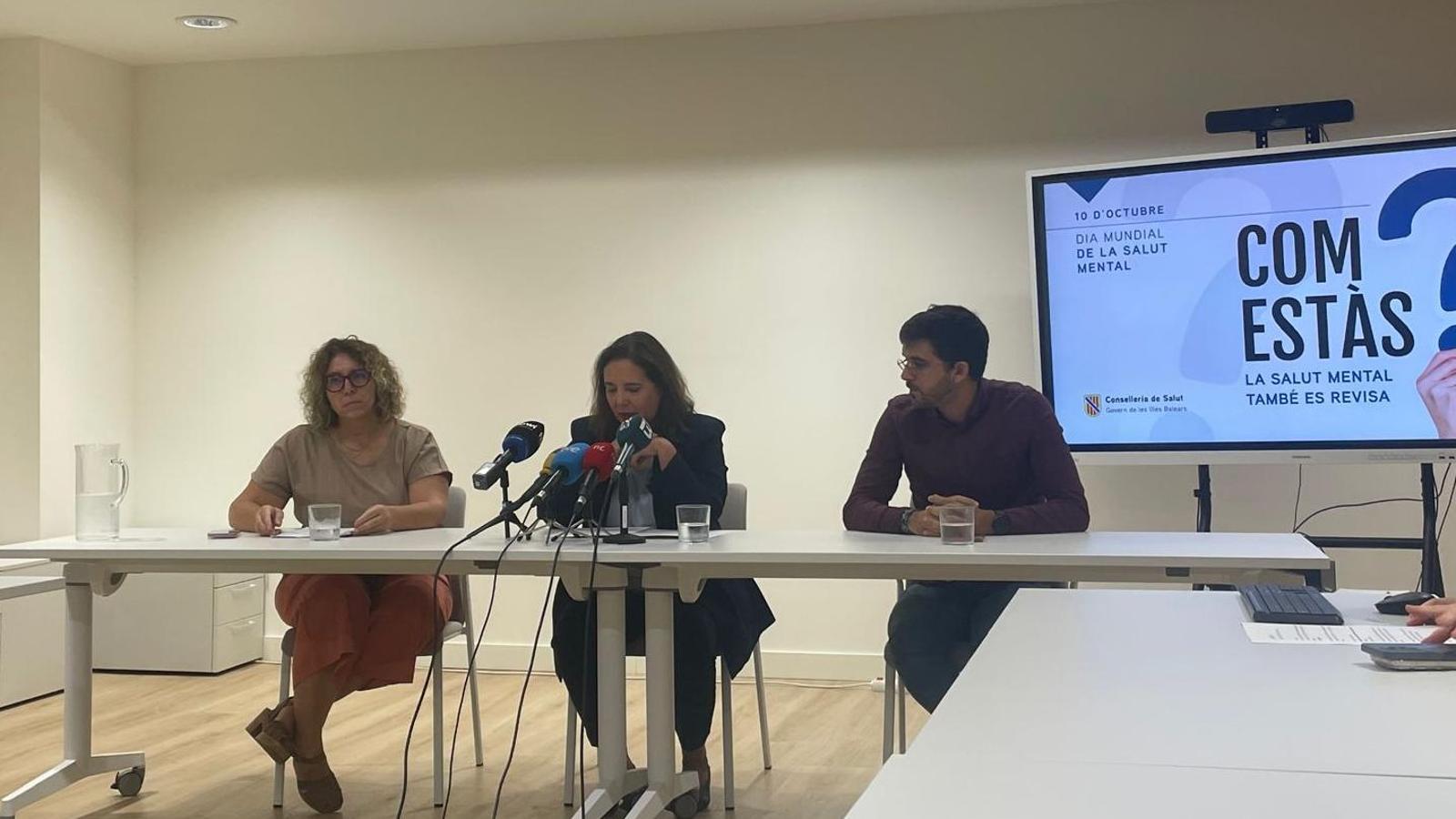
PalmaThe Ministry of Health wants checking the state of mental health to be as routine as monitoring diet or eyesight. On the occasion of World Mental Health Day, which is celebrated this Saturday, October 10th, the Government has emphasized the importance of detecting emotional difficulties in time and bringing mental health resources closer to Primary Care. The Minister of Health, Manuela García, noted that when a person is asked how they are, they often automatically reply that they are fine, without stopping to think about their emotional state. "We want to recover the deep meaning of how we are, stop for a minute and listen to ourselves: saying 'I am not okay', recognizing that we are going through a difficult time," she pointed out.
García has defended that checking mental health "does not mean being sick" and has committed to normalizing the fact that people can talk about how they feel and ask for help when they need it. "Talking is the first step," she noted, before emphasizing that resources must be "accessible, close, and professional." In this sense, the Ministry has launched a campaign with seven video podcasts featuring people linked to the Balearic Islands with different backgrounds and experiences. Among the participants are Jaume Colombàs, Jaume Anglada, and José Tirado, coach of Palma Futsal, who answer the question "how are you?".
More than 5,000 patients attended to
The Director General of Mental Health, Carme Bosch, explained that Primary Care mental health services have attended to 5,347 patients, with a total of 29,200 consultations. Most users are adults, although 229 adolescents have also accessed them. By island, Mallorca concentrates 2,887 patients and 14,171 consultations; Ibiza, 1,039 patients and 4,576 consultations, and Formentera, 50 patients and 125 consultations. The majority profile is that of a woman between 35 and 64 years old. Women represent 79.4% of patients and 92.5% have received individual care.
Bosch explained that this greater presence of women in consultations is related, among other factors, to the fact that women tend to seek help sooner than men. In this sense, she pointed out that stigmas associated with masculinity still persist, such as the idea that “men don't cry” or that they must be able to face difficulties all by themselves, a fact that can make it difficult for them to ask for help. This also has an impact on suicidal behaviors. As the director general explained, women account for more suicide attempts, while men present more cases of completed suicide, a difference she linked to the fact that women seek help sooner.
Among the main reasons for consultation are family problems and support groups, which represent 44.6% of cases. Psychosocial circumstances related to work or unemployment represent 23.7%, while depressive and anxiety symptoms also have a prominent weight. Health authorities have pointed out that depressive and anxiety symptoms tend to go hand in hand.
88% reduce symptoms
The data presented by the Government indicate that going through Primary Care has positive effects on patients' symptomatology. 88.7% of users reduced depressive symptoms and 88.3% reduced anxiety symptoms after the Primary Care process. Consultations usually last between three and five sessions. If after a process that can reach up to eight sessions there is not sufficient improvement, professionals assess whether the person needs more specific care. 50.8% of patients were discharged, while 14.2% were referred to another level of care. The rest abandoned the health process for various reasons. The Health Department maintains that a significant portion of the people who arrive at Primary Care mental health consultations present mild symptomatology that can be addressed at this same level of care.
The Ministry currently has 16 psychologists. The goal is to continue expanding this deployment until reaching the 61 health centers in the Balearic Islands progressively. In the case of Formentera, a psychologist offers care five days a week. The Ministry thus advocates for the incorporation of mental health at the community level closest to the citizenry. The idea is to bring psychologists closer to health centers so that the family doctor can detect patients' needs, accompany them, and facilitate their access to the resource they need. When a person requires a different level of care because they have a disorder that requires more specialized resources, their referral to a specific unit is provided for. "It is much easier to have the family doctor, who will be able to accompany you and can bring you closer to the resource," the minister has defended.
