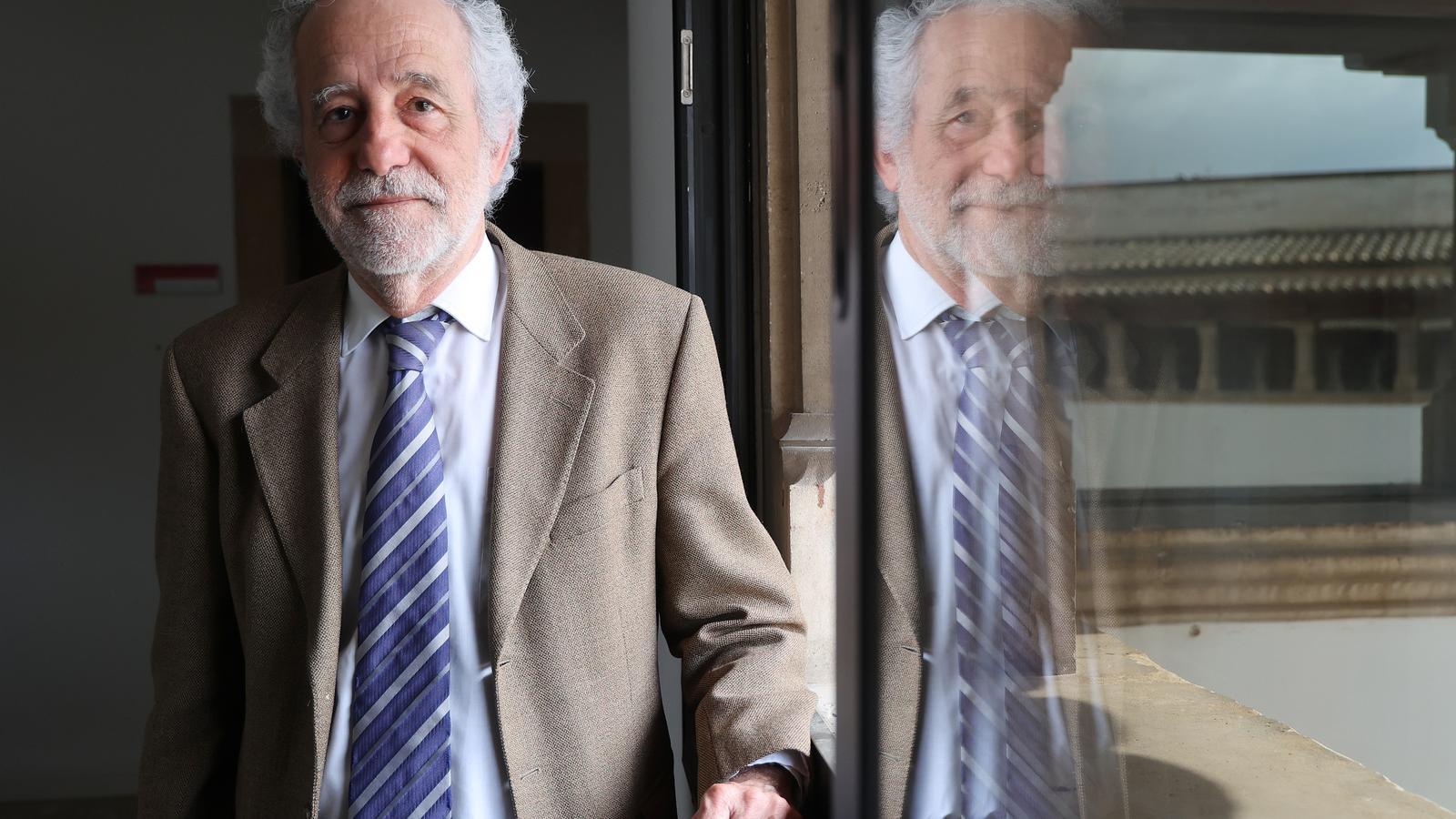
Carlos Gómez: "Legalizing urban irregularities can generate a sense of injustice"
President of the High Court of Justice of the Balearic Islands

-
CAT -
CAST -
DE
PalmDespite being a magistrate with a brilliant career, when he was just a Law student at the Complutense University of Madrid, where he graduated two years after the assassinations of the Atocha labor lawyers, Carlos Gómez (Madrid, 1957) did not know that he would end up dedicating his life to the judiciary. “I hadn't even considered it, because Franco was still alive and at that time being a judge meant being part of a repressive body”, explains the president of the Superior Court of Justice of the Balearic Islands.
“Franco died when I was in my 2nd year and in my final years I had Gregorio Peces-Barba as a professor, he encouraged me to pursue a career as a judge”, he points out. His career was built during a time of institutional transformation after the approval of the 1978 Constitution. Gómez passed the competitive examinations in 1982, a few months after 23F, he recalls.
His professional beginnings first took him to Catalonia, to Santa Coloma de Farners, a place he has many memories of, and then to Barcelona, where at just 26 years old he served as an investigating judge, a particularly complex position in the criminal field. In Palma, he served in Investigating Court number 2 and, subsequently, in a civil section of the Provincial Court (formerly Territorial Court) where he spent nearly 30 years. This long period was only interrupted by a personal tragedy that would mark his life and professional career, the premature death of a son.

Gómez was forced to seek a professional opportunity that would allow him to move to France, where they would try to cure his son. “I was a judge and I didn’t know how to do anything else, I didn’t know how I had to do it to be able to leave for France,” he recalls. And so, through a commission of services granted by the General Council of the Judiciary, he was sent to Bordeaux to learn and understand the French judicial training system.
That stay, motivated by a tragic circumstance, had an impact on the Spanish justice system. In Bordeaux, he encountered a radically different model of judge training, based on practice, the analysis of real cases, and immersion in the different actors of the judicial system. Years later, that experience would lead him to be appointed director of the Judicial School in Barcelona. During the three years he held the position, he promoted a profound reform of the initial training system for judges, incorporating methodologies such as mock trials, internships in institutions like prosecutor's offices, prisons, or law firms, and even non-verbal language workshops. “It was very old training and we modernized it completely,” he summarizes. Years later, he was the director responsible for modernizing the Judicial School, located in Barcelona, from top to bottom. In addition to innovating the pedagogy of the judiciary, Carlos Gómez has been the first Spaniard to be part of the UN Human Rights Committee (2020-2024).
¿How did you come to direct the Judicial School?
— Years later, almost by surprise, I was offered to be the director of the Judicial School. I was practically the only one who had studied other training models in depth. I accepted and was there for three years.
What changes did they introduce?
— Many. Until that moment, the training of judges in Spain was very theoretical and very brief, about fifteen days based on lectures. We introduced a practical model inspired by the French: work with real cases, mock trials, internships in prosecutor's offices, law firms, prisons, and police forces.
Did they also innovate in other aspects?
— Yes. For example, we introduced legal cine-forums, workshops with actors to simulate trials, and training in non-verbal language, which is very important in the courtroom. It was a much more modern way of understanding judicial training. I would say it has been my main contribution. It was a very rich and transformative stage. We profoundly modernized the initial training of judges in Spain.
He is considered a magistrate with great social sensitivity. Where do you come from?
— I don't know exactly. I've always lived it naturally. I believe it's a responsibility. In societies with inequalities, if you are minimally sensitive, you understand that there are many injustices. At the Monti-Sion Foundation, I collaborate by interviewing people who need help, some, especially, to eat. This teaches you a lot about reality and about the difficulties many people experience.
You also boosted the Legal Clinic. How did it arise?
— We will learn about the existence of one of the first State Legal Clinics in Madrid, at a conference I attended with the professor, Santiago Cavanillas. Returning to Mallorca, we talked about launching it here, and so it was. In 2013, based on an agreement with the Faculty of Law and the ICAIB through pro bono justice. It is a way to combine academic training with real social service. Students learn a lot, but so do the people who participate. It is a very enriching exchange.
What are the main current challenges for justice in the Balearic Islands?
— The main challenge is to adapt to the new organizational structure. It goes from a fragmented model, with many judicial micro-offices, to a more centralized model with large offices. It is a significant change in the way of working, but from a rational point of view it makes sense.
The Balearic courts closed 2025 with more than 120,000 pending cases. How can this be solved?
— This situation requires a combination of measures: better organization, more resources, and a clear commitment to digitalization. There is no single solution, but there is a need for a global approach.
Do you trust the new Efficiency Law?
— It can help, especially in the reorganization of the system, but no law by itself solves problems if it is not accompanied by resources and good implementation.
Are you saying that more judges are needed?
— Yes, above all it is a problem of a lack of judges. That is where everything gets stuck and the judges make a great effort to resolve a large number of cases, but the work continues to overwhelm them. Reorganizing is important, but if the workload increases, human and material resources must also be increased.
Are undue delays a problem? In which areas are they most common?
— Yes, clearly. When justice is served late, it ceases to be effective and, therefore, a constitutional right of citizens is violated. It is one of the great challenges of the judicial system. Especially in the criminal field and in certain civil proceedings with a high workload.
Have you noticed an increase in litigation in any of the sections?
— This last year there has been a considerable increase in cases in civil courts, especially due to labor issues such as dismissals, disabilities, compensation, etc.
What do you think of the new law that legalizes housing on rustic land that was not before?
— When irregular situations are regularized, there is always the risk of generating a sense of injustice among those who have complied with the rule from the beginning. It is a kind of amnesty, but I cannot opine further, because, after all, it depends on the will of the legislator.
He was the first Spaniard to be part of the UN Human Rights Committee. What experience would you highlight from your time there?
— I have seen many cases, especially from countries like Russia and Central Asia —Uzbekistan, Turkmenistan—, with many individual complaints.
Has there been any case that has particularly marked you?
— Yes, the case of a 12-year-old girl in Nepal, raped and murdered by soldiers. The family did not obtain any investigation from the State and did not even know exactly what had happened. It is a very harsh example of human rights violations.
What other cases do you remember?
— Also cases of girls in Latin America, victims of abuse, who could not access abortion. They are very impactful situations.
What does the Committee's work consist of?
— On the one hand, we analyze individual cases. On the other, we review entire states. For example, I participated in reviews of Ukraine before the war; of Russia, which did not show up; of Venezuela —which I particularly remember for the arrogance of its government—, and of Iran for systematic human rights violations against women.
How do these reviews work?
— Governments appear before the Committee and answer questions about human rights. Afterwards, recommendations are issued on what they should improve.
Do you consider that geopolitical polarization affects international law?
— Yes, and I hope it is reversed soon, because precisely public international law exists to curb that idea of making politics by force, from the biggest against the smallest or taking something because you consider it yours. The world cannot subsist without International Law. The greatest conquest that the West has achieved is, precisely, that of the recognition of human rights, we cannot allow it to regress.
What would I tell a citizen of the Balearic Islands who doesn't understand how an attack on international law can affect them?
— A citizen should care because the Constitution includes a series of fundamental rights, which for me are the most important part of the constitutional text and that we must know that not all countries recognize. For example, freedom of expression which is also freedom of information, because without one the other does not exist. Journalism and freedom of information and the press would also not exist without international law that upholds human rights. We must remember that there are places in the world where all these rights do not exist, it is our obligation to defend them.
