The posters of a Mallorca for sale: "The rich make killings there and take the best part"
The proliferation of banners in foreign languages made from a colonial mentality consolidates the tourist commodification of the Archipelago, which has just inaugurated a direct flight to the United Arab Emirates, three times a week

-
CAT -
CAST -
GER
PalmaIt has been a long time since the Balearic Islands became a consumer postcard. At Palma airport, you can find a 'clever' advertisement from a car rental company that says: 'It’s pronounced ‘MA-YOUR-CAR’’. Three weeks ago, on the facade of the complex, there was also a giant advertising banner from the German financial group Sparkassen-Finanzgruppe. It promoted Wero, an instant payment application similar to Bizum. The slogan used had a double meaning: 'Was auf Malle passiert, wird auf Malle beglichen’ (‘what happens in Mallorca, is settled in Mallorca’). The phrase refers to the famous slogan of the US 'sin city': 'what happens in Vegas, stays in Vegas'. 'Malle’, the substitute for Vegas, is a very common colloquial term in Germany to refer to Mallorca as an emblem of excess tourism.

The banner caused indignation among citizens, the tourism sector, and the Balearic Government. Aena, the airport owner, ignored the criticism. The German financial institution did take them into account, and finally, after a week, withdrew the controversial poster. It apologized, lamenting, however, that its irony had not been understood. The controversy was closely followed by the UIB Geography professor Ivan Murray. In 2012, he published his doctoral thesis Geographies of Balearic Capitalism: Power, Socioeconomic Metabolism, and Ecological Footprint of a Tourist Superpower. “The Son Sant Joan anecdote – he assures – is related to the tourist commodification of spaces that, worldwide, capitalism has imposed. The limits of political correctness have been overstepped. Last year, during the war in Israel, the US president Donald Trump dared to publish a very tasteless AI-generated video. It showed the Gaza Strip rebuilt and turned into a tourist complex called 'the Middle Eastern Riviera'.

Explosion of contradictions
Murray warns of the current uninhibited drift of capitalism. “The rules of the game have changed. Now anything goes. Aena, in order to make money, is capable of accepting any advertising. Thus, at Palma airport you find posters promoting excess tourism alongside others that speak of sustainable and responsible tourism. It is an explosion of contradictions”. The current islands of lords and servants are the fruit of turbocapitalism, also known as predatory capitalism, which generates more harm than benefit to the population – curiously, ‘depredar’ comes from the Latin ‘praeda’ (‘booty’). “Our archipelago is seen as a kind of fattened pig. The rich come here to slaughter and each takes the best part. It is a very colonial idea, full of arrogance”.

After the pandemic, turbo-capitalism hit the accelerator. In June 2022, at the behest of the insular council, in the hands of the socialists, a direct New York-Palma flight was opened, which has resulted in the landing of North American real estate companies. “The same will happen now – warns Murray – with the new Etihad Airways route, which connects Dubai (the United Arab Emirates) with Palma three times a week. Last week, on the day of the inauguration, the airline's representatives took a photo with two women dressed as peasants. It is the same folkloric image that was sold of the Islands 70 years ago during the tourist boom. Back then, 'ball de bot' dance performances were organized on the tarmac to celebrate each new tourist record”.
The commitment to strengthen the international connection of the Balearic Islands contradicts the tourist containment measures defended by Marga Prohens' popular government. Furthermore, it promotes an elitist tourist model that ignores problems such as saturation, the housing crisis, and pressure on natural resources. “With the new route to the United Arab Emirates – points out the geographer – Mallorca will become an alternative investment center for Arab sheikhs. However, within the disaster we are experiencing, it is important to highlight that a part of the island society is taking to the streets to protest”.
‘Mallorca, game of homes’
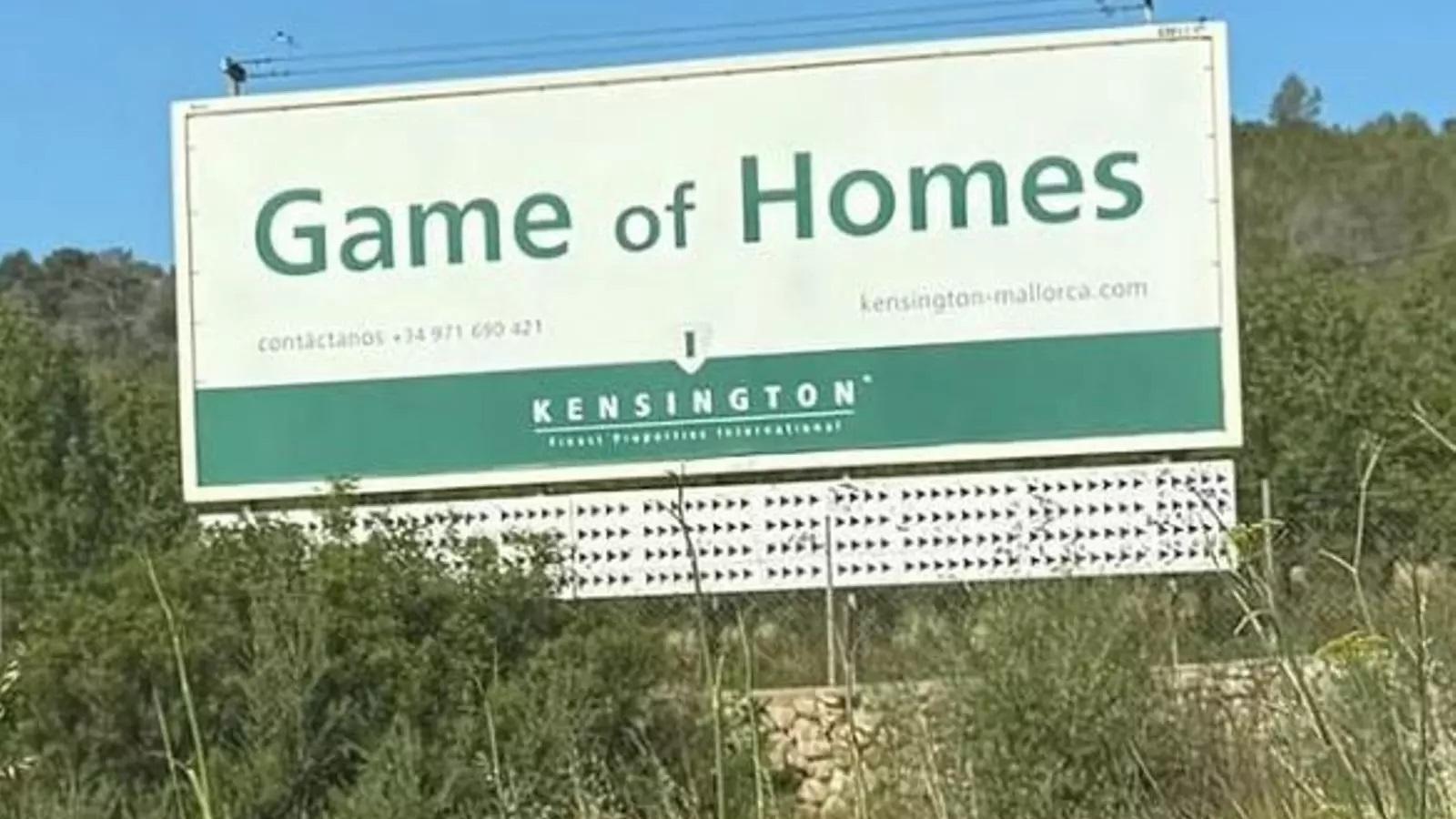
In February 2025, citizens already staged a 'poster war', which affected Algaida's iconic Osborne bull, always a target for graffiti. That time, on the animal's silhouette, one could read: 'Rich foreign property buyers go to hell' ('rich foreign property buyers, go to hell'). It seems, however, that no one felt addressed. Three months later, in various places in Mallorca, billboards appeared with the slogan 'Game of Homes' ('Game of houses'). The adaptation of the title of the famous HBO series Game of Thrones' (2011) was the initiative of the German real estate company Kensington, which, without any shame, presented Mallorca as the best place to speculate. The advertising was also eventually withdrawn due to social pressure. 'These are banners – Murray emphasizes – that hold up a mirror to us and remind us that we have turned our home into a real estate paradise'.
The diagnosis made by the UIB researcher is in line with the Fènix Report, which has just been prepared by a group of six renowned Catalan economists. The study confirms the failure of the Balearic Islands' economic model, a territory where the strong economic growth promoted by the sun and beach industry has not meant greater prosperity for the population. The euphoria over the increase in GDP in recent years has been completely diluted by an exceptional demographic increase – with 1.2 million inhabitants, over the last two decades the population in the Archipelago has grown by almost 30%. While we were breaking visitor records, immigrants arrived to serve them with low-skilled jobs and low wages. This “dysfunctional dynamic” is also present in other tourist communities such as Catalonia, the Canary Islands, the Valencian Community, and Andorra. On the other hand, there are the examples of the Basque Country and Aragon which, with a much lower population growth than the Balearic Islands, enjoy a better GDP per capita.

Murray is pessimistic. He assures us that we are on the verge of a major crisis. “In the 19th century, islanders emigrated fleeing famine. Now the new generations will have to emigrate again, this time, however, due to the difficulty of accessing housing. The current technological and financial alliance is crushing societies and this will cause the system to run out of labor. And meanwhile, some talk about 'national priority'. The triumph of capitalism is that a poor person blames another poor person who has just arrived while opening their arms to the rich who generate their misery." According to the annual report of the Bank of Spain, in 2025 foreigners bought more than three times the number of houses in the Balearic Islands than the state average. Specifically, these acquisitions accounted for 23% of total sales. The main buyers are Germans.
‘Mallorca zu verkaufen’
The slogan ‘Mallorca zu verkaufen’ (‘Mallorca for sale’) began to be displayed in 1986 with Spain's integration into the European Union, which imposed the free movement of capital and people within the European space. In 1991, the popular president Gabriel Cañellas set the course to follow. “We want to turn the Balearic Islands into Europe's second home,” he assured in his third term's investiture session. Soon, in Germany, Mallorca ceased to be known as die Putzfraueninsel’ (‘the cleaning ladies' island’) to become the refuge of celebrities like tennis player Boris Becker and supermodel Claudia Schiffer. That buying fever would be controlled by the Teutonic magnate Matthias Kühn. The slogan of his real estate agency was ‘Every paradise has its price’.
In July 1993, MP Dionys Jobst already dared to propose that Chancellor Helmut Kohl buy Mallorca to turn it into the 17th Land (federal state), two hours away by plane. The controversy resurfaced in 2018 with an advertising campaign in Berlin by the airline Easyjet. The slogan in German was 'The best of Germany: Mallorca'. Journalist Alexander Sepasgosarian, deputy editor of the weekly Mallorca Magazin, views with concern the damage that big capital is causing on the island where he has lived for 26 years. 'Germans –he says– have a very strong emotional connection with Mallorca. Those who buy here are a minority with money who are fleeing the bad weather. Some integrate and some do not'.
On July 26, the Menys Turisme, Més Vida platform has called for a new demonstration through the streets of Palma. “Majorcans – states Sepasgosarian – have reasons to go. However, the protests should not be directed at tourism, but at their politicians, who have not been able to manage it. We are all tourists at some point. The overcrowding experienced in the Balearic Islands is a global phenomenon. In Germany, we also have destinations saturated with tourists and with housing prices through the roof. The same happens in cities like Venice, Barcelona, and Amsterdam”.
The inauguration in 1903 of the Gran Hotel de Palma marked the boost for the sun and beach industry in the Balearic Islands. In 1928, Foment del Turisme de Mallorca was already promoting the island's first promotional poster. Titled Mapa de Mallorca, it featured popular scenes such as caves, windmills, the cathedral, and the 'ball de bot' dance. That nascent 'tourist factory' was cut short in 1936 with the outbreak of the Civil War and then, in 1939, with the Second World War. In 1949, an attempt was made to relaunch it with an iconic poster: 'Luna de miel en Mallorca', by artist Simón Muñoz Lemaur. It depicted a large almond blossom branch supporting a nest. Inside, the figures of the Cathedral and Bellver Castle were nestled. And, looking at it intently, there were two little birds carrying suitcases, symbolizing a couple arriving for their honeymoon on the well-known island of calm. The campaign was aimed at newlyweds from the peninsula and abroad.The production of tourist posters increased with the tourist boom of the late 1950s. Many have now been restored by La Nueva Balear, Mallorca's oldest printing company (1913). Another important tool of tourist propaganda was postcards. The most successful were those by the Catalan portrait artist Josep Planas i Montanyà (1924-2016), who discovered Mallorca in 1945 while doing his military service. In Spain, Planas was the first to take color photographs, which were sold all over the world. He was also a pioneer in Europe in buying a helicopter to take aerial shots. In one year, he managed to sell 25,000 postcards of the Cathedral. His most iconic postcard, however, was the one he created for Tourist Day (September 25, 1968). It featured three peasant women in 'rebosillo' skirts, standing on rocks by the sea. Their arms were outstretched in a gesture of welcome to the tourist.Other postcards marketed by the Catalan artist included those featuring young women posing under orange trees or among fig trees with a seductive air. These were images that folklorized island society with attire that was more characteristic of the 18th century. In the autumn of 1962, Palma Airport, inaugurated two years earlier, welcomed the millionth tourist to the sound of a group of 'xeremiers' (bagpipes) and a group of dancers. Immortalizing the charming scene, as always, was NO-DO, the Francoist propaganda newsreel. The snapshot was repeated on October 21, 1983, when the supersonic aircraft Concorde landed at Son Sant Joan for the first and only time, arriving from Manchester. In 2013, the Felanitx artist Miquel Barceló offered a more realistic image of Mallorca at the most important tourist fair, ITB Berlin. Promoted by GOB, he bathed a map of the island in black ink to denounce the territorial aggressions of the government of José Ramón Bauzá (PP).

