The doctors' strike in the Balearic Islands: a labor dispute or a political struggle?
The strike has left more than 86,000 consultations and tests cancelled and has opened a tug-of-war between the medical community, the Ministry of Health, and the autonomous communities
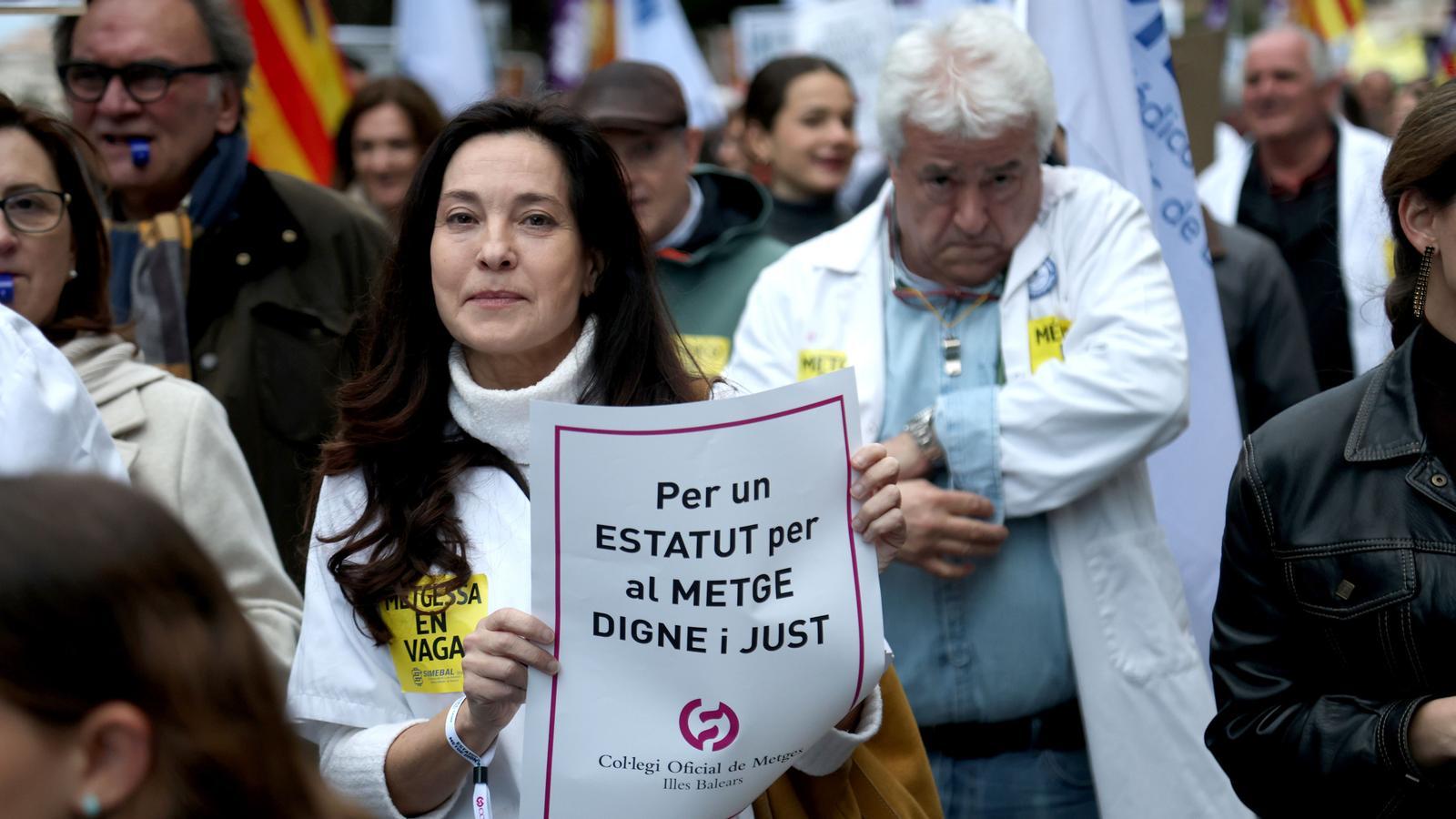

PalmaMore than 86,000 consultations and tests canceled, more than 2,100 operations postponed, and an economic impact of 12.5 million euros. This is the provisional balance of the 31 days of doctors' strike in the Balearic Islands against the proposed Framework Statute from the Ministry of Health that is advancing in its processing. A conflict that has gone far beyond a labor dispute and has become an open tug-of-war between medical unions, the Ministry, and the autonomous communities over the public healthcare model, in a context where healthcare competencies have been transferred to the autonomies.
But it is also a strike that divides the collective itself. While the organizers defend a conflict focused on working conditions and the reform of the state framework, some professionals consider that the protest has acquired a clear political component. Some doctors consulted openly define it as a “political strike,” aimed at directly confronting the government of Spain and, specifically, with the Minister of Health from Sumar, Mónica García.

The protest has had a particularly high turnout in the Balearic Islands. During the last week of mobilizations, between June 15 and 19, the Simebal union placed the participation of hospital outpatient physicians at 70% and primary care professionals at 40%. It is noteworthy that, since the start of the indefinite strike in January (one week each month), the Ministry of Health has not provided its own data at any time and has accepted the union's figures, a circumstance that some doctors consider suspicious. "They don't want to confront Simebal," they say.
The scope of the protest contrasts with what has been registered, for example, in Catalonia. There, the Department of Health, which does provide data, placed the turnout at 4.2%, while the convening union raised it to 29%. Adherence has also been modest in Galicia and the Valencian Community, among others. However, in the case of Catalonia, it must be borne in mind that the health system is much more diversified: there is the Catalan Health Institute, but also other providers. In the Islands, on the other hand, 69% of doctors work for IB-Salut, and therefore, are subject to the Statute in processing, according to the president of the College of Physicians of the Balearic Islands (COMIB), Carles Recasens.
The requests
But what exactly are doctors demanding? And to what extent do their demands really depend on the Minister of Health, to whom the organizers have made the main recipient of their criticism? The answer is complex. A significant part of the demands refer to issues that depend directly on the central government: the reform of the Framework Statute, the creation of a specific statute for physicians, the A1+ professional classification, the basic regulation of the working day, and the creation of a specific negotiation area for doctors, among others.
However, many other demands that have arisen during the mobilizations are the responsibility of the autonomous communities, which are responsible for health management: hiring more professionals, reducing the workload, organizing schedules, salary supplements, incentives to cover hard-to-fill positions, and the effective application of the 35-hour work week.
The doctors' demands therefore combine state and regional demands. However, unions maintain that the separation is incomplete: many of the measures that formally fall under the purview of the autonomous communities —such as reducing the workload, reorganizing schedules, and improving staffing— actually depend on the regulatory framework set by the Statute. In this regard, they argue that the autonomies have the capacity to implement them, but without a prior reform of state regulations, they do not have room to apply the changes they are demanding. The Ministry, however, assures that the doctors' demands depend on the communities.
It is precisely at this point that a large part of the dispute is concentrated. Beyond the jurisdictional debate, the doctors have gone on strike with a set of demands: the creation of their own statute for medical professionals, a specific professional category (called A1+) that recognizes the years of training and responsibilities associated with the profession, and their own state negotiation table where their working conditions are not diluted among those of other healthcare professionals.
They also demand the end of mandatory 24-hour on-call duties, that on-call hours are fully counted for retirement purposes, and that any working time exceeding this limit be considered overtime and paid as such. “There is no professional category that works 48 hours a week except doctors,” says Miguel Lázaro, president of Simebal.
To these demands are added other claims related to the lack of professionals: measures to retain resident internal physicians (MIR), facilitate the incorporation of new specialists into public healthcare, reduce the bureaucracy undertaken by physicians, and promote mechanisms to retain talent in a context where many professionals opt for private healthcare or to practice abroad.
But one point that generates particular consensus within the sector is the on-call model. The organizers denounce that 24-hour shifts still exist and demand that they cease to be mandatory. A doctor from Son Espases, critical of Simebal, agrees that this is one of the most urgent reforms: “I don't want to work 24 hours nor do I want to be treated by a doctor who has been awake for 23 hours,” he says.
The core debate: competencies and responsibilities
Miguel Lázaro, who besides being the president of Simebal is also that of the state confederation of medical unions, argues that the reform of the "Estatut Marc" (Framework Statute) is the keystone of the entire conflict. "The Estatut Marc is a prerequisite and then there is the autonomous development. If the State does not define the framework, this cannot be done," he states. As he explains, doctors have been demanding differentiated treatment for years because they assume responsibilities that other health professions do not have.
Lázaro assures that the central demands cannot be resolved unilaterally by the autonomies: "The autonomous communities can only reduce the number of on-call hours, but not eliminate their mandatory nature." He also calls for a professional reclassification and a specific negotiation area because, as he says, "doctors' conditions cannot be negotiated with unions that are not medical."
Recasens shares much of this diagnosis. While acknowledging that health management has been transferred, he recalls that "the Estatut Marc must provide rules for the autonomies to apply in health matters" and that "the only body that can promote or modify the Estatut Marc" is the Ministry.
The president also regrets that the negotiation process has ended without an agreement with the medical unions and denounces that the Ministry has preferred to make agreements with the large union confederations. "The minister can do it because the votes of CCOO and UGT are enough for her to move forward with the law," he states. The tone of his criticism towards Mónica García is particularly harsh: "The minister has a double message: one before being a minister and another now," he maintains. He also assures that "she has done what she wanted to do, without doctors" and goes as far as to define the reform as "the final blow" for public healthcare.
A strike that also divides
Within the same medical collective, there are professionals who share a large part of the demands, but deeply disagree with the way the protest has been conducted and with the narrative that has been constructed around the Minister of Health, Mónica García. However, the corporatist atmosphere that pervades the collective means that they do not want to identify themselves for fear of being exposed as opponents to the majority current. A doctor from Son Espases considers that "it is a political strike" and accuses Simebal of using the doctors' demands to wear down the State government. Despite this, he acknowledges that "the Framework Statute should be reviewed", because it had not been updated for decades and admits that the proposed changes are insufficient.
Several Primary Care professionals consulted repeat the same idea. Some consider that there are legitimate demands, but they believe that the unions have taken advantage of the conflict to directly confront the minister. One of them maintains that “Mónica García has been the first to dare to open the can of worms of reforming the Statutory Framework”.
Others go further and attribute the real conflict to the debate on incompatibilities between public and private healthcare. “What a good part of the doctors don't want is incompatibility, because there are a lot of people who work mornings in the public sector and very lucrative afternoons in the private sector,” states a Primary Care doctor. Another speaks of “corporatism and classism” within a part of the medical union movement and rejects the creation of an exclusive statute for medical professionals. "We need one that encompasses the particularities of all professionals working in the healthcare field, from janitors to doctors," he adds. Miguel Lázaro flatly rejects these accusations and assures that the conflict transcends any political acronym. However, when asked if the reaction would have been the same with another political force in the Ministry, he avoids a categorical answer: “Probably”.
Meanwhile, the consequences of the mobilizations are accumulating. According to available data, 53,677 hospital consultations and diagnostic tests, 31,134 Primary Care consultations, and 2,146 surgical interventions have been canceled. The impact on care activity and waiting lists is widespread, with part of the activity rescheduled and a system subjected to growing pressure.
However, consensus on this impact does not prevent disagreement when it comes to assigning responsibility and finding possible solutions. Unions warn of further mobilizations if negotiations are not resumed. The Ministry maintains that many of the improvements requested by doctors can already be applied by the autonomous communities, which insist that a state regulatory reform is necessary to move forward. Amidst this exchange of responsibilities, the result is the same: thousands of patients continue to wait for a consultation, a test, or a surgical intervention, without any horizon that anticipates a close solution.
