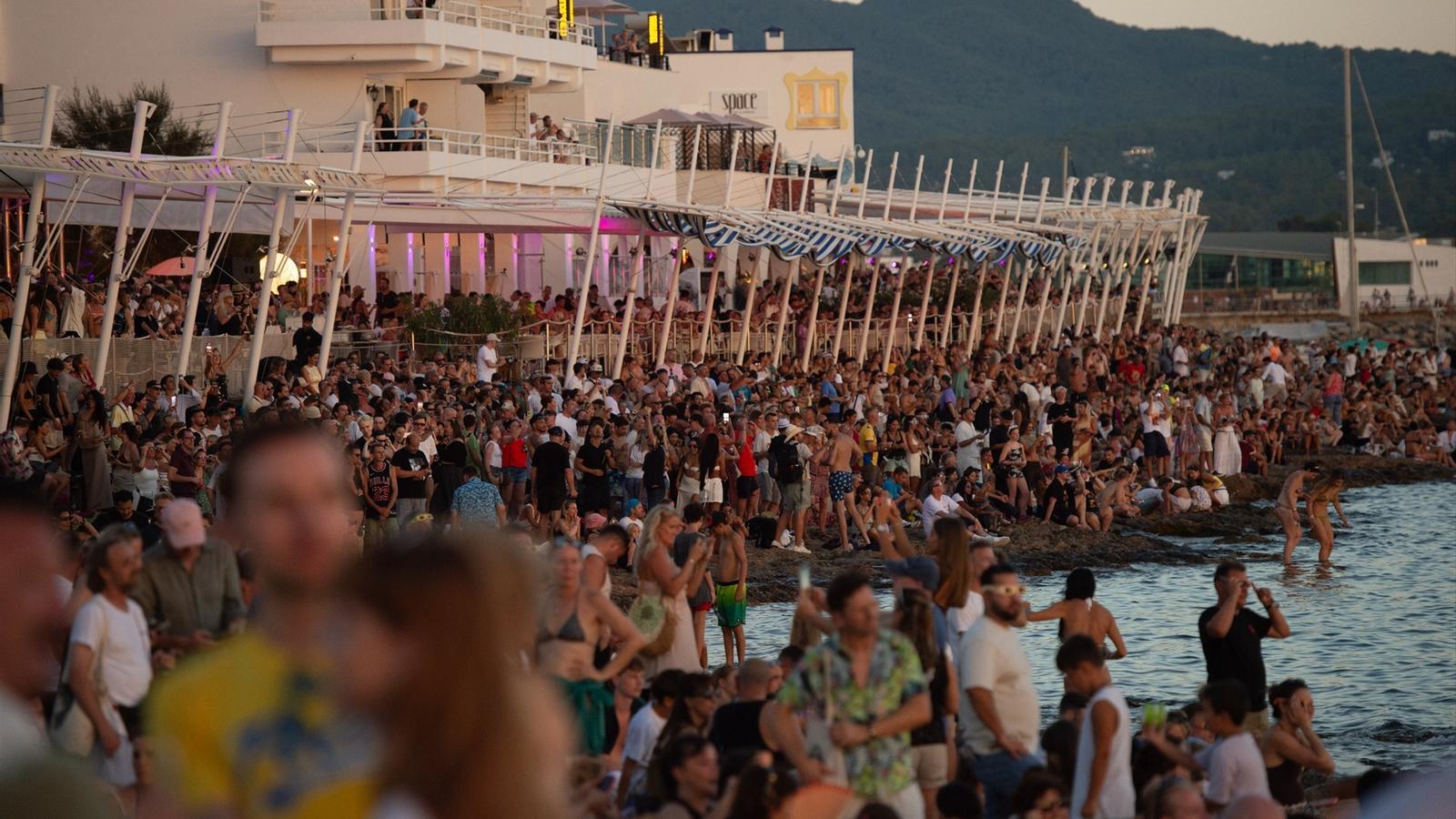
The overcrowding to see the eclipse breaks a new record in the Balearic Islands: 2.1 million people
On August 11 and 12, the Balearic Islands exceeded two million people of human pressure, with nearly 850,000 visitors, according to Ibestat data
-
CAT -
CAST -
DE
PalmaThe solar eclipse brought together more than 2.1 million people last August 12th, including residents and visitors in the Balearic Islands, according to the latest data from the Human Pressure Index (IPH), published this Wednesday by the Balearic Statistics Institute (Ibestat) and corresponding to the month of August. In fact, the Archipelago recorded its monthly and historical maximums of human pressure during August 11th and 12th, with 2,117,026 and 2,116,491 people, respectively.
It should be noted that, in the month of July, the Archipelago recorded a population of 1.2 million residents, according to population data from the National Statistics Institute (INE), which indicates that nearly 850,000 people who experienced the eclipse were visitors. The daily evolution of the index shows the impact of the eclipse on human pressure in August, since the highest values are concentrated around the date of the phenomenon.

During the previous days, human pressure increased until reaching its peak on August 11th. Subsequently, starting from the 12th, a downward trend began until closing the month with 1.9 million people on the 31st.
The management of the phenomenon
It should be remembered that, given the forecast of a high concentration of people due to the eclipse, the Government prepared a specific public safety, natural space protection, and influx management device, through the activation of the Eclipbal specific civil protection plan, which complemented the Territorial Civil Protection Plan of the Islands (Platerbal).
Among the planned actions were the regulation of access and traffic on roads and in natural areas with a forecast of high influx, as well as the creation of 26 official observation zones distributed between Mallorca, Menorca, Ibiza, and Formentera. The device also included the monitoring of main access points and the coordination of emergency services and the administrations involved.
These measures were adopted with the aim of distributing the influx, avoiding concentrations in the most vulnerable areas, and guaranteeing the safety of residents and visitors in the face of an extraordinary event. The operation mobilized nearly 3,000 personnel from different administrations and agencies, with up to 2,147 professionals acting simultaneously during the hours of greatest intensity.
Despite the highest human pressure in the historical series, the 112 Emergency Coordination Center recorded a total of 46 incidents during the 24 hours of August 12 (34 in Mallorca, 3 in Menorca, 8 in Ibiza, and 1 in Formentera), a lower figure than that of the incidents recorded on the same dates in previous years. Likewise, a lower influx of vehicles was recorded on the roads than usual.
