The 'rent a car' stand up to the vehicle limit in Mallorca and ask for the intervention of Competition
The employers' association of vehicle rental companies of the Balearic Islands presents 22 amendments to Galmés' law and warns that the quotas may violate the free market
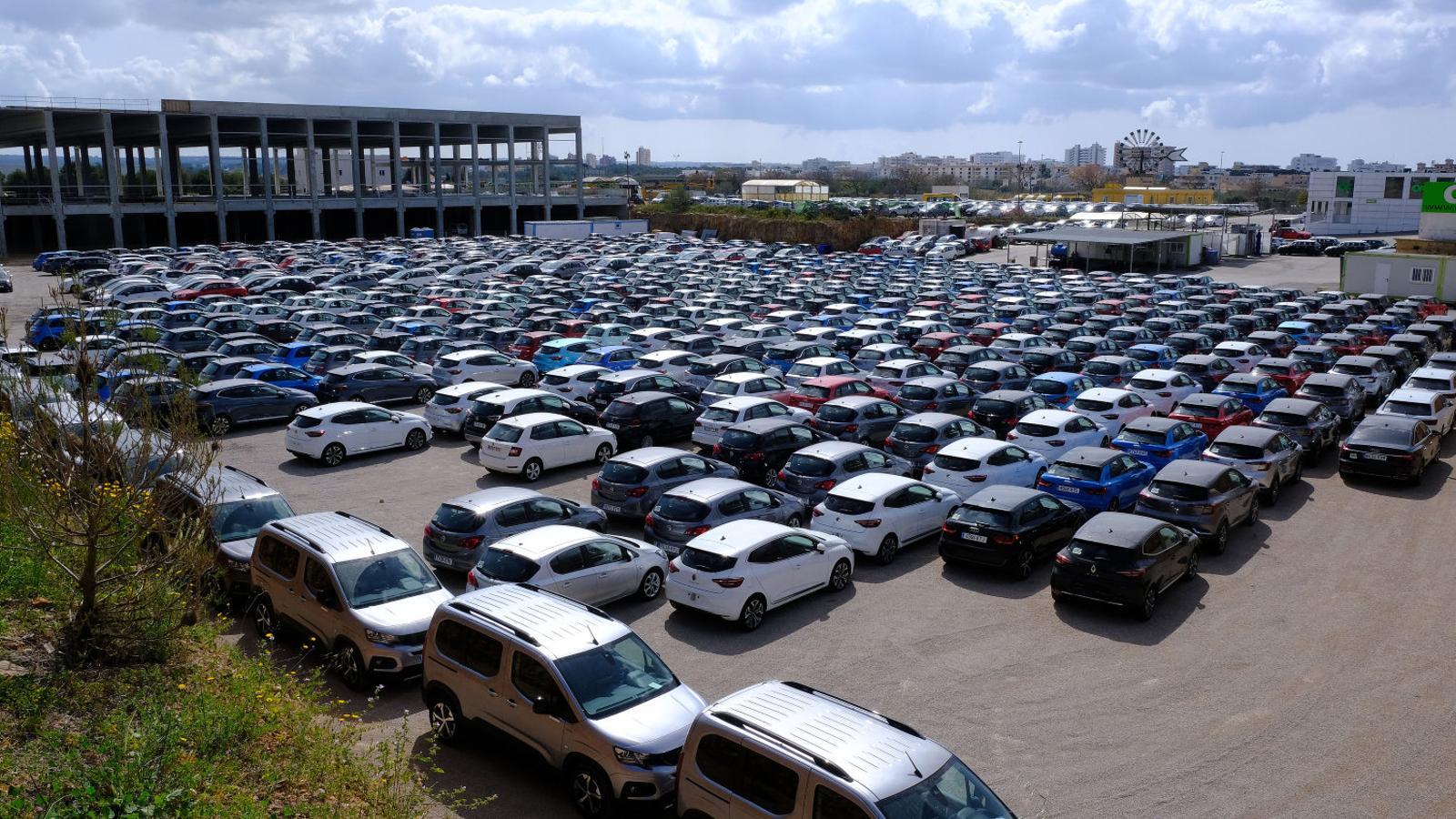
PalmaThe proposal for a law by the Council of Mallorca on the regulation of vehicle influx on the island of Mallorca has already encountered its first obstacle: the vehicle employers' association rent a car, Baleval. The Balearic Association of Vehicles with and without a driver brings together large, medium and small operators that carry out their activity on the Islands. In a forceful document registered in Parliament on September 17, Baleval has presented 22 amendments to the initiative that promises to limit the entry of rental vehicles to Mallorca with the aim of slowing down the circulatory collapse and saturation.Baleval considers that the bill promoted by the executive of Llorenç Galmés restricts access to an economic activity without demonstrating that rental vehicles are the specific and main cause of the problem: "The law is based on an attribution of singular responsibility to the vehicle rental sector that does not appear sufficiently accredited in the legislative file". Therefore, if this responsibility is not accredited, they consider that the law may result in being arbitrary or discriminatory. They believe that the bill does not incorporate a sufficient analysis of less restrictive regulatory alternatives nor does it accredit why the specific limitation of rental vehicles is the most appropriate measure. The employers' association maintains that limiting fleets and distributing vehicle quotas is an "intense intervention" in the market that requires solid data, a detailed justification, and the study of less restrictive alternatives.
The rent a car employers' association considers that the limitations promoted by the Council present "serious doubts of compatibility with the Spanish legal system". They argue that the regulation would violate the freedom of enterprise, market unity, free competition, and free access to economic activity.
In this sense, they warn of the negative effects of the regulation on prices and competition, as they believe that ceilings and quotas could create barriers to entry, favor some companies, prevent the growth of others, and make services more expensive. "The artificial reduction of the supply of vehicles can cause price increases, hinder the entry of new operators, reduce incentives to invest in fleet renewal, and limit the capacity of the supply to adapt to actual demand", states the document registered at the Parliament of the Balearic Islands. That is not all: they warn that the restrictions could also especially affect residents, workers, and visitors in areas that do not have adequate public transport alternatives.
Intervention of the National Commission on Markets and Competition
In light of all this, Baleval is calling for the intervention of the National Commission on Markets and Competition. Firstly, it asks Parliament to consider requesting a report from the CNMC regarding the entirety of the law, but amendment 11 goes further and proposes introducing into the regulatory text the obligation for the Council to request a report from the state body before approving the award criteria, in accordance with “the principles of free competition, market access, and the absence of discrimination between operators”.
According to the proposal from the car rental companies, the CNMC should examine whether the quotas are justified by objective data, whether there are less restrictive alternatives, whether the system truly provides for the entry of new operators, whether it favors already established companies, and whether the exemptions based on fleet size are discriminatory, among others. In short, whether the instruments set by the Council restrict competition more than is necessary.
The document also considers it problematic that the law leaves essential elements such as the cap, quotas, and distribution criteria to subsequent agreements by the Council of Mallorca. For this reason, Baleval asks to know the rules of the game in advance: that quotas be awarded one year in advance and that the justification be “sufficient, transparent, and verifiable”.
The precedents of Ibiza and Formentera
Baleval recalls that the CNMC has already questioned, through appeals, "certain allocation criteria" of the vehicle limitation systems applied first in Formentera and later in Ibiza. They point to these precedents as evidence that quota systems could favor certain operators and "unjustifiably" limit access or business growth.
The state body has urged the Ibiza Council to review the distribution system, as it considers it potentially harmful to large companies, and has warned of taking legal action.
“We are not the main ones responsible for the congestion”
The rent a car employers' association admits that Mallorca suffers from road congestion problems, but rejects that rental vehicles are the main cause. Baleval asserts that studies do not prove that the rental sector is the main party responsible for road saturation. “Neither the 2024 road network load study nor the 2017 rental vehicle impact study allow us to conclude that rental vehicles constitute the main cause of the existing congestion problems in Mallorca”, they point out.
The business association maintains that the traffic collapse is explained above all by demographic growth, dependence on private vehicles, the insufficiency of public transport, and the concentration of traffic at specific points.
The Council is confident in the parliamentary processing
Sources from the Council of Mallorca have assured the ARA Balears that they trust in the parliamentary process and that all amendments that are presented will be agreed upon with all the parliamentary groups that support the law. For this reason, they maintain that "a law with the maximum political and citizen consensus" will emerge from it.
