The urgency of housing clashes with the limits of legislating in the heat of the moment
Legal experts warn of legal uncertainty, and consider that with a view to future regulations the government must assume its responsibility and not load it onto the owners

-
CAT -
CAST -
GER
PalmaThe decrees approved this week by the Spanish government regarding housing in the wake of the Maricarmen case have opened a debate that goes beyond the content of the measures. Although the two regulations have not passed the Congress filter, the emergency response to a residential crisis that manifests itself in evictions, rental prices, and a lack of housing alternatives has also brought to the table the extent to which one can legislate quickly without simultaneously generating more legal uncertainty.
The jurists consulted by ARABalears warn of the risks of legislating "in the heat of the moment," of the succession of regulatory changes, and of a formula, the decree-law, that allows for the immediate entry into force of measures before their parliamentary validation. From the political sphere, however, the reading is different. Political scientist Xavier Calafat interprets the decision to separate the measures into two decrees as a strategy to combine social pressure with the need to achieve a parliamentary majority that allows at least part of the package to move forward. A strategy that, for the moment, has not obtained results because both decree-laws have been repealed.
The risk of legislating without a plan
The professor of General Theory of Law at the UIB Toni Bennàssar considers it especially worrying that a specific situation ends up triggering an immediate legislative response. "As a legal technique, it is a blunder to legislate in the heat of the moment based on a specific case. The specific case must be solved in an individualized way," he maintains.
In his opinion, a punctual response should not directly become a general rule, since this can compromise the quality and stability of the regulation. This concern also extends to the use of the decree-law, which allows measures to enter into force before the ordinary parliamentary debate, and this practice can generate problems if sufficient support is not subsequently achieved to be validated. "The decree-law steals the participation of the General Courts, which are the depositories of popular sovereignty. The rule is published and enters directly into force," he points out.
The problem arises especially if the regulation does not move forward later: people who have made decisions or have been affected during the period of validity may find themselves afterwards facing a different legal framework. This can cause, in their opinion, a “significant legal uncertainty”, they consider, because people in similar situations may end up being subject to different consequences depending on the moment in which a certain regulation is applicable to them. In the case of housing, this uncertainty can affect both landlords and tenants, especially in an area subject to successive legislative changes.
Insecurity for landlords
The coordinator of the UIB Legal Clinic, Sebastià Arbós, focuses on how this insecurity can influence the decisions of individuals within the rental market. At the Legal Clinic, he explains, they handle numerous cases related to room rentals and encounter landlords who prefer not to renew contracts due to the uncertainty about what will happen subsequently. "Many times they do not even want to negotiate a rent increase with them because of the existing legal insecurity. They want them to leave and then they will see if they rent it out again or wait," he relates.
Arbós stresses that this situation does not necessarily affect large property holders. Some owners may be reluctant to rent to people or groups considered vulnerable due to the difficulties they perceive when it comes to recovering the property later. The jurist also questions that part of the responsibility for addressing the housing crisis falls directly on the owners. "Passing the obligation of the administrations onto the administered does not usually yield good results in the long run," he states.

Regarding the second decree, which mainly provided for measures to reinforce the stability of lease contracts and prevent price increases, Arbós is particularly critical of it, as he considers it problematic and difficult to reconcile with the first. “The second one is nonsense, it should never be approved. I suppose it serves to get the first one approved,” he states. In his view, presenting two contradictory texts simultaneously generates even more uncertainty about what the applicable framework would be if both had been validated. “It is contradictory. I do not understand how a government can issue two contradictory decrees at the same time, which if they had been approved, I do not know what we would have done,” he points out. To this contradiction, he adds a technical difficulty: according to Arbós, both decrees contain “indeterminate legal concepts” that can generate problems when applying them. “Technically, they are not well made,” he concludes.
The price problem is not solved
The lawyer for the Platform for People Affected by Mortgages (PAH), Gloria Olmos, introduces another element into the debate. In her opinion, some measures of the first decree, focused mainly on stopping evictions, could have given some leeway to families, although they do not solve the main difficulty of the housing market in the Balearic Islands: the price of rent.
Olmos values that the automatic extension of contracts would have meant giving “a bit of breathing room” to families who know that their contract will end and who do not have a residential alternative. She also considers the suspension of evictions in cases of people in situations of special vulnerability to be especially important, a measure that has already begun to have effects in Mallorca.
In these cases, according to the lawyer, the courts could require the intervention of the administrations before continuing with the procedure. “The administration would have the obligation to provide an alternative. If it did not provide one, the procedure could remain suspended,” she points out.
At the same time, Olmos argues that the lack of response from the Administration should not fall upon the owner. “The administration that is not addressing this situation should compensate the owner,” she states. For the lawyer, the measure can also serve to “unblock administrative inaction” and force institutions to provide the means to offer a residential alternative to especially vulnerable people.
Another of the points she considers relevant is the control of temporary contracts. This formula, as she explains, can be used to cover up habitual housing rentals or even vacation rentals. “So that it is not a fraudulent contract, the reason for the temporality will have to be proven. The landlord will have to specify why a temporary contract is being made,” she explains.
Regarding the limitations on certain housing acquisitions by large entities, Olmos points out that they may have some effect on the market, especially in the purchase of homes to be subsequently destined for sale or rent, although it is still difficult to determine what concrete effect they will have on the rental market.
For the lawyer, in any case, the main difficulty remains unresolved: “The big problem is the price of rent.” Olmos considers that the declaration of stressed residential market zones could have effects on prices and market conditions, but questions whether the Prohens Government will take steps in this regard.
Social pressure and parliamentary calculation
If jurists focus on legislative technique and the effects of legal insecurity, political scientist Xavier Calafat interprets the division of the housing package from the perspective of parliamentary arithmetic and the pressure exerted by social movements. He considers that the decision to present two decrees responds to a combination of social pressure and parliamentary calculation: the government has tried to achieve an initial victory that would give it political oxygen and allow it to rebuild, at least partially, the investiture majority.
In this sense, Sánchez could have opted for a riskier path: presenting a single maximum-ambition decree and, if Congress rejected it, considering early elections with housing at the center of the debate. This option, according to Calafat, could have brought the government closer to some of the demands of housing movements and unions and forced the rest of the political forces to discuss this issue. But it would have also entailed risks, because neither the support of the housing movement nor a favorable electoral result would be guaranteed.
The chosen path sought to separate the measures that could gather a majority from those that generated more resistance, with the aim of approving the first package and continuing to negotiate the rest. In this scenario, if Junts had supported the first decree, the state government could have presented it, according to Calafat, as a sign that it still retains the capacity to act and articulate agreements. This has not been the case and now the door is opening to a possible electoral stage.
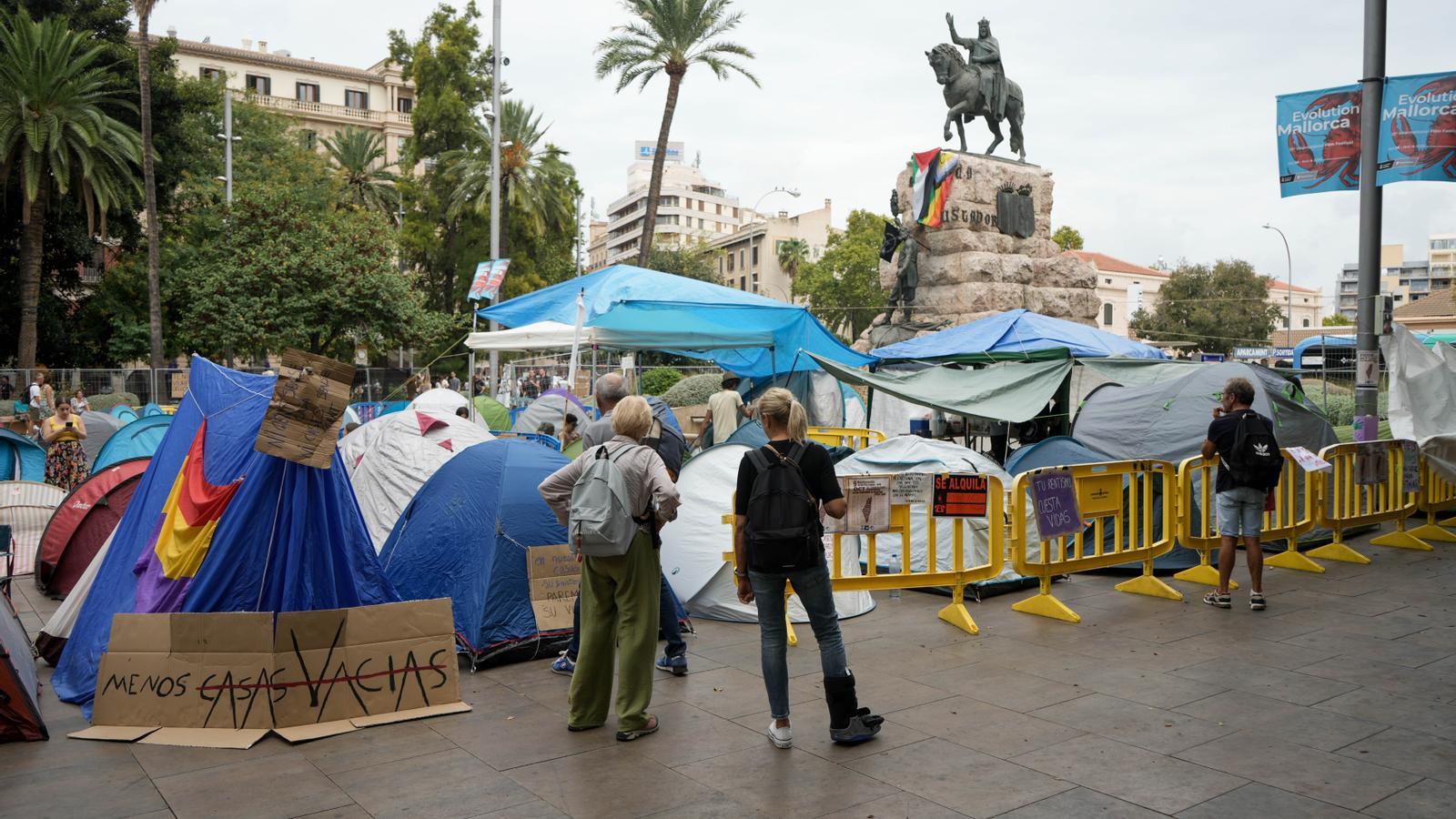
However, the factor that the political scientist considers most important is social pressure. The protest camp at Sol and the mobilizations in other parts of the State, according to his interpretation, have expanded the framework of what is considered politically possible and have made it more costly to continue without providing a response to the housing crisis.
In this reading, the PSOE would have assumed measures that until recently it had not incorporated or that had remained stalled, such as the regulation of seasonal rentals or limitations on purchases by large property holders. Calafat interprets that the executive is thus trying to convert the pressure from the streets and its parliamentary partners into a response that can prosper in Congress and that, at the same time, allows it to regain political initiative.
Despite everything, the rejection of the two decree-laws leaves an immediate question about what Pedro Sánchez's next move will be. The Spanish government can try to bring one of the packages back to Congress – or reformulate the measures to seek the support it has not yet achieved – but it also has the option of an early election on the table. Social pressure, meanwhile, is not easing. The housing protest camp is being maintained and unions are already beginning to raise the possibility of a general strike in the face of a crisis that continues without a response that satisfies social organizations.
The question is, therefore, whether the executive will choose to insist on the parliamentary path and try to approve the housing measures again, even if only partially, or whether the difficulty in gathering a majority will end up opening the door to the polls. Between both options, the residential crisis continues to pressure the state government from the street while Congress once again places limits on its legislative capacity.
