"A secondary school student must know how to underline a reading book"
The Minister of Education, Antoni Vera, attributes to screens part of the decline in reading comprehension in the PISA tests and bets on recovering paper, reading books and the pen in the classrooms

-
CAT -
CAST -
GER
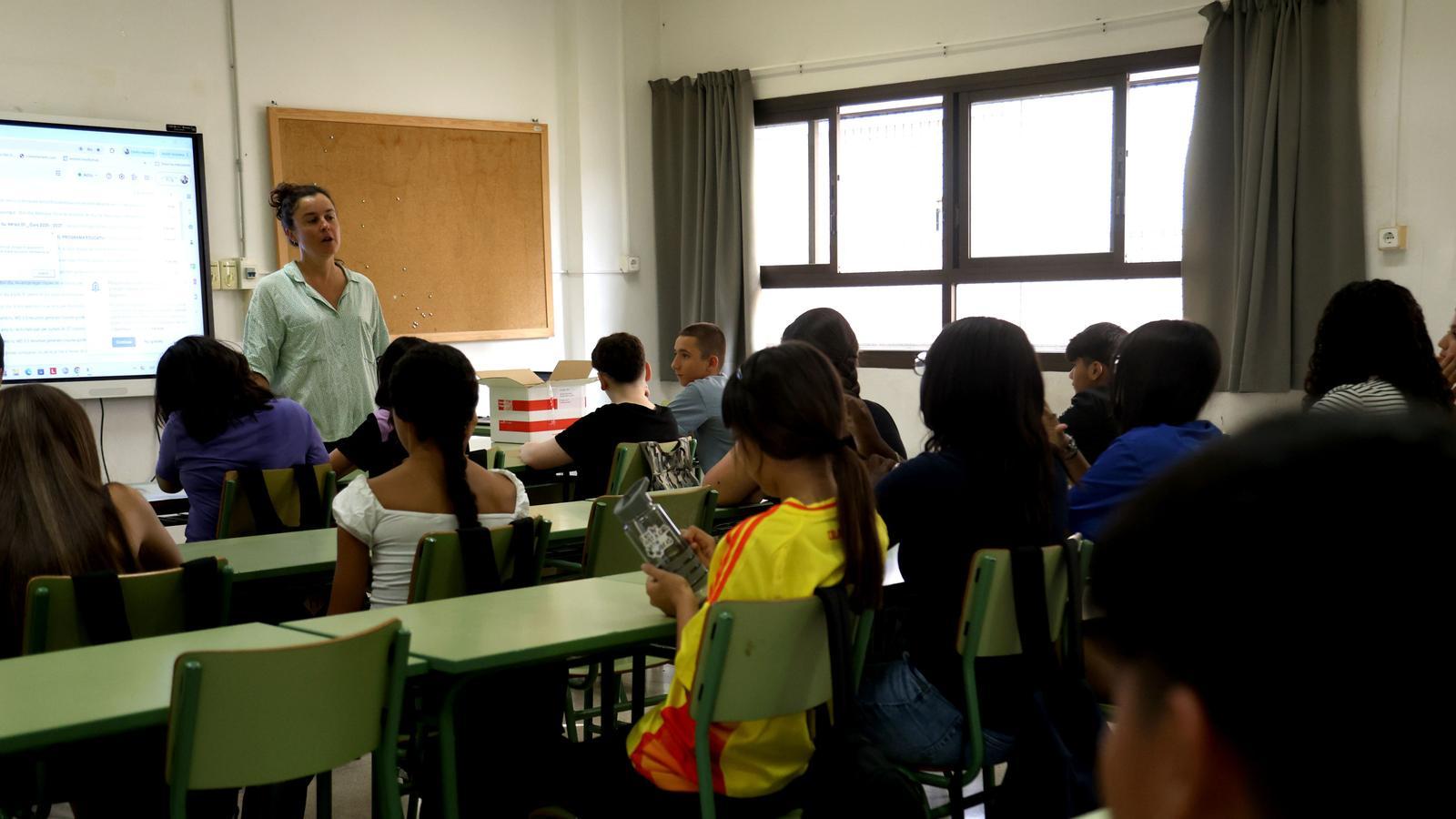
PalmaThe decline of the Balearic Islands in Reading comprehension in the PISA tests has opened the debate on the causes of the setback and on what measures the education system should adopt to reverse it. The Minister of Education, Antoni Vera, has pointed to screens as one of the elements that may explain the situation and advocates for recovering certain reading habits in the classrooms. "Screens do not help," Vera stated when analyzing the results of the Balearic Islands. The minister argues that "languages cannot be learned with screens: paper and pen are needed" and that reading books must regain more prominence in the classrooms.

His proposal involves recovering a series of habits that he considers basic in learning to read. And he summarizes it with one sentence: "A secondary school student must know how to underline a reading book". Vera adds that they must also know how to "read a novel, look for its important concepts". The minister's demand comes after an especially significant drop for the Balearic Islands in the PISA tests. In Reading Comprehension, the students obtained 441 points, 31 less than in 2022, when they obtained 472. The fall has also occurred in Mathematics and Science, although with different intensity.
One of the elements that has significant weight in the debate on digitalization is distraction. The PISA 2025 data analyze the use of digital devices in educational centers and differentiate between use for learning purposes and recreational use. The OECD points out that moderate use of digital devices for educational purposes can be related to better results, while recreational use during classes is associated with worse results. This places the discussion in a broader field. The problem is not necessarily just whether a student reads on paper or on a screen, but what they do with that screen while they read and what level of attention they can maintain in front of a device that simultaneously offers many other possibilities. Vera's proposal, on the other hand, opts to recover the physical book and more traditional reading practices: reading an entire novel, underlining it, and looking for the main ideas or concepts in it.
The new frontier
The minister incorporates a new element of debate. "We must also regulate AI in education," he states. The emergence of artificial intelligence tools presents a new scenario for classrooms. Students have access to systems capable of summarizing texts, explaining concepts, answering questions, or generating content. This forces centers to consider how to work on skills that require direct student participation, among them reading and comprehension. In this sense, the defense of the book that Vera makes is not just a vindication of paper as a physical medium. It also puts on the table a specific way of understanding learning.
Vera's diagnosis is not limited to screens and AI. The minister also points out the characteristics of the education system and, especially, the constant incorporation of newly arrived students and the specific attention they need. "Our context, I know it is complicated: we have many newcomers, constant arrivals of students," he points out. According to Vera, this reality makes it necessary to begin to "consolidate milestones for each grade and stage." The minister also focuses on the differences between schools. "Now there is a lot of diversity between one school and another and we must begin to unify the level," he states.
The fall of the Balearic Islands in reading comprehension thus opens a debate that goes beyond the choice between paper and screen. PISA data show a significant regression and the Education department is proposing several lines of action. For Vera, part of the answer involves recovering a scene that he considers essential within a secondary school classroom: a student reading a novel and underlining a book. However, the reality, as teachers who are day after day in the classrooms systematically point out, is much more multifactorial and less simplistic.
