They demand a moratorium for more than 50 battery projects "that will destroy what remains of rustic land"
The platform Renewables yes, but not like this denounces that the Government processes the installations without a specific energy and territorial planning and demands that industrial estates be prioritized
-
CAT -
CAST -
DE
PalmaThe platform Renovables sí, però així (Renewables yes, but not like this) has demanded a moratorium from the Government for the more than 50 battery energy storage projects that, according to its calculations, are currently being processed in Mallorca. The entity denounces that around forty of these facilities are planned on rustic land, even though they are industrial-type infrastructures, and criticizes that they continue to be processed without having a specific energy and territorial planning to regulate their implementation.
According to the data collected by the platform, about 9 projects are planned in industrial estates and nearly 40 on rustic land. Of the latter, 22 correspond to independent battery installations, known as stand-alone, while 18 are storage systems linked to existing or planned photovoltaic parks. "What is being processed will destroy the little virgin rustic land that remains," lamented the entity's spokesperson Margalida Rosselló.
The entity believes that the proliferation of projects highlights the need to revise the Energy Sector Master Plan of the Balearic Islands (PDSEIB), modified in 2015, which does not incorporate specific regulation for these installations. The platform maintains that it should be established beforehand where they can be located, what conditions they must meet, and how to avoid the implementation of new energy infrastructures transforming agricultural land.
In fact, the Government began the procedure to revise the Energy Sector Master Plan last September to adapt it to the objectives of the climate and energy transition regulations. The preliminary public consultation ended on October 19, but the revision has not yet been approved.
From Pollença to Andratx: the proliferation of projects
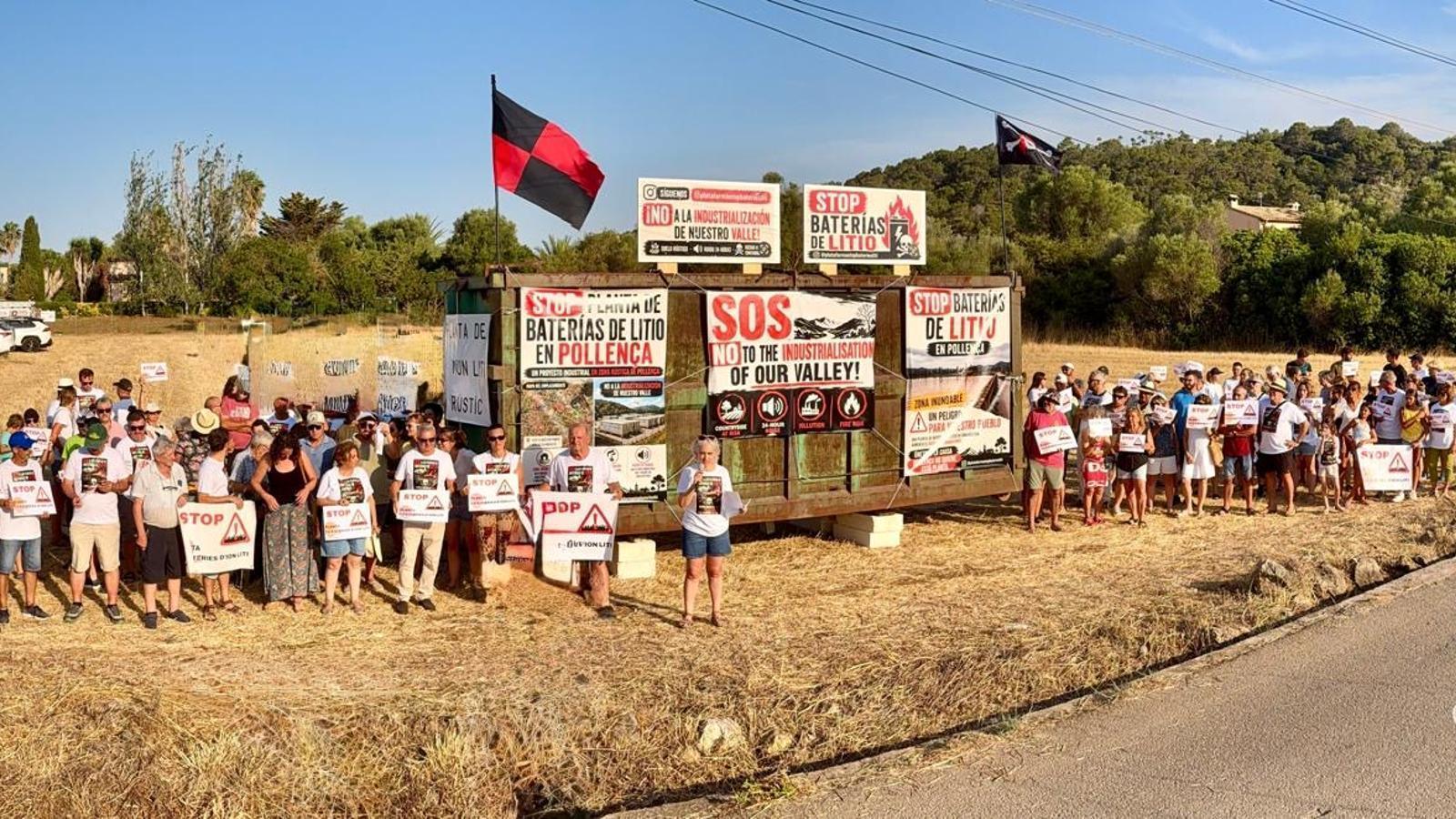
The complaint comes two days after the protest by more than 150 residents in Pollença, who on Sunday took advantage of the visit by the President of the Government, Marga Prohens, to the fair to show their rejection of four battery plant projects planned on rural land in the municipality.
As ARA Balears previously reported, the conflict began with Jilguero ST1, an installation with 10 MW of power and 40 MWh of capacity planned in Llenaire, against which about 8,000 signatures were collected. Subsequently, the BESS Servet project in l’Almadrava, with 10 MW and 44.03 MWh, became known, and later Bocchoris BESS and BESS Pollentia Energy were added. Citizen mobilization has been growing as new initiatives have become known. Last week, the Pollença City Council plenary session unanimously approved a motion rejecting the four projects. During Sunday's protest, representatives of the neighborhood platform were able to speak with Prohens, who, according to those affected, promised to receive them.
But Pollença is not the only municipality where these installations are concentrated. 'Renewables yes, but not like this' points out that there are also projects in the process of being approved in Palma, Alcúdia, Santa Maria, Bunyola, Capdepera, Manacor, Marratxí, Llucmajor, Felanitx, Calvià, Inca, and Andratx. In the latter municipality, the platform highlights a group formed by about twenty storage projects, with a combined capacity of 341 MWh, according to its data. In Palma, it focuses on two other groups that add up to 25 and 11 files, respectively.
The entity denounces that developers present some of these installations divided into 10 MW modules, each linked to a different company, despite sharing the same location or infrastructure. According to the platform, this way of processing the projects makes it difficult to have a comprehensive view of the territorial impact. More than a year ago, an investigative report by ARA Balears warned of the impact that the processing of many of these files, which do not stop growing in number, will entail.
The Government recommends prioritizing industrial land
One of the main contradictions pointed out by the platform is that a large part of the projects are being proposed on rustic land, despite the fact that the environmental criteria approved by the Government itself in May prioritize industrialized areas and already transformed land. "These are theoretical criteria, which have no real meaning, as we are verifying with the processing," states Rosselló.
These criteria, prepared by the General Directorate of Urban Harmonization and Environmental Assessment, establish recommendations for the evaluation of photovoltaic projects and battery storage systems. They also provide protection measures regarding population centers, isolated homes, forest spaces, and habitats of environmental interest.
The platform considers that these recommendations should have an effective translation into territorial planning. It also maintains that the Mallorca Territorial Plan generally limits industrial activities on rustic land and demands that the urban compatibility of battery plants be clarified.
Another of the aspects that worries the entity is the storage systems that are incorporated into photovoltaic power plants. According to the platform, there are about 18 projects of this type under processing in Mallorca. These facilities can take advantage of existing connection infrastructure, but the entity warns that they can also increase the occupation of agricultural land.
Concern about risks and environmental impact
The platform also warns of the risks that lithium battery installations may present if they do not have adequate safety systems. Among other issues, it mentions the possibility of overheating and fires, as well as the need to take into account extreme temperatures and other effects of climate change. The environmental criteria approved by the Government precisely incorporate safety recommendations and measures to minimize risks, in addition to establishing protection distances from homes and natural spaces.
The entity insists that it is not opposed to renewable energy or storage systems, but to the implementation model which, it denounces, is being developed without sufficient territorial planning. For this reason, it demands that the Government temporarily suspend the processing of projects while it does not have a specific plan that determines the appropriate locations. It also asks that energy policy prioritize savings, efficiency, and individual and collective self-consumption, especially on urban and industrial land, to avoid further occupation of Mallorca's rural lands.
