"We cannot blame the tourist for traffic jams when islanders go to buy bread by car"
Experts warn that Mallorca's road saturation is structural: residents make four out of five journeys even in high season
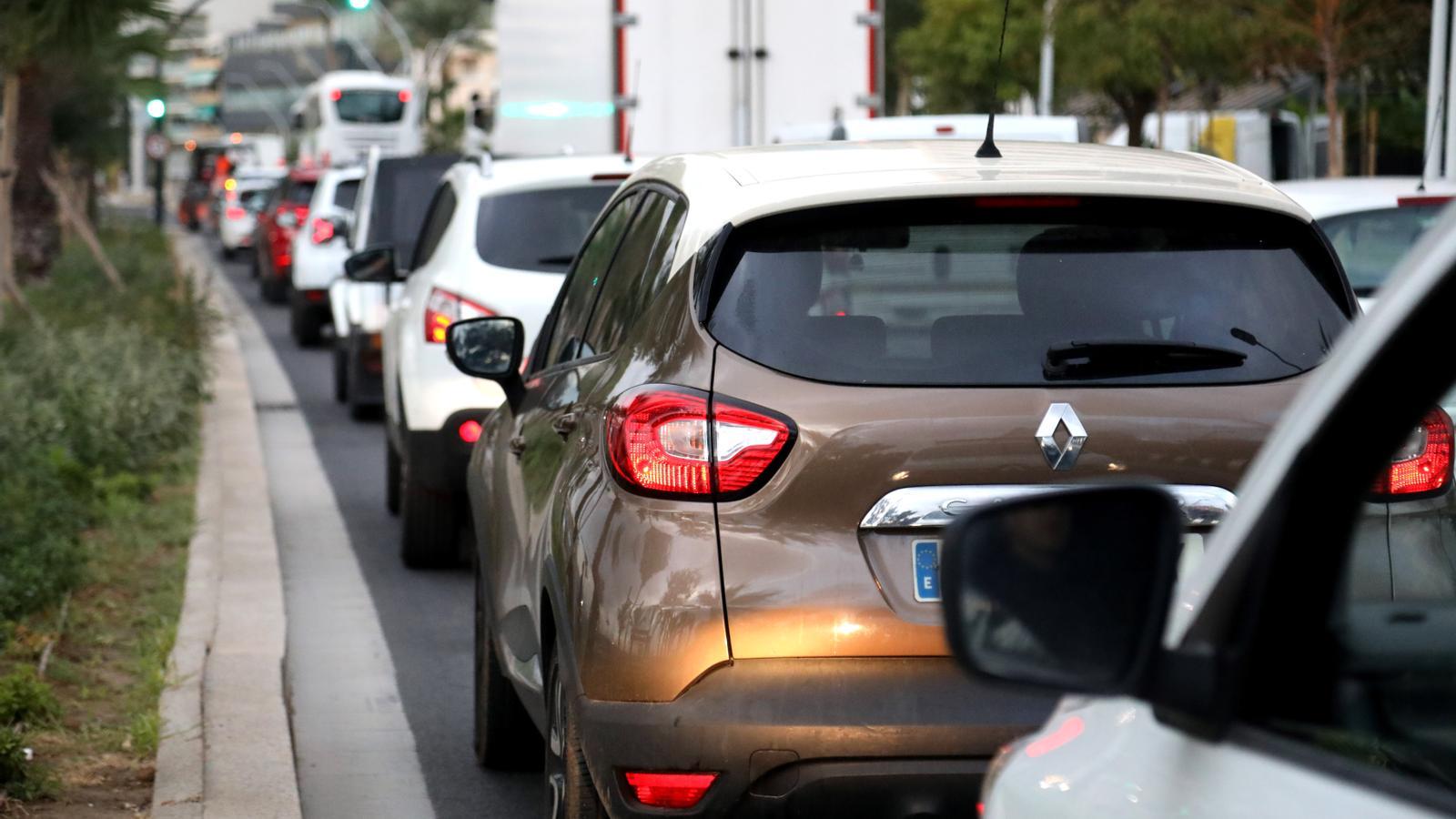

PalmaEvery time the president of the Consell de Mallorca, Llorenç Galmés, arrived in his hometown, Santanyí – of which he was also mayor – he had to hear the recurring comments from neighbors, many of them PP voters: “There is no way to get around Mallorca. Llorenç, you have to do something”.
We will limit vehicle entry to the islandWe will limit the entry of vehicles to the island”.
The president of the Council surely did not expect that moving forward with the limitation would be so complicated. Vox, his government partner, refused to impose taxes and limitations on the entry of cars from "Spaniards to Spain", while shipping companies and large rental platforms have genuinely pressured, as has the state PP. According to what ARA Balears has been able to learn, Galmés encountered a surprise on Friday when he was about to approve the regulation: someone from Genoa was asking for explanations for this measure. The matter did not escalate, but it portrays the large number of interests surrounding the private car that today is collapsing the Islands.
But now that it has managed to overcome the obstacles and advance the rule that it wants to be law before the elections, the question is: will limiting vehicle entry really be effective? The specialists' answer is, to say the least, unsettling: not much, because the majority are already on the island, even if the islanders don't like to hear it.
Saturated starting point
The Balearic Islands start from an extreme scenario: 921 cars registered per thousand inhabitants, 21.6% more than the state average. The difference with Catalonia is very large: 921 versus 683, 33.5% more vehicles per thousand inhabitants. Compared to the Basque Country – the least motorized community in the State – the difference is 272 vehicles per thousand inhabitants (the Islands have 42% more). Reality shows that the assertion that this is the fault of rental companies is not quite true, because the large platforms have cars registered in the Peninsula for tax reasons – they seek municipalities with less pressure.
“The starting point for the Balearic Islands, and for Mallorca, is one of enormous vehicle saturation,” explains Geography professor Joana Maria Seguí. The data supports her. Between 1998 and 2019, the car fleet in the Balearic Islands increased by 66%, “while the population grew by 44%,” she explains. In Mallorca, the number of vehicles grew by 60% and the population by 40.6%. Not only are there more inhabitants, but there are also more vehicles per inhabitant than two decades ago.
And the population continues to grow. Between the end of 2017 and the end of 2023, the Balearic Islands went from 1.17 million to 1.23 million residents, with an increase of over 65,000 people, “many of them with private vehicles,” explains a council technician consulted by ARA Balears. “We cannot solely blame tourists when the resident population does not stop growing and when, moreover, we go to buy bread by car,” he adds. When the avalanche of foreign rental cars arrives, “the glass is already about to overflow,” he says. During the summer, this reality becomes complicated, but “the traffic jams on the ring road have consolidated throughout the year and that is not the tourists' fault,” this technician points out.
Almost a million vehicles
The load capacity study commissioned by the Council estimates that the theoretical vehicle limit that Mallorca should support is between 834,263 and 863,061 vehicles. In contrast, during the peak week of August 2023, 956,660 vehicles circulated on the island: between 93,000 and 122,000 more than considered optimal.
The mobility data from the study provide an important clue. During the week of maximum mobility in 2023, residents made 81% of inter-municipal trips, and only 19% were by visitors. At the time of greatest tourist pressure of the year, four out of five journeys between municipalities correspond to the resident population.
One of the most repeated figures by the Council is that in 2023, 324,623 vehicles entered Mallorca's ports as passengers – with a driver. This figure represents an increase of 108% compared to 2017. If the 55,000 vehicles arriving as merchandise are added, the total rises to 379,628 vehicles. But the data also requires context. “A vehicle entering the port is not necessarily a tourist. This category includes residents, second-home owners, workers, business people, and foreign citizens who spend long seasons on the island,” explains the technician consulted by ARA Balears. And not all these vehicles remain in Mallorca.
Roads are supporting more and more traffic. Seguí recalls that the average daily traffic intensity in Mallorca increased by 50% between 2007 and 2017. This is a particularly significant figure because it does not refer to registered cars, but to vehicles that actually circulate.
The most congested municipalities
The territorial analysis points in the same direction. The main congested corridors identified by the Council connect Palma with municipalities such as Marratxí, Llucmajor, Inca, Manacor, and Calvià. These are displacements associated mainly with work, studies, services, and other daily activities.
According to Seguí, this is "the reflection of a territorial model that has increased dependence on private vehicles", with tourist rentals having consolidated the model of residential dispersion, and tourists forced to rent cars to reach villas on rural land. Residential expansion, the concentration of jobs and services in Palma, and the insufficiency of public transport alternatives have generated mandatory mobility throughout the year, not just in summer. Tourists exacerbate the collapse, but it is locals who create it.

