The Delgado law made possible a good part of the tourist places that the PP attributes to the Pact
The norm of the populars established mechanisms of growth and implied a very permissive regulation of hotels and tourist rental

Palma“With the issue of tourist rentals, no one has been more open than us. When I arrived at the Ministry, there were 800 homes that had been inactive for three or four years. We registered them and expanded from 5,000 to 10,000 [homes]. 80,000 tourist places in holiday homes that are now available thanks to this Government.” The person who said this was not a member of the Pact, but the current mayor of Palma, Jaime Martínez, one of the politicians with the longest careers within the PP ranks and then Minister of Tourism of the executive of José Ramón Bauzá – he was from December 27, 2013, to May 2015, and before that, he had been Director General of Tourism. These statements can be found in the Official Journal of the Plenary Sessions of the Parliament of February 3, 2015.
“There has been no government that has done more for tourist rentals. The tourism law (...) is absolutely pro-tourism in this matter. (...) In the way that (...) tourist rentals are being regulated, the number of holiday homes registered in the ministries has doubled in just two years,” he added, referring to the Delgado law (2012), a regulation that created the mechanisms for one of the largest increases in tourist places in the history of the Balearic Islands. The legal effects of this regulation extended far beyond Bauzá's term.
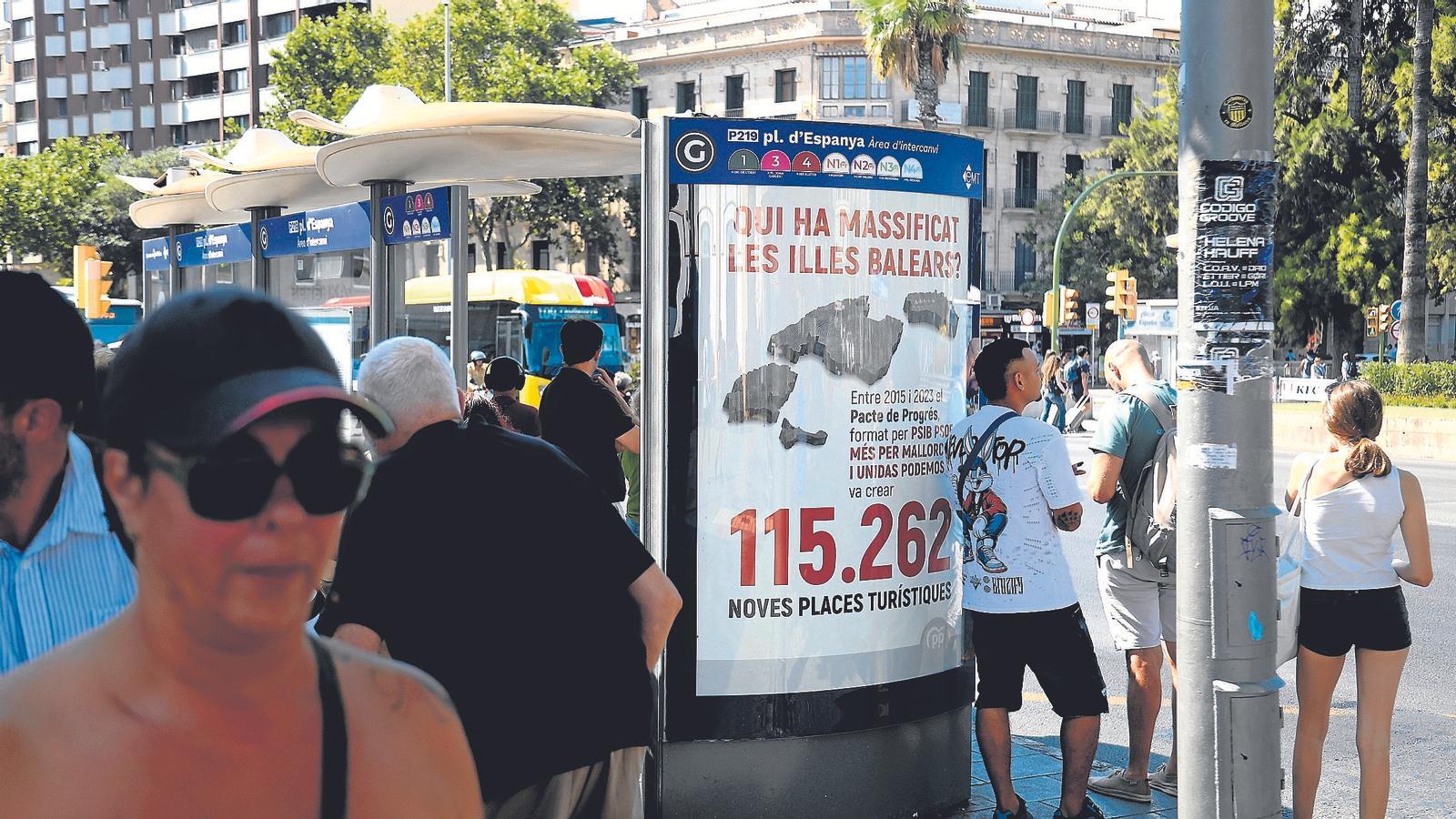
More than ten years later, the Popular Party has gone from boasting about the increase in places to claiming that the Pact is responsible for creating 115,262 places, as can be seen in the advertisements that the PP has placed in various locations in Palma coinciding with the anti-saturation demonstration on July 26. The issue is more complex than these messages suggest. Chronologically, many of these places emerged and were authorized during the Pact's term. But legally and administratively, a large part originated from the legal framework established by the PP in 2012. This is the story we will try to explain.
The exceptions
With the Delgado law, some hotels could create spaces without the bagThe general rule (article 88) was that to create new places, existing places had to be deregistered. But the same law provided for exceptions (article 89). Rural tourism establishments, certain tourist accommodations, interior hotels, certain five-star hotels, hostels, and some four-star or higher city hotels could create new places without having to acquire others on the market.
An important reform
The PP's norm allowed growing in size and height in some casesThe fourth additional provision of the Delgado law created an extraordinary regime so that hotels that modernized could expand their facilities with important urban planning advantages. The rule allowed for expanding buildings, growing in height, and increasing the number of places without having to buy them on the stock market. In certain cases, these facilities prevailed over the limitations of municipal urban planning.
Tourist rental
A regulation considered permissive regarding single-family homesThe Delgado law created a specific chapter for tourist stays in homes and allowed the marketing of short-term stays only in single-family homes through the owner, platforms, or companies. A responsible declaration (DRIAT) was sufficient to start the activity, without having to wait for administrative authorization. The law also did not provide for any zoning system to limit the activity according to the territory. Furthermore, the Bauzà government did not develop the regulations regarding this matter until May 2015, when the legislature was about to end.
The Pact introduced multi-family homes with limitationsThe Delgado law only allowed tourist rentals in chalets, and it was Biel Barceló's tourism law, with the Pact in government, that opened the door to multi-family homes in 2017. But it did not do so automatically. The rule established that the island councils had to draw up a zoning plan, and in the case of Palma, the City Council could decide. In fact, Cort prohibited tourist rentals in apartments. Authorization from the community of owners was also required. Furthermore, places had to be purchased on the market and had a validity of five years. According to Pact sources, the opening of tourist rentals to multi-family housing represented approximately 9,000 places.
The figures
115,000 places that mix two different issuesWe arrive here at the crucial point of the issue: what do these 115,000 places measure? One thing is the moment when a place appears in the official statistics. Another, very different, is when the legal right that allows its creation is born. The PP emphasizes that the 115,000 places were authorized from 2015 to 2023 and assures that 93,000 were a consequence of the Barceló law, an interpretation that contrasts with the statements that Jaime Martínez made to Parliament in 2015, when he advocated for the open-door nature of the Delgado law.
According to various former officials of the Pact consulted separately by ARA Balears, who agree on the figures, many of the places that were counted during those years derived from procedures initiated under the legal framework of the Delgado law. They detail that, at the end of Bauzá's term, there were already 46,607 tourist rental places authorized and in operation in single-family homes that did not appear correctly in the official statistics. And they add that there were 11,630 uncounted hotel places, many of them for the modernization of establishments. There were also, according to the same sources, approximately 5,000 places that, despite being registered in the 2015-2019 term, came from previous permits.
Finally, they specify that approximately 45,000 tourist rental places in single-family homes were indeed registered before the Barceló law was approved (even though the Pact was governing, the Delgado law remained in force). This calculation places at 108,237 the places that, according to these sources, already existed, derived from the PP's regulations, or came from procedures initiated before the 2017 reform. To this must be added the 9,000 tourist rental places in apartments.
“The announcement of the processing of the draft tourism law [from the Pact] produced an avalanche of places. Everyone started asking for them,” points out the geographer specialized in territorial planning, Margalida Mestre, who believes this could have been avoided by implementing a moratorium on places before making the preparation of the new regulation public. As the Barceló law had not yet been approved, this avalanche consisted of tourist rental places in single-family homes. “The Delgado law introduced the responsible declaration as a way to speed things up, it established the mechanisms to accelerate. And it accelerated when the Pact said it would bring order. There was an aberration in a matter of months,” adds the expert.
For his part, Geography professor Macià Blàzquez laments that the Barceló law went a step further with the type of tourist rental and included apartments. “The tap has never been turned off, there has always been a sieve. Everyone has sinned,” he remarks about the PP and Pact governments. He also describes as a “bomb” the provision of the PP law that allowed hotels to increase in volume, height, and places. And he recalls that the current PP government “has removed the expiration date [for tourist rentals in apartments] and has delinked tourist rentals from ownership.” This means that the places are not assigned to the homes, but to the people, who can sell them or link them to other homes. “It deepens rentism,” he states.
PP deputy Salomé Cabrera recalls that the Delgado law was approved in a context of “very tough economic crisis” and emphasizes that it was necessary to “incentivize the improvement of establishments and promote investment and reconversion.” And she insists that the real siren effect occurred with the introduction of tourist rentals in apartments by the Pact. Furthermore, she points out that the zonings of the councils and the possibility of limiting by Cort were established “after the chaos” of the tourist rental applications in multi-family buildings. But Cabrera omits that the limitations and zonings were part of the original design of the regulation.
“The 2017 law gave the Councils and the Palma City Council a deadline to zone and say what can and cannot be done,” explains the former Minister of Tourism during part of the first term of the Pact, Biel Barceló. The former official points out that the 2017 law also introduced a de-growth formula that the PP has eliminated: places that were registered without recourse to the waiting list had to be eliminated if they were deregistered. For his part, the former Minister of Tourism for the 2019-2023 term, Iago Negueruela, highlights that, even though the possibility of renovating hotels was maintained, the Pact eliminated the increase in places and the increase in height. “What was done was to apply the legislation [the Delgado law] with the requests that had been made and modify it as soon as possible,” he states.
