"What do you want a certificate for? Without papers, we are all vulnerable"
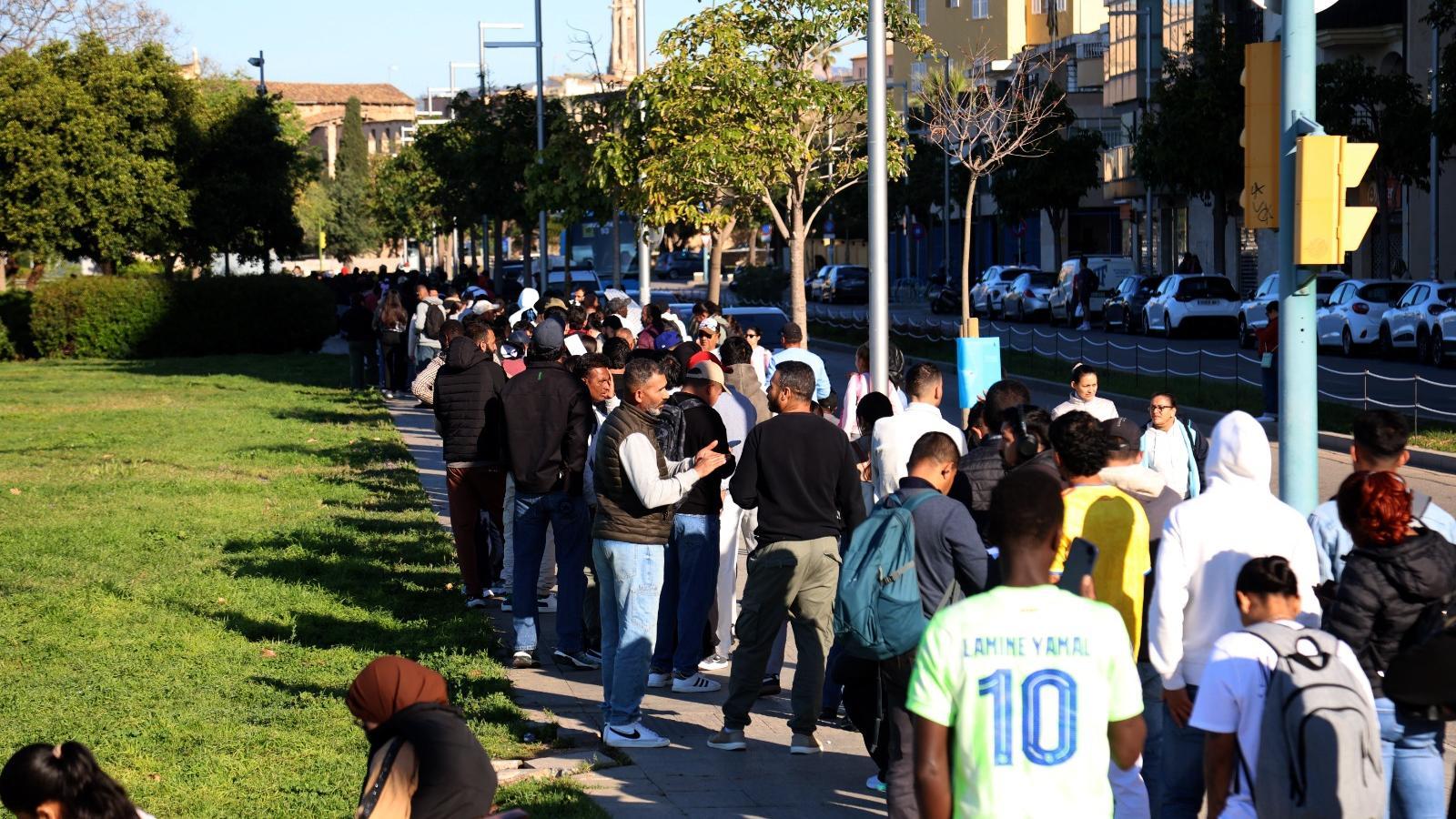
Thousands of migrants queue endlessly at town halls on the islands to benefit from the extraordinary regularization, while the PP and Vox rebel against it from within institutions.

-
CAT -
CAST -
GER
PalmMore than 30,000 undocumented immigrants in the Islands now have the possibility to emerge from invisibility. Since April 16, long queues at town halls have become the image of the extraordinary regularization driven by the Spanish government. They have been preparing documentation for months, but until the last minute they did not know that they would also need a vulnerability certificate, and that explains, in part, the system's saturation. "I don't understand why they want it, if all of us who are undocumented are vulnerable," reflects Abdou, a 32-year-old Senegalese man. Despite this, the priority is clear. "Even if we have to lose days of work: papers are papers," assures Khalid.
Unlike an ordinary regularization, which can drag on for years, this process will allow obtaining a work permit through the fast track if a series of requirements are met, including having arrived in Spain before January 1, 2026, proving that they have been in the country for at least five months, and having no criminal record. At the state level, the measure could benefit half a million people. In the Islands, estimates point to 30,000 affected individuals. Nevertheless, the second vice-president and Minister of the Presidency, Antònia Estarellas, specified that this is an approximate calculation, as there are no records of undocumented people. This margin of uncertainty suggests that the number of immigrants who take advantage of the express regularization could be higher.
The measure has pitted the PP and Vox on one side against the left on the other. The deputy spokesperson for the Popular parliamentary group, Marga Duran, accused the Spanish government of "wanting to cause the collapse" of the town halls by entrusting them with the issuance of vulnerability certificates. In contrast, the PSIB maintains that the popular mayors are "boycotting" the procedure. The socialists have opened their headquarters to provide information and advice to people in this regard.
In Palma, the City Council (PP) has admitted that it gave the order not to reinforce the Citizen Attention Office (OAC). Witnesses consulted by ARABalears have pointed out that, in some neighborhoods, people got up at four in the morning to process their certificate. Furthermore, organizations like Cáritas have warned of the proliferation of scams targeting immigrants, taking advantage of the doubts surrounding the procedure.
Despite the obstacles, migrants see regularization as an opportunity to avoid situations of exploitation. This is the case of Jessica, a 29-year-old architect who arrived less than a year ago from Latin America. “Since I don't have papers, I can't practice my profession. When I had just arrived, I took a job painting a house,” she explains. Although the owners paid for the service, she didn't receive a single cent: her boss kept it all. “Unfortunately, this was my first work experience in Spain,” she recounts. “I couldn't do anything, I'm alone, without papers, I had to accept it,” she states.
“Employers take advantage”
Khalid [fictitious name at the witness's request] and his four companions are queuing at the citizen's office in Santa Eulalia square (Palma). “Employers take advantage”, he laments. He explains that in the construction sector he can earn up to 30 euros for a demanding workday. “By the end of the day, I lift two tons of weight”, he says. “You can’t refuse because, if you do, you lose your job and can be without work for weeks”, he adds. Next to him, another young man points out that in the hospitality sector they can earn half of a normal salary if they don't have papers.
“We want to work and contribute to this country we love”, says Abdou, who was an English teacher in Senegal. Most testimonies share the same goal: to get stable employment. This is the case of Mariana [fictitious name], a 37-year-old Colombian woman who has been in Spain for eight years, but has not been able to regularize her situation through the ordinary route because she has not managed to get a work contract: “I tried in a restaurant and a beach club, but I couldn't”.
A few meters away, a Colombian mother and daughter, who do have their papers, are waiting for their turn to pay a fine. They observe the queue without surprise: “In administration, everything is slow”. They are domestic cleaners, and they got their papers because the mother convinced one of her bosses to give her a work contract, in exchange for her covering the Social Security contributions herself. “They do it this way, and you can't complain, because they are doing you a favor”, explains the daughter.
The difficulties in finding work have a direct effect on housing access, in a context of a tight market with high prices. “If it's already difficult with papers, imagine without”, laments a middle-aged Moroccan who has been living on the street for a year. Although for a time he slept in a shelter, he is now on a waiting list to access a spot. In the same vein, Khalid recounts how many migrants live crammed together “like sardines”: he pays 160 euros for a bed in an apartment where about ten people sleep.
A measure with “triple legitimacy”
The regularization has intensified the confrontation between the Spanish government of PSOE and Sumar and the communities governed by the PP. President Marga Prohens has warned about "the pull effect" that the process can generate and has announced that she will challenge it in the courts. She follows the trail of other PP barons, such as the president of Madrid, Isabel Díaz Ayuso. In parallel, the new government pacts between the PP and Vox in Extremadura and Aragon place more emphasis on the anti-immigration discourse. For the first time, both have included a "national priority" clause to exclude immigrants from aid and rights, and have registered this proposal in a motion in the Congress of Deputies and a written statement in the Balearic Parliament [signed by Vox].
The Spanish government is swimming against the tide at a time when rejection of migrant entry is gaining strength in Europe. Nevertheless, the Minister of Inclusion, Social Security and Migrations, Elma Saiz, has defended that regularization is based on a “triple legitimacy”: social, political, and economic. Furthermore, the process has broad support from organizations of all kinds, from social entities to employers' associations, and also sectors of the Church.
Apart from granting rights to thousands of people already living in Spain, regularization involves a fight against the underground economy, because the money and jobs that were circulating illegally will now do so through legal channels. According to a report presented by BBVA this week, the economy of the Islands could improve by at least 0.5% as a consequence of the regularization process. This was stated by the chief economist of BBVA Research, Miguel Cardoso, who explained that they are working on the basis that approximately 22,000 people will end up being regularized in the Balearic Islands.
In statements reported by EFE, Cardoso pointed out that the impact could improve if unregistered employment emerges or if migrants who obtain papers access better-paid jobs, which would boost household consumption. However, he detailed that the impact on macroeconomic data will be “moderate”, as a large part of irregular work is partially accounted for in the indicators.
21 years since the last process
It had been more than 20 years since an extraordinary regularization of immigrants had taken place. But the socialist Pedro Sánchez is the fourth Spanish president to activate a process of this kind. Felipe González, José María Aznar, and José Luis Rodríguez Zapatero also did so. The most important was Zapatero's, which took place in 2005, as more than half a million people benefited from it.
The leader of the Association of Dominicans in Mallorca, José Solano, was one of them. “I suffered mistreatment from employers, I collected olives and perhaps they paid me ten euros in a day, and other abuses like that,” he says. “Because of the humiliations I received, I went hungry, although I endured it discreetly.” But as soon as he obtained his papers, his situation changed drastically. “With my first ID card, I got a job in a restaurant,” he recalls. “The change is enormous, whoever has papers has respect, and can now coexist on equal terms,” he states.
