

Another victim of the climate of terror imposed by the victors in Esporles was Leo Israel Frischer, a German of Jewish descent, originally from the city of Breslau, now belonging to Poland. His life can be followed in the documentary El alemán de la tienda de fotos (The German from the Photo Shop) (Quindrop), directed in 2022 by Luis Pérez with a screenplay by Pedro Echave and research by Pere Bueno and Joan Pérez. Beset by Nazi delirium, at the end of 1939 Frischer fled Hamburg with his wife Elsa and two other couples. Having made a stopover in Malaga and Barcelona, the German decided to take refuge in Esporles – his wife, who was not Jewish, had managed to exile herself in the United Kingdom with the promise that she would join him there. Frischer opened a photo shop at number 11 on Sant Pere street, then the most commercial street in Esporles – it was a business he already had in Hamburg. After a year, however, on June 16, 1940, he received an expulsion order as a result of the agreement that Franco had signed with Nazi Germany in 1938 to deport any of the 30,000 Germans residing in Spanish territory, suspected of being Jewish. A month later, Frischer fled to Barcelona with a false passport. He was arrested while trying to cross the French border. He ended up spending three years in the Miranda de Ebro concentration camp (Burgos). Upon his release, he left for Wales, where he finally fulfilled the promise of reuniting with his wife. Both would set up a photography business again dedicated to wedding and christening reports. The couple Hans Mayer Claassen and Lissy, who had accompanied Frischer on his Mallorcan adventure – he was a jurist who had previously been in the Buchenwald concentration camp – also had to leave Esporles. They avoided prison. They had money and were able to reach New York. Theirs is a special case because in 1958 they applied to return to Mallorca. The documents found by researchers Pere Bueno and Joan Pérez confirm that they received the relevant authorization because the agreement for their expulsion had then been "null and void." The couple settled in Cala Llamp (Andratx). The deportation agreement with Nazi Germany remained in force until 1942. In Mallorca, it caused great concern among the known xuetes, the historical descendants of converted Jews, who since the Middle Ages had been the object of European antisemitism. In 1942 Hitler asked the Spanish government for a census not only of Jews, but also of Mallorcan xuetes. The objective was to send them to an extermination camp. However, some historians claim that Bishop Josep Miralles stopped these deportations, which could have affected approximately 35% of the island's inhabitants.
Esporles, "little Russia" repressed
In July 1936 the Falangists raged against the important workers' movement that germinated in the six textile factories of the town in the Tramuntana mountain range. 157 esporlerins suffered all kinds of abuses: torture, imprisonment, exile, and confiscation of property. About twenty were murdered

-
CAT -
CAST -
GER
PalmLocated at the foot of the Tramuntana mountain range, 14 kilometers from Palma, at the beginning of the 20th century Esporles was known as the 'little Russia' of Mallorca. Its six textile factories had managed to forge a strong proletarian consciousness. The inauguration in 1930 of the Casa del Pueblo would be a reflection of that class pride. Already in the municipal elections of April 12, 1931, the municipality would be one of the few on the island where the left triumphed. Two days later, King Alfonso XIII departed into exile and the Second Republic was proclaimed.
On July 18, 1936, the day of the military uprising, a group of armed workers did not hesitate to mobilize to defend the constitutional order. However, three days later, the falangists already had the Esporles town hall under control and the Casa del Pueblo, converted into their headquarters – before that they had set fire to a large part of the library. Supporting them would be the doctor Mateu Palmer Ferrer (1908-1986), who would be provincial chief of Militias, and the rector, Mateu Tugores Maimó from Felanitx (1870-1953), who provided a blacklist with names to watch out for. Some of the 'marked' ones ran to hide in the Sierra, in corners they knew well thanks to smuggling. The fascists went out to 'hunt' them with dogs. From Navarra, the orders of General Emilio Mola, the 'director' of the insurrection, were clear: “We must sow terror, we must leave the feeling of dominance, eliminating without scruples or hesitation all those who do not think like us”.
Crucified Batle
The brutality exercised in Esporles during the Civil War and the postwar period can be traced in the book The Footprints of the Forgotten, which in 2016 was published by Guillem Mir, Arnau Alemany and Bartomeu Garau, members of the municipality's historical memory group. It is an inventory of the biography of 157 repressed individuals based on documentation found in legal cases and archives. Many were tortured, imprisoned, and victims of property confiscation. Fifteen were banished to the La Savina penitentiary center in Formentera, including Sebastià Coll Xigues, the last republican mayor. Others, about twenty, were murdered.

Often the horror began in the form of denunciation. This was the case of the socialists Miquel Seguí Seguí, 37 years old, brother of Tomàs, in Ramellí (the first republican mayor), and Josep Comes Ferrà, alias Largo Caballero, 27, father of a one-month-old son – in 1933 he had returned enthusiastically from a trip to the USSR. Both were captured one night when they came down from the mountain to the village. They were immediately taken to the Casa del Pueblo in Palma. In 2005, Rafel Nadal Bestard, son of a repressed person, detailed in an interview with Margalida Capellà the ordeal they suffered: “[Seguí] had his tongue cut out for not confessing where his brother was [...]. [Comes] had a tattoo [he had on his chest] removed by tearing off the skin [...]. Afterwards [on October 14, 1936], in the cemetery of Palma, they were shot.” Llorenç Capellà's Red Dictionary provides more information about Comes's last hours: “They say that, before killing him, he had been terribly tortured. They told him: ‘Say 'Viva España’. And he said 'Viva Rusia’. Three years later, in 1939, after a court-martial, his 36-year-old brother Bartomeu would also be executed.
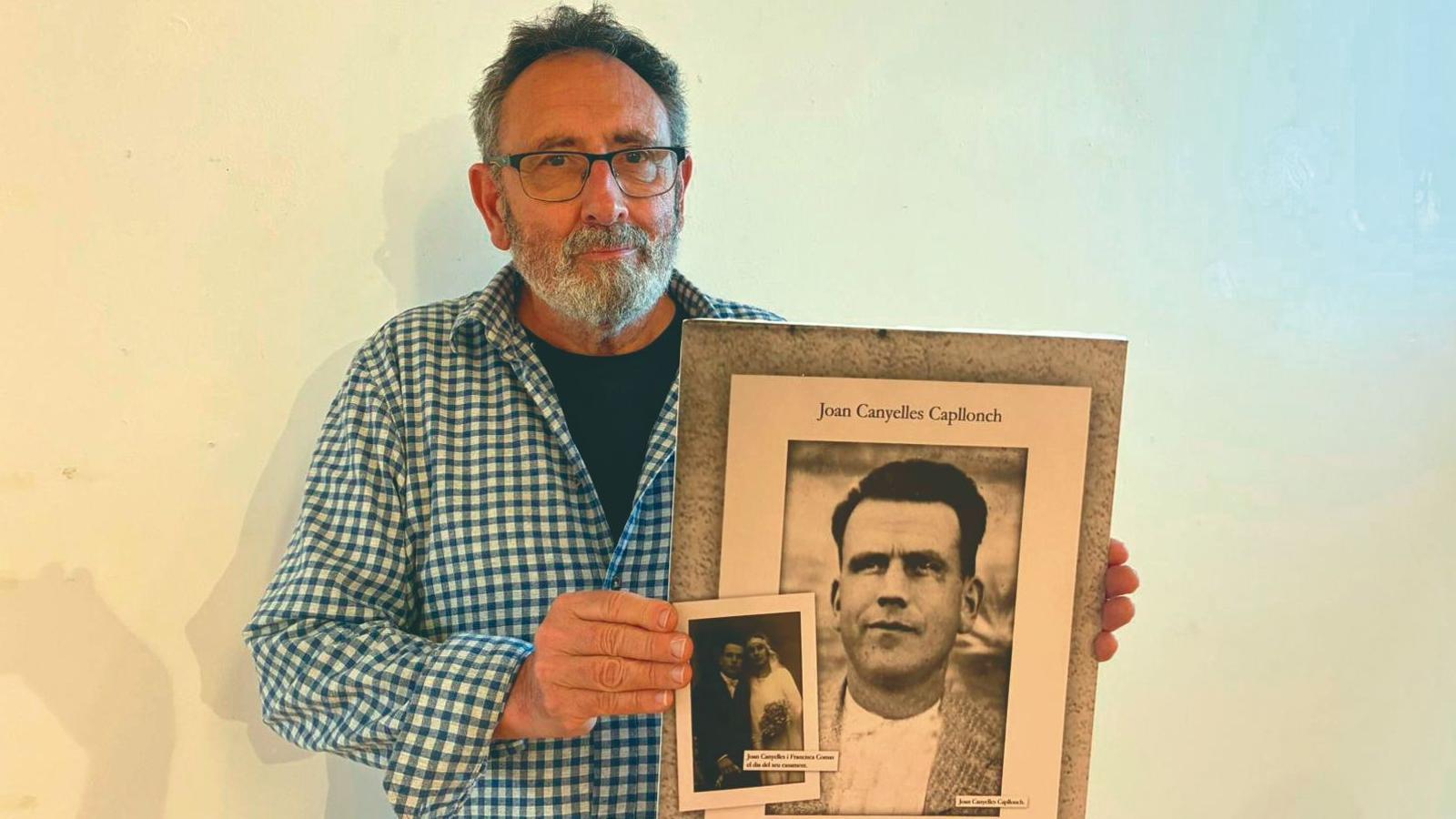
Another victim of fascist madness was Joan Canyelles Capllonch,
The heroines of misfortune
Another victim of fascist madness was Joan Canyelles Capllonch, from Can Manent. He was a 31-year-old stonemason, affiliated with the socialist group and father of two young girls. His 'disappearance' has marked the life of his grandson, Guillem Mir, 63 years old. "He hid – he assured – inside the woodshed at home, from where he would come out to eat when no one was around. In December, the day before Christmas, two civil guards and a falangist went to look for him at home, alerted by a neighbor. Upon hearing them, he ran back to the woodshed. At that moment, however, my mother, who was two years old, came to meet him and said 'daddy, daddy'. Immediately after, the agents insisted that if he revealed his father's hiding place, they would give him a candy. That's how they ended up arresting him. My mother always felt guilty. They took him away in chains towards the Town Hall. On the way, he met his eldest daughter, four years old, who was leaving school. That scene impressed her a lot".

(‘stone that makes you travel’) in memory of his godfather. Two others were also dedicated to the married couple Jaume Nadal Ensenyat, “Leave it be”
From his childhood, Mir only remembers tears. “My grandmother and mother always started crying when I asked about my grandfather. They would even pull their hair out.” When he turned 17, the young pigeon fancier became obsessed with repairing that family trauma and consulted records in every possible archive. “My mother always told me: ‘Leave it be, leave it be’.” In 2006, hopes increased with the establishment of the Associació Memòria de Mallorca. A year later, the socialist government of José Luis Rodríguez Zapatero approved the first state Law of Historical Memory.
In 2010, with Francesc Antich's second Pact of Progress, the first map of mass graves in the Balearic Islands began to be compiled. In 2014, Francina Armengol's Executive carried out the first exhumation, in Sant Joan. In 2016, it was the turn of the one at the cemetery of Porreres. Then the earth revealed the truth sought for three decades. “One day –Mir recalls with a broken voice– Maria Antònia Oliver, the president of the Associació Memòria de Mallorca, called me. She assured me, all emotional, that they had found my grandfather's bones. His DNA samples matched mine. I could do nothing but cry. My mother had senile dementia then and didn't understand anything anymore.” At the moment of seeing the remains, there was no solace. “I hugged my grandfather's skull and kissed it twice. He had two bullet holes in the back of his neck. There were two more in his legs. He was found tied to another repressed person with a string in his hands.”
On January 14, 2018, the ceremony took place for the return to the Esporles cemetery of the box containing the remains of Joan Canyelles Capllonch and those of Mayor Tomàs Seguí Seguí, who had also been identified in the Porreres exhumation. That same year, the Armengol government would give the green light to the first Law of democratic memory and recognition of the Balearic Islands, which complemented the Balearic Law of Pits, approved in 2016. Now the PP Government of Marga Prohens, spurred on by Vox, has just repealed it. “From Vox –says the one from Esporles– I am not surprised by anything. More sad is the role of the PP, a theoretically moderate right-wing party, which at the time partially supported the norm. For the second time they want to erase the victims of Francoism from collective memory”.
Since last week, Mir has felt more satisfied with his fight against amnesia with the placement in Esporles of a Stolpersteine (‘stumbling block’) in memory of his godfather. Two more were also placed dedicated to the couple formed by Jaume Nadal Ensenyat, in Pino, and Margalida Bosch Bestard. He died in 1953 due to the after-effects of a beating three years earlier, and she in 1936 was savagely tortured for refusing to say where her then-partner was. Her head was shaved and she was forced to drink castor oil. She died in 1952 due to an illness.
