Difficulty 3 out of 5Distance 15 kmElevation gain 457 mDuration 4 h 50 minMaximum altitude 373 mNot a circular route
The hermitage of Betlem along the path of Can Canals
Linear itinerary through the municipal term of Artà following old paths that united the town with the ancient Muslim farmstead of Binialgorfa
14/08/2026 - 20:11 h
-
CAT -
CAST -
GER
PalmaThe following route is a long but quiet walk between the town of Artà and the hermitage of Betlem. A linear itinerary that crosses one of the most intense cultural landscapes of the gregal of the island of Mallorca: paths and estates with history, such as Son Sureda and Can Canals, which in Muslim times constituted the farmstead of Benimira; narrow and elongated scrublands with an interesting and very fragile natural heritage; a beautiful and interesting toponymy that reveals uses, customs, and legends closely linked to the territory, such as the rock of the hermit Macari and the military observatory of La Coassa. As always, we recommend using public transport for our trips. To get to Artà, we have the following lines: L-325 Alcúdia-Cala Ratjada; L-411 Cala Rajada-Manacor; L-411e Cala Rajada-Palma; and L-421 Colònia de Sant Pere-Artà. On the website ‘tib.org’ you will find all the information on timetables and availability of each line.
The route
[00 min] We start walking from the old Artà train station, where the TIB bus lines currently stop, on Costa i Llobera Avenue. Oriented towards the northwest of the town, our first objective is the path of Can Canals, which begins between the Pou de sa Lluna nursery school, on the right, and the CEIP Na Caragol, on the left, the latter adjacent to the IES Llorenç Garcias i Font. As we take the first steps, we recall that the railway section between Manacor and Artà was inaugurated in 1921 and remained active until 1977, the year in which the line connecting Inca with the northeast of Mallorca was closed. Currently transformed into a greenway, it can be traveled from Artà to Manacor on foot or by bicycle.

Located at the start of the Can Canals path [15 min], between the Pou de sa Lluna kindergarten and CEIP Na Caragol, we advance towards the outskirts of Artà. The path, paved and with a long, straight initial section, goes up and down. [30 min] Soon, a sign informs us that we are entering the area of influence of the Llevant Peninsula Natural Park. Shortly after, the track turns right, loses the asphalt, and places us at an important crossroads. We must continue straight ahead, leaving the Son Sureda path to the left. We pass between centuries-old cypresses where, to the left, you can see the well of en Petro. Ahead, we can see the houses of Can Canals [45 min], which we leave to the right. In Muslim times, Son Sureda and Can Canals formed the Benimira farmstead.
We follow a wide, dirt path that plunges into a dense pine forest. Attention! Because just around a left turn and before crossing a stream tributary of the Can Canals stream, we must see a bedstead on the right serving as a barrier [55 min]. We leave the track and pass through this gate, because from here starts the old path to the hermitage of Betlem. After an initial flat and lush section – the sementer de ses Piquetes – [1 h 10 min], the small path begins to climb the slopes of this long and narrow ravine that originates at the Replà, very close to the Coll dels Pescadors (374 m). Although we have to overcome a significant difference in altitude, the climb is very gentle and comfortable.
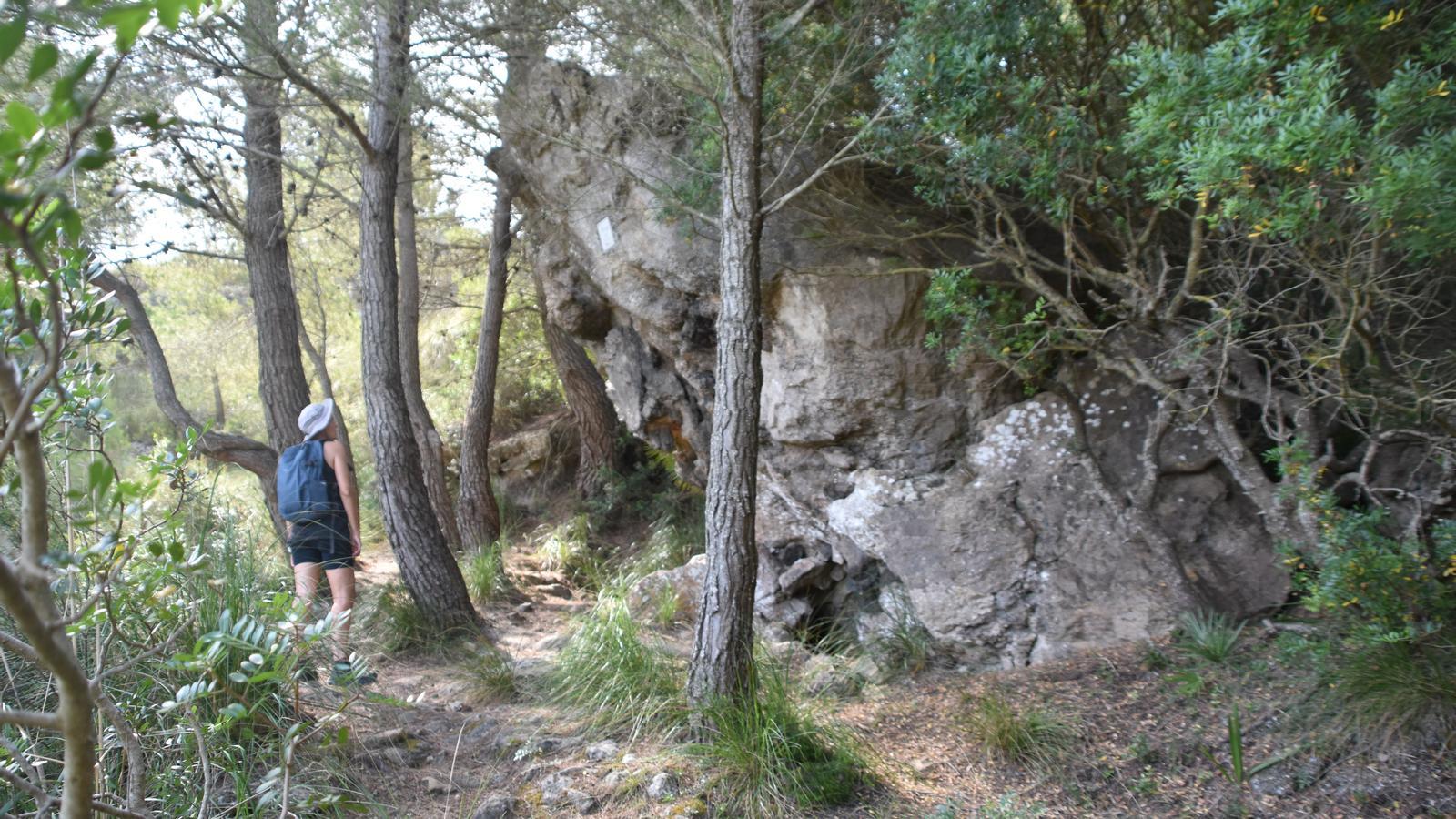
We emerge onto the Artà to Betlem hermitage road [1 h 45 min], at km 7 (Ma-3333). We head left, towards the Coll dels Pescadors. About two hundred meters away, on a right turn already descending to the hermitage, on the right side of the road, we find signage for the park route that crosses this area. The path, not very clear at first, soon becomes so, and also precise. Shortly before emerging onto the road again [1 h 55 min], we pass under the rock of the hermit Macari. A small cave where a tile attached to the stone informs us about this legendary place.
But who was hermit Macari? According to the important Majorcan folklorist Andreu Ferrer i Ginard (Artà, 1887 - Palma, 1975), he was born in Felanitx on October 2, 1799. Baptized with the name Bartomeu, he was the son of Bartomeu Monserrat and Antònia Adrover, from Can Passol. His religious life began at the hermitage of the Santíssima Trinitat in Valldemossa and, desiring an even more austere life, he migrated to La Trapa (Andratx). After a brief period of exclaustration, around 1820, he regained his vocation at the hermitage of Betlem until his death on May 7, 1881. Hermit Macari lived the life of a penitent saint and was distinguished by his blind obedience to all commands.
All in all, a personality that has become a legend... Thus, it is said on the rock bearing his name that "hermit Macari, once, was digging gravel with some men just below the rocky outcrop that formed a small cave". At that moment, everyone heard with dread the creaking of the boulder that was about to fall on them. When all seemed lost, the hermit "stopped the boulder with his hand, as if it were a small stone". Believing is not a sin, said Father Alcover.

Mrs. Bernadeta
After the first shortcut, we come out onto the asphalt and move left to join the continuation of the old road to the hermitage of Betlem. We regain the road and at the next bend, we turn right and follow the path to the fountain of the Hermitage [2 h 05 min], also known as na Bernadeta, for the representation housed in this small artificial grotto in commemoration of the Marian apparitions in Lourdes in 1858. From here, we head towards the hermitage of Betlem along a path lined with cypresses, in its final stretch. [2 h 15 min] The old Muslim farmstead of Binialgorfa became a hermitage in 1805. Founded by members of the eremitical community of Sant Honorat de Randa and La Trinitat de Valldemossa, it had among its benefactors Cardinal Despuig and Canon Joan Dameto.
Just behind the hermitage, we find a small gate from which, facing northwest, a path begins that connects to La Coassa (325 m) [2 h 25 min], a promontory with beautiful views over the bay of Alcúdia, from where we can enjoy an extensive perspective of the Serra Artana, from the peak of Ferrutx to the Talaia Moreia. Here we also find some constructions corresponding to an old military observatory from the end of the Civil War. From here we will begin our return by retracing the steps we have taken until we reach the Artà station [4 h 50 min].
The data
@Fita_a_Fita
