And Okuda loses his colors in the West End
The project, with a cost of 371,000 euros, faces imminent repairs and leaves the future of maintenance in the air due to premature wear
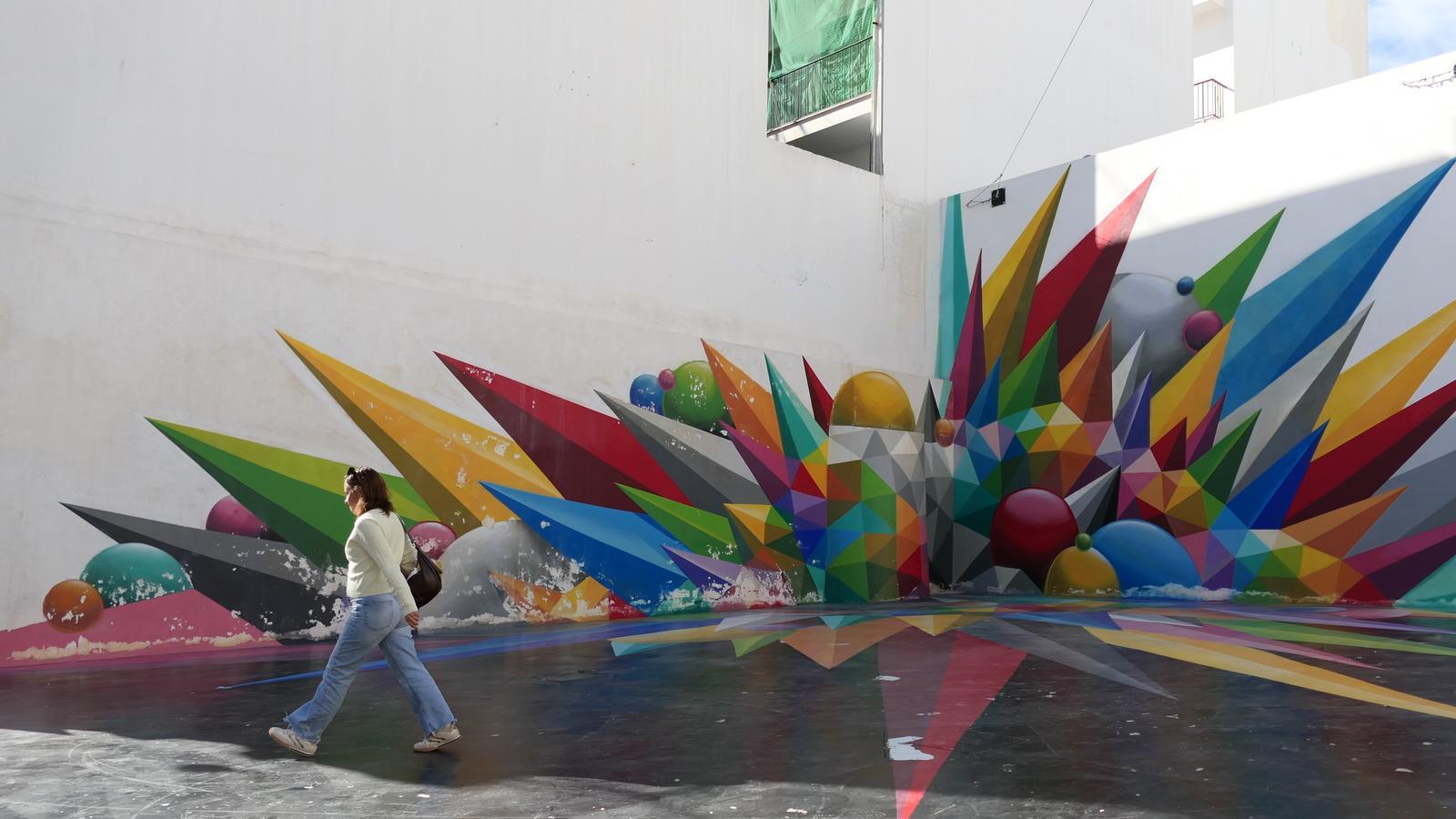

IbizaSomeone in the Sant Antoni de Portmany City Council had an idea: what if we painted the main street of the West End in bright colors? The idea was to combat drunken tourism with art – the West is an area known mainly for its bars – or, in the words of the Portmany mayor, Marcos Serra: “An integral reconstruction project for this entire area, to make the leap in tourist quality that we have always sought.” And so it was done. The artist in charge was Okuda San Miguel, a Cantabrian painter of international fame, a versatile author – responsible, among other things, for the controversial transformation of the Ajo lighthouse, the 2018 Valencia City Council falla, and the interior of the International Church of Cannabis, in Denver. On May 21, 2025, Okuda's work in Sant Antoni was presented to society: the ground of Santa Agnès street completely painted with colorful geometric shapes, plus a square where Okuda's main emblem stands, the so-called Star of Chaos. In total, 371,000 euros, with a contribution of 220,000 euros from European funds.
It's not that the idea has turned out badly, but it could end up being very expensive. The artistic intervention is called Endless Rainbow Walk. The 'rainbow walk' may have no end, but its materials do; in fact, it has been observed that they wear out very quickly; Okuda's intervention, after ten months of humidity, rain, and inclement sun, no longer has the splendor of its debut; the colors have faded and the ground is chipped in many places. The worst is presented when accessing the square, to the star that functions as the heart of the piece, which shows serious damage. Curiously, the wall part is much worse than the ground that pedestrians tread.
In response to questions from this newspaper, the Portmany council has not wanted to estimate the cost of repairs; it has emphasized that the work will be repaired “befor the start of the tourist season, as planned from the beginning of the project.” The repair of the ground on Sant Agnès street is for now at the artist's expense, “ since the contract includes a one-year warranty ”, while the mural in the square, an additional work requested by the City Council, will be borne by the Council. And from next year, the Sant Antoni City Council will be responsible for any damage or wear and tear of the Endless Rainbow Walk.
From an artistic point of view, Endless Rainbow Walk is a review of Okuda's main resources and themes: geometric shapes with a very intense polychromy, which build an authentic 'jungle of colours'; this geometry sometimes reorganizes to form an animal's head, a star, an eye or lips; only sometimes is colour abandoned in favour of the grayscale and the viewer's gaze rests for a moment.
As the artist himself explains in the work's promotional video (endlessrainbowwalk.com), what inspired him is the “constant diversity of people who come, of all types of cultures, and of this cultural feedback that exists”. In reality, Okuda's motifs – especially animal heads and stars – are repeated over and over again in many of his projects, and geometric polychromy is a constant in everything he paints. If Endless Rainbow Walk speaks of 'cultural diversity', it is not the only work by the Cantabrian painter that does so.
And now what?
Leaving aside the issue of the intrinsic quality of the piece –tastes differ, as the saying goes–, the question the Council must answer is how the maintenance of a work of art that shows such notable degradation in just ten months will be addressed. Will it have to be repaired at the start of each season, like someone replacing damaged tiles on a promenade? It is one option. But a work of art is not a promenade. An authentic work of art is expected to be in perfect condition at all times. Immortal through time. This is the idea –mistaken or not– that many people have of art, at least of ‘museum’ art: a heritage worth maintaining and preserving in costly public infrastructures called museums: places with guards, controlled lighting, temperature and humidity sensors, and that usually charge an entrance fee.
Or will the Endless Rainbow Walk be treated as authentic urban art? In theory, that is what it is; in fact, Okuda San Miguel is one of the main figures in Spanish urban art. Urban art, unlike museum pieces, is conceived to degrade; it is not intended to be immortal, but transient. This is the idea: it is incorporated into the urban landscape –often with a political message– and disappears as this landscape also transforms and degrades. It is the other option: to let the Endless Rainbow Walk degrade until it disappears –despite the criticism that its decay would undoubtedly provoke.
Two options: one that will represent an annual expense for the taxpayers of Sant Antoni that the Council itself still ignores, or, the other, to allow the progressive degradation of a work that has cost 371,000 euros. Did the Sant Antoni City Council know what they were buying when they commissioned the work from Okuda?
