
A commons is an area of land, generally a forest, belonging to all the inhabitants of a town. In Mallorca, the largest is that of Bunyola. Located in the heart of the Serra de Tramuntana – a World Heritage Site since 2011 – it covers 716 hectares populated by pine forests, scrubland, and holm oak groves. This area represents 8.5% of the municipality's surface, which today has nearly 7,000 inhabitants, including those of Orient. Its highest peak is the Penyal d’Honor, at 819 meters high. “The place,” says researcher Biel Mateu Batle, “is part of the sentimental memory of the people of Bunyola. It is where the pine cutters came from who, in the 1950s, were national champions on four occasions. It is a place much loved by hikers and climbers. It is no longer as well-maintained as it was a century ago, when it was the economic engine of the town.”Mateu, grandson of a charcoal burner, offers a snapshot of the Bunyola commons from his ancestors' time. “It was like the estate of the King of Pollença's castle, now owned by the March family, which looks like a garden. It's unlikely there would be a fire, considering how clean the land is. This is how all the estates in Mallorca should be.” After the Catalan conquest, in 1300, the Ordinances of James II led to the cession of a significant amount of communal land to various towns. This land provided inhabitants with raw materials such as firewood, charcoal, and lime, pasture for sheep, goats, and pigs, and thrush hunting with nets. The town councils, then called Universities, were responsible for auctioning off the forest exploitation. The Bunyola commons are documented from 1416. Their history can be traced in the book Tot pot ser en aquest món. Llegendes i contarelles de Bunyola (Edicions Documenta Balear, 2012), written by Bàrbara Suau, Elisabet Abeyà, and Gaspar Valero.In 1912, the opening of the Palma-Sóller railway line, with a stop in Bunyola, allowed for the mass sale of firewood from the commons to other parts of Mallorca. Thanks to the profits obtained, the Bunyola council was able to undertake a series of public works without the need to collect taxes. Thus, streets and roads were improved, buildings such as the slaughterhouse and the school were constructed, and the sewage system was developed. Forest exploitation lasted until the 1970s. Currently, as the area is a Natural Area of Special Interest (ANEI), about a hundred hunting grounds for thrush hunting with nets are auctioned among the inhabitants of Bunyola.Besides Bunyola, the commons that still belong to a town today are those of Lloret de Vistalegre, in the center of the island, with a 131-hectare scrubland. One of its attractions is the Cova d’en Dainat, a Bronze Age burial cave. The memory of these communal spaces is still preserved in the toponymy of other places on the island.
The 'aizkolaris' of Bunyola
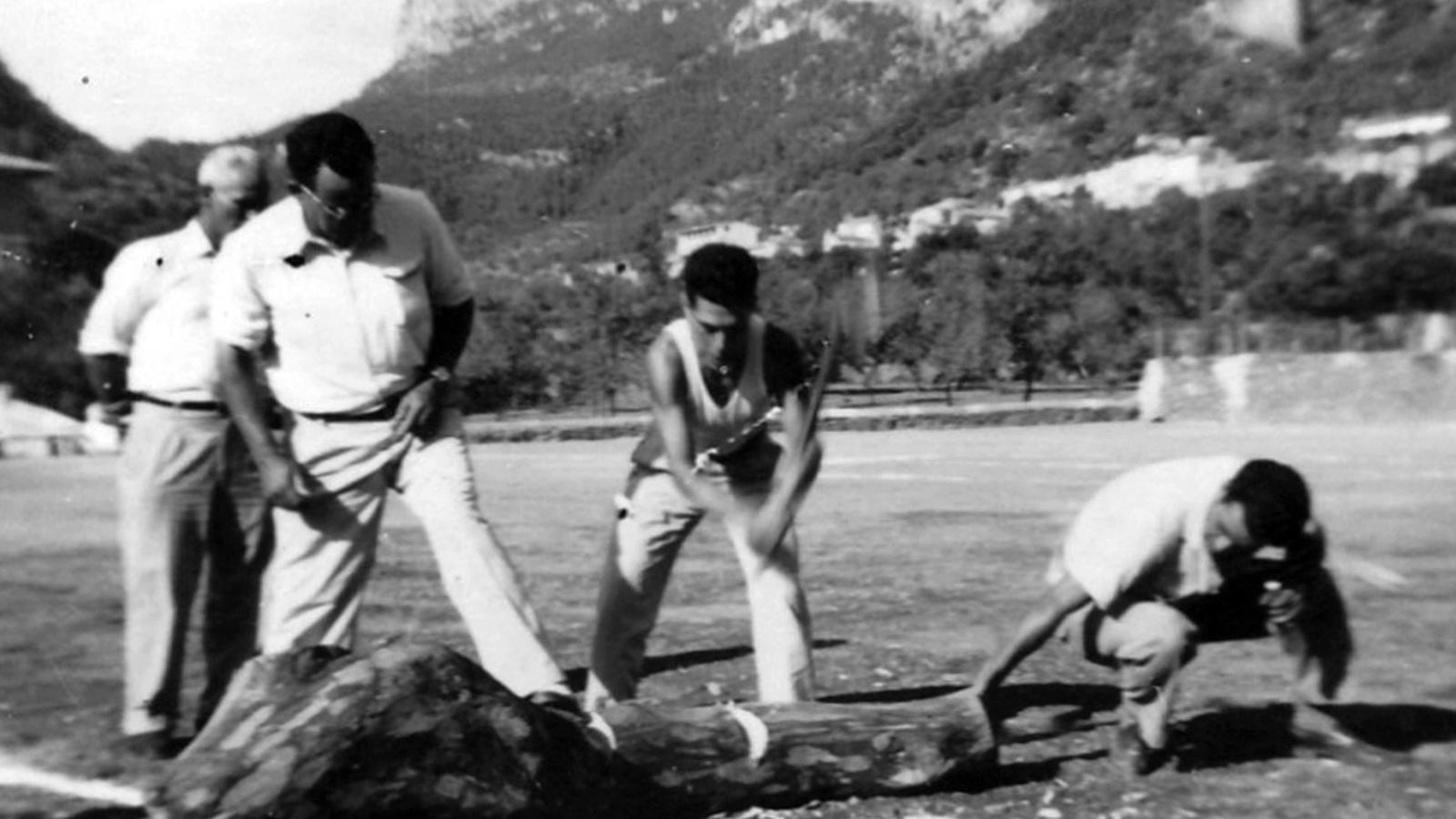
In the 50s, eclipsing the fame of the Basque woodcutters, the bunyolins were four-time Spanish champions in the contests organized by Francoism to claim 'national vigor'. Their training ground was the Commune of the municipality, which supplied wood to all of Mallorca

-
CAT -
CAST -
DE
PalmaFrom his house in Bunyola, at the foot of the Serra d’Alfàbia, Miquel Canals Canyelles Moro, 93 years old, proudly displays a framed photo from his youth. It's no ordinary photo. It shows him with the trophy that in 1956, at the age of 23, accredited him as the best pine cutter in the entire State. At the end of November 2019, local researcher Biel Mateu Batle rescued his story and that of his companions from oblivion. This was during the Mountain Fair he organized in the town, which would later be called the Fira de Santa Catalina.
“In the 1950s – assures Mateu under Canals’ watchful gaze –, woodcutters from Bunyola won the well-known National Log Cutting Championship four times. On another occasion, they were runners-up.” These competitions were organized by the Frente de Juventudes and the National Delegation of Sports. For one week each year, they took place in a different location in the State, often in a bullring. “These were contests that Francoism used to claim ‘national vigor’. There were also regional ones. In the Basque Country, pine cutters are known as aizkolaris. However, the Basques could only compete among themselves. Franco did not want them to win the state prize because he knew they were very good.”

The researcher contextualizes that era: “Bunyola was very poor. Unlike Sóller, which had about twenty factories, here there was only one, inaugurated in 1913. Mainly women worked there; the rest were dedicated to picking olives. The lands were in the hands of a few gentlemen, who hired men to be woodcutters or charcoal burners. Those who could, emigrated. In Brazil and Algeria, some had the opportunity to continue working as professional cutters”.
Municipality of Bunyola
Bunyola was able to emerge from poverty thanks to its Commune, an extension of 716 hectares populated by pine and holm oaks. “All the firewood, in different sizes –states Mateu–, was transported by train to Palma, to the carpentry shops, but also to Manacor, where there was an important furniture industry. This business allowed the City Council not to charge taxes to the citizens, which did not happen anywhere else. With the profits made in two years, the village school could be built, which was inaugurated in 1928”.
The exploitation of the Commune was not carried out indiscriminately, but followed an established protocol. “It was divided –says the researcher– into 30 zones or ‘cortes’, which the cutters were responsible for always keeping very clean. Each year, pines were cut from only one zone to ensure reforestation. There was an engineer who marked the pines that could be cut. The charcoal makers followed the same instructions with the holm oaks they needed to make the kiln”. From those times of close relationship with nature, there are words that have already disappeared, such as ‘barriscar’. “It was the name given to the agreement between a businessman and the cutter when setting the price for the order. The agreement was sealed with a handshake. It was mandatory even if it was not recorded in any document before a notary”.
International fame
The action of felling the pine tree was called ‘tomar el pi’. Once on the ground, it was proceeded to ‘esbrancar-lo’, to remove its branches. With the thicker ones, ‘companatge’ was made, which was used for fire and to boil cauldrons, and with the thinner ones, ‘feixines’, much in demand at bakeries and for firing earthenware tiles. Next, with a smaller axe, ‘es pelava el pi’, its bark was removed, which, once ground, was used to dye fabrics. Then, it was time to ‘treure el metro’, to make pieces of the trunk with a long saw called verduc.
The skill that the people of Bunyola had in that ancestral trade crossed borders. “They were strong and had a lot of technique – assures Mateu. At the beginning of the 20th century, some were hired to work in the French Pyrenees. There everyone knew how to recognize the pine trees they had felled. To make the most of the wood, they left the tree stump cut flush with the ground. Furthermore, inside, they made the shape of a cup, so that when it rained, the root would rot much faster and allow for quicker regeneration of the pine tree.”
Canals agrees with Mateu in everything he says. “There were also pine cutters in other towns in the Serra such as Sóller, Deià, Galilea and Santa Maria. I was happy working in the Comuna de Bunyola. On some occasions, I also went to cut in Felanitx, Artà and la Colònia de Sant Jordi. We were very careful. We made sure that when the pine fell, it did not damage the others around it. We knew how to direct it. I witnessed few accidents. We brought the tree down from the mountain with a machine with two large wheels like cart wheels called ‘burro’.”
In the service of the fascist mayor
required me to go with him and Bernat Castell, Juana, in tandem with Rafel Cànoves from Santanyí. A year later, in Soria, Verdera repeated and was second classified alongside Joan Riera Porret (son). “In 1956 – recalls Canals– the Falangist mayor Miquel Mesquí asked me to go with Bernat Castell, Xinga. And in 1958, in San Sebastián, the glory was for Tomeu Batle In Segovia, the two Bunyola residents put on a good display of strength. “They gave us a log and when one had finished a cut, the other had to make the second cut, so that the final result was three pieces. We broke the record by doing it in 20 minutes. We cut from the ground. The Basques, on the other hand, who competed separately, did it from on top of the log”. The title of Spanish champion was merely a symbolic recognition. “We didn't see a single peseta. We suspected that the prize money, which was very substantial, went into the pockets of the Falangist mayor of Bunyola. That's when I understood his insistence that I participate in the competition”.
The return of the bunyolí home occurred amidst absolute indifference. “We were news –he assures– in the press. The neighbours, however, did not give us any welcome. At that time, nobody gave importance to a practice that was part of the village's modus vivendi.” In 1957, in Valladolid, the one who lifted the precious trophy was Canals' brother, Joan, partnering with Rafel Suau Raxón. And in 1958, in San Sebastián, the glory went to Tomeu Batle Montserrat and Biel Batle Guitarró. In the 60s, with the outbreak of the tourist boom, the bunyolí left the axe in the Comuna to go work in a hotel on Palma's Maritime Promenade. “It was a better paid and less arduous job. Many of my colleagues also did the same.”
Humble people
In full construction fever, Mallorcan wood was totally dispensable. “To make the insides of sofas –explains Mateu– it's fine. However, it's not useful for making finer pieces like doors, because it has a lot of knots. Nevertheless, it was a time when chipboard and melamine were imposed for the large production of furniture.” Little by little, the sign of the new times would make people forget Bunyola's woodcutter past. Its vindication arrived in 2019. “In the first edition of the Mountain fair, the City Council, under Andreu Bujosa (Esquerra Oberta), promoted the first tribute to pine cutters. The five who were still alive came. They were very humble people who placed no value on their trade. Many neighbors did not know that in the 1950s they had been champions of Spain”.
Soon the Bunyola aizkolaris will receive another tribute in the form of a statue. It will be placed in the spot where until 2021 stood the Creu dels Caiguts and will also be dedicated to other lost trades of the municipality. Canals is happy with this unexpected recognition. “With the work I've done –he says, smiling broadly– it seems incredible that I'm doing so well at 93 years old. Until I was 85, I went cycling every week. Sometimes I went up to Lluc. My daughters forced me to stop because they were worried. I, however, would still pedal.” This testimony of the transformation of agricultural Mallorca to tourist Mallorca ends the conversation with a single lament: “Now the dirt is eating away at the farms and there is a greater risk of fires in the summer. Before, when people lived off the land, everything was better cared for”.
