Ferran Palau: "I have renounced pop and embraced song in its purest state"
Musician

-
CAT -
CAST -
GER
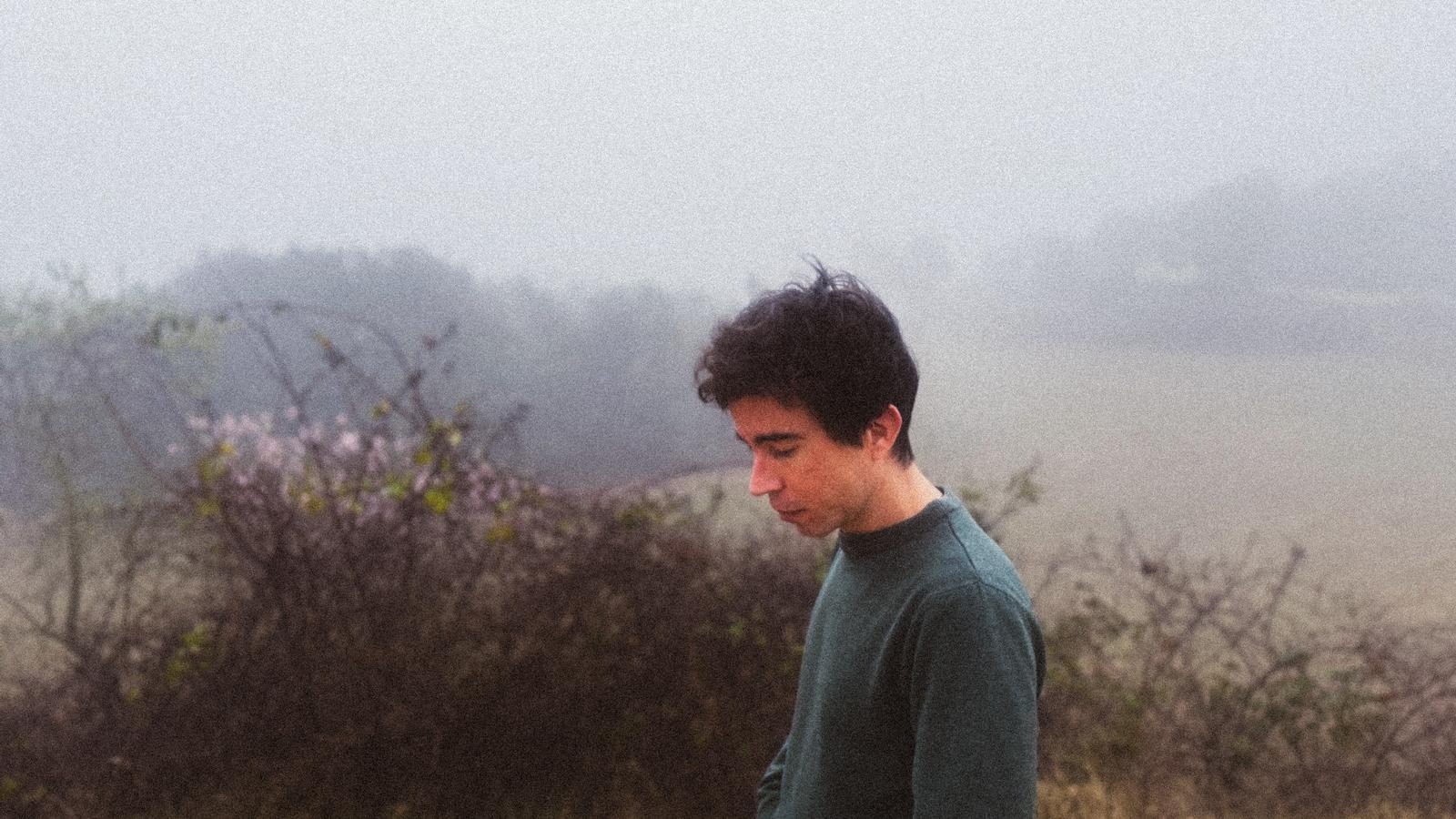
PalmaIt was at the beginning of the year, on January 24th, when Ferran Palau released the album Aniversari feliç. An album of ten songs with a visual part full of fog and a protagonist: the ghost. The musician explains that the fog represents the “idea of being in heaven, in the clouds,” and the ghost is a metaphor for shedding layers: clothes, skin, until only the soul or spirit remains. “I needed to give up certain clichés that were associated with me and my music,” he says. Thus, he has removed the drums, proposing a listening experience that takes the listener to a no-place, an ethereal, light space. He will present Aniversari feliç in Mallorca on June 27th, in the garden of Casa Llorenç Villalonga, as part of the La Lluna en Vers festival. We spoke with him.
“I will set fire to so many things” is the first phrase of the album, which begins with the song ‘Tan feliç’. Does this mean writing and making songs in a different way?
— Also. I wanted to return to a more essential place: writing a song, recording vocals and guitar, and not needing much more. That the song itself would be the proposal and the production less relevant. I've sought an airy feeling, like a walk through the clouds. I'd like people, when they see the concert, to feel it's something outside of space and time, without a specific epic or trend. So that many years from now you can listen to the album and not know if it's from 1956, 1976, or 2026.
On a scale of sensations when creating, how has this new way of doing things struck you?
— It has been a process that has served me to empty myself and to get excited again. I had lost the fresh perspective a little and the feeling of knowing where I was going. Compared to a few years ago, now I do feel fresh. I have renounced pop and embraced the song in its purest state.
Sounds risky but honest.
— I know, commercially, it's not the best strategy; but, vitally, it is. There comes a time when you have the feeling that you do what you do because an inertia for extra-artistic reasons is driving you. The pop format allowed me to play in all sorts of spaces and it was a music that was easier to sell. The change had a point of risk. But Louise, my partner and manager, was the first to tell me that I had to follow my artistic compass and not think about anything else. Otherwise, you end up losing your essence.
You often explain that you write very intuitively. Although you have touched some things in the production process, I understand that the way of writing has not changed.
— No. My method consists of doing a little each day. But the world changes, I am not the same person, my gaze and attitude also change. I never feel like I'm controlling what I do. As for the lyrics, I feel more like a spectator of what I do than the person who writes it. I don't usually make a conscious decision about what a song will be about. Possible interpretations appear and I reinforce the ones that seem interesting to me. I have written many songs and, sometimes, I think it is difficult to understand exactly how these things happen.
Let me tell you that the lyrics of this album are perhaps more literal than on others…
— A little, but not much. In fact, I ended up correcting some things so they wouldn't be so explicit. When the subject of a song is too clearly glimpsed, I lose interest. I like possibilities. A song must have elastic capacity. When it becomes a closed story, it no longer works for me.
Is there any that surprised you to write?
— 'Bang Bang', for example. It's a song about a murder. I didn't decide it. I had this idea saved for years, from the onomatopoeia bang-bang. I wanted to use it at some point, but the day never came. Until now. Pulling on the thread, this little story ended up appearing.
A Hey, what's up? this idea appears of continuing to live normally while everything seems to collapse around. You have slightly changed your gaze: from inside out. Do you agree?
— Totally. On the records from the Kevin and Parc eras there was very escapist music from reality. Which, in fact, is also a response to reality, but from evasion. On the other hand, when I listened to the bulk of the songs on this album, I saw that they looked further, to the world beyond my body and my head. There is more awareness of what is happening and also of the anxiety people have. All this has crept in. It didn't happen so much before. When I sing them live, I see that there are phrases that suggest things very aligned with how many people feel. Everyone knows that things are not going well, everyone would like the situation to change, but nothing happens and nobody feels capable of doing much about it.
And that's why we go out to dispel the mist, as the song says.
— People do what they can with contradictions. There are issues like mobile addiction or consuming more responsibly, which we know affect us. Many things happen at once and generate guilt, anxiety, and distress. But, in reality, we shouldn't feel guilty. If you live a normal life even if you have the feeling that everything is falling apart, you don't have to feel guilty. One day I read a poem by Wisława Szymborska, and one of the verses said: “Forgive me, distant wars, for bringing flowers home." In the end, what we have to do is try to make our family and friends happy.
How has removing layers influenced the sound of the album? Also, the cello, the transverse flute, and the clarinet, the trombone are playing on it…
— I was interested in working with timeless instruments, outside of eras and fashions, which at the same time have the capacity to sound very contemporary. They fit with this search for an airy sound out of rhythm. That's why it was also important to remove the drums. All the weight falls on the guitar and voice. And without a click track. In the studio, I was looking for a final sound, on the record, very natural. During the last fifteen years, new technologies have made musical production more and more polished. It is very easy to tune a voice or make a rhythm go perfectly to a click track, and this makes many people tend to clean up and over-edit music. I think it's perfect, and there are people who do things that amaze me, but it's true that the sound has also become more artificial and homogeneous. Everyone uses the same resources. I was clear that my music could not go through this. I want to hear my tone of voice, I want the guitar to sound like the way I move my fingers.
You are working again with Jordi Matas, and Louise Sansom and your son Leo have participated in a special way. What do you take away from each of them?
— With Jordi, we are a kind of two-headed monster. We've been working together for many years. He is a very restless person in the field of sound research and I am more obsessed with writing songs. He is a sound psychopath and often insists on the idea of "we've already done this". He always tries to open a new window, even a small one, and take us to the next screen. Sometimes he succeeds and I thank him for it. Louise is present in all aspects of my life: musically, familially, and sentimentally. On this album, she has also had a lot to do with the idea of the ghost, with the cover photograph, and with the music video. It had been years since we had worked together like this, and it reminded me of the early days of Anímic, when with few resources we tried to do beautiful things. It has been very nice to reconnect making this type of project.
And Leo? He's growing up…
— Leo also participates. In addition, he is writing his songs, learning to play the guitar and, if we can, we will record his first album. He is very hardworking and is eager to improve as a musician.
You have said on occasion that your illness with deafness has worsened. It is a limitation, but you have also commented that it can be a creative influence. How are you, at this moment, with that?
— There are things that are already problematic for me: exposing myself to noise, for example. If there are many people around me, or if I'm sitting at a table with more than four people, I have to wear earplugs. The same happens musically. On stage, if I expose myself to high volume, my ears distort. That's why I try to work at a soft volume. Very large stages can become unbearable. Years ago, the doctor told me I couldn't expose myself to certain noise levels. We could say I haven't always behaved well in this regard, and that's why I'm suffering more now. The illness is there and it's inevitable. The years I can continue hearing can be of higher quality or lower quality, and there's a part that depends on me. One ear is already very bad and I have to take care of the other. That's why I'm very happy with this live format. Sometimes I even forget about this hearing problem, because there are no frequencies that bother me or volumes that distort me.
