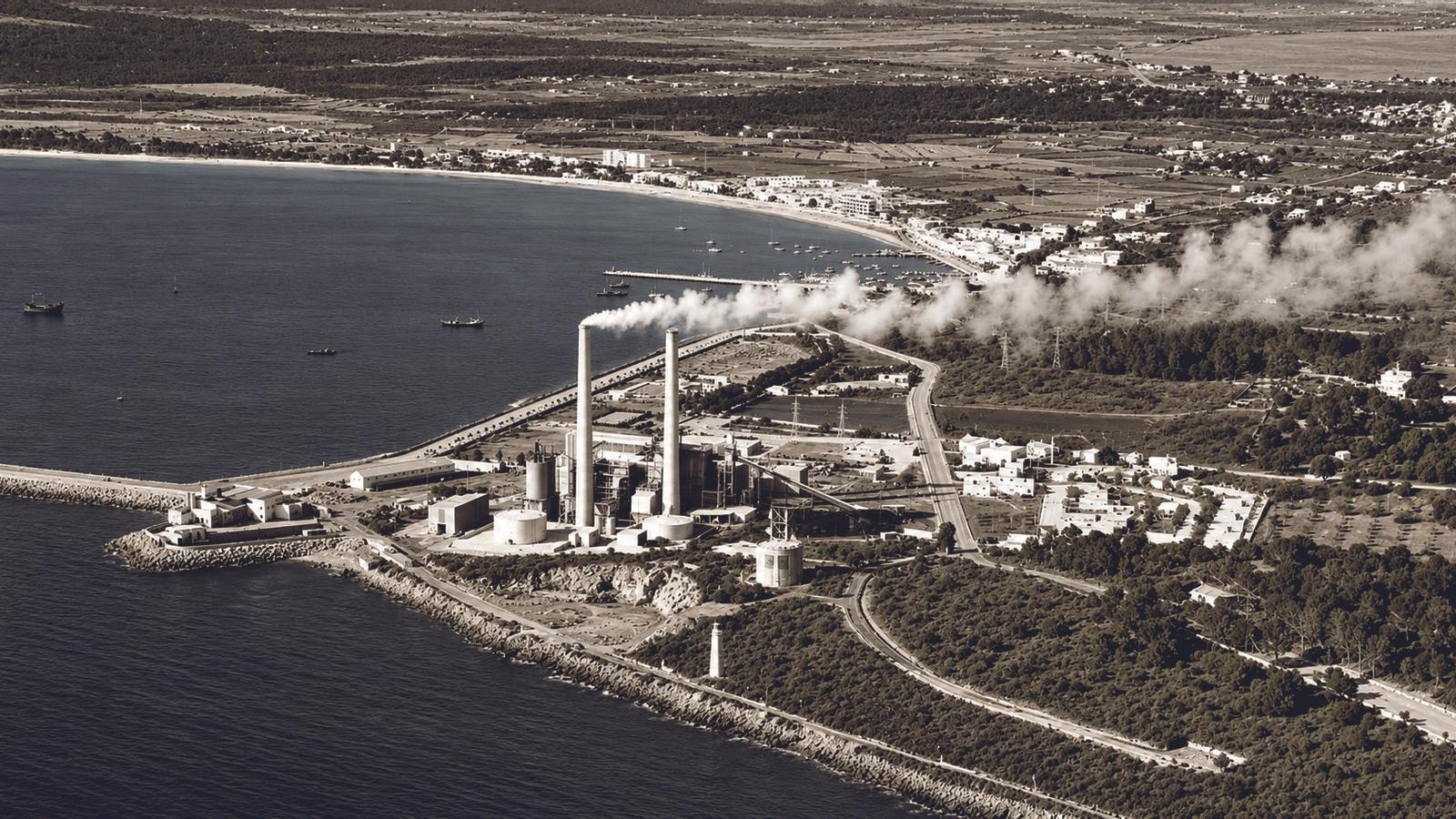
Alcanada, the power station that illuminated tourist Mallorca
In 1960 Franco inaugurated in Alcúdia the electricity generator for a large part of the island which was built with professionals who arrived from the Peninsula, especially from the north. Some married in sa Pobla, amidst the indignation of the people of the town
PalmaIn 1892, the Menorcan Francesc F. Andreu promoted the first power plant in the Balearic Islands, Eléctrica Mahonesa. The first one in Mallorca was inaugurated in Alaró in 1901 through the initiative of the brothers Gaspar and Josep Perelló Pol, local soap and oil merchants. In 1902, electricity arrived in Manacor with the company Servera i Melis. And in 1903 it would be Palma's turn, thanks to the Compañía Mallorquina de Electricidad, which built a power plant near the Can Pere Antoni beach designed by the architect Gaspar Bennàssar. As pioneering infrastructures, there were also the hydroelectric power plants of Gorg Blau (1905) and La Costera (1908). In Ibiza, the first power plant dates back to 1907 and its architect was the businessman Abel Matutes Torres.
In 1927, Gas y Electricidad S.A. (Gesa) was born from the merger of Compañía Mallorquina de Electricidad with Sociedad Alumbrado por Gas in Palma, founded in 1858. In 1955, at the beginning of the boom in tourism, the company decided to build a new power plant in Mallorca under the direction of the renowned architect Ramón Vázquez Molezún. The chosen site was Alcanada (Alcúdia), on the Llatzeret estate. Located by the sea, it was a site where the boilers could be cooled quickly and where coal could arrive with ease. Locating the complex on the side of the Pollença bay was ruled out to prevent it from being visible from the exclusive Hotel Formentor. Instead, in the part of the Alcúdia bay, the tourism industry had not yet taken off.
The construction of the Alcanada power plant, with its two imposing chimneys, required qualified professionals from the Peninsula, where the steel industry was more advanced. One of them was Jose Rojo Sierra, a 26-year-old young man from Barakaldo (Biscay). From this Basque town, his widow, Simona Pol Mir from Sa Pobla, aged 89, recalls that adventure. “Back then he was 26 years old and was a first-class boiler maker. Along with about twenty other workers, he was sent to Mallorca to help assemble the boilers for a new infrastructure. It was a group formed not only by Basques but also by other workers from northern Spain and Andalusia. On the island, they stayed in a hostel in Sa Pobla, which was about 20 kilometers from Alcanada”.
Group of Basques in the square of sa Pobla.Family archive of José Rojo Sierra
Those newcomers felt privileged in their new destination. “They earned –Pol states– much more than the rest of the people in sa Pobla, who lived off the land. They had motorcycles with which they could get to know Mallorca better. When work was over, they would go out to have beers at the village bars.” Flirting with the local women caused tensions. “The local men sought fights with them. They couldn't stand that outsiders were stealing their girls. They would tell us: ‘You’ll see. When they leave, they’ll leave you stranded.’ That wasn't the case with Jose, my sweetheart.”
The young local woman’s new excitement was crushed by a rumor. “A woman who worked at the hostel for the Gesa workers whispered to me that Jose was receiving letters from his wife, with whom he already had daughters. That angered me greatly. I went looking for him immediately and gave him a piece of my mind: I told him he was a scoundrel and that I never wanted to see him ever again.” Distraught, Pol, educated at the nuns' school, went to confess to the priest of sa Pobla. His reaction was not what she expected. “He calmed me down. He assured me that it was all a lie. He knew that the letters of discord were actually from his sister, who was a mother of two children.” Then came the reconciliation. “Jose insisted to me that if he was with me, it was because he loved me.” The young woman in love had to gather courage to share the news at home. “My mother raised a hue and cry when she found out I had fallen in love with an ‘outsider’.”
In 1958, two years after courting, the wedding day arrived. It was the year that the Alcanada power plant also began operations. “After having assembled the boilers, Jose was left without work. Some of his colleagues opened a blacksmith shop in sa Pobla. He, however, preferred to return to Barakaldo, where he had guaranteed work. I was pregnant with my first child at the time.” The adaptation to Basque lands was not easy. “I missed my family a lot. A year later, my mother died. If she hadn't died, we surely would have returned to sa Pobla. I am the only one of the five friends married to a peninsular who left to live away.” Pol does not regret at all having let herself be guided by the dictates of her heart. “Jose gave me four children and has been the love of my life. I was able to enjoy his company for a short time. He died of a heart attack at 49 years old. I was 40.”
In May 1960, from the Basque Country, the people of Sa Pobla could see through the NO-DO how Franco officially inaugurated the Alcanada power plant –on that occasion he would also travel for the first time to Menorca to cut the ribbon for the Maó one. It was the second time the dictator visited Mallorca, where, between 1933 and 1935, during the Second Republic, he had been stationed as military commander of the Balearic Islands. The first time occurred in May 1947. It was on the occasion of the inauguration of the La Feixina monolith in Palma dedicated to the 765 victims of the cruiser Baleares, sunk in 1938 by the republican navy off the coast of Cartagena.
In 1968 Palma added a new power plant, that of Sant Joan de Déu, in Coll d’en Rabassa. It complemented the one that had opened in 1903 on the beach of Can Pere Antoni and which would be demolished in the 70s –in 1977, right in front, the avant-garde Gesa building was inaugurated, the work of architect Josep Ferragut, murdered in 1968. In the mid-70s, faced with the demand for electricity on an island fully committed to tourism, the company planned another power plant in Alcúdia. It was located on the Murterar site. Attached to the Albufera, it was two kilometers away from the sea and ten from the one in Alcanada.
Simona Pol Mir, an 89-year-old woman from Sa Pobla, married the Basque man Jose Rojo Sierra, one of the workers at the Alcúdia power plant. In their apartment in Barakaldo, she poses next to their 1958 wedding photo.Jose Rojo Sierra's family archive
For that construction, qualified professionals were once again requested. One of them was Constantino Diego Carrera, a native of Santander. “I –he recalls today at 90 years old– had arrived in Mallorca in 1963, at 27 years old. I was part of the second group that came from the Peninsula to continue the conditioning work at the Alcanada power plant. We stayed at the same hostel in sa Pobla. I immediately met a local woman from sa Pobla. She was the woman I married and who made me stay to live here. About fifteen years later they also asked me to go and assemble the boilers at the Murterar power plant”.
Indignant hoteliers
The first to raise their voices against those works were GOB and Unió de Pagesos, founded in 1973 and 1976, respectively. Joan Mayol, one of the historic leaders of the environmental organization, does not hesitate to recall a curious anecdote: “The hoteliers of the Port d’Alcúdia joined our campaign not out of any kind of environmental sensitivity, but because they did not want a power plant to prevent them from urbanizing the rest of the Albufera”. The activists did not manage to stop the Es Murterar complex, which was inaugurated in 1981 with a gigantic chimney. “Given the hoteliers' reaction, it was a lesser evil that we had to accept. If not, today the entire Albufera, which was declared a Natural Park in 1988, would be full of hotels. We, however, were left with the satisfaction of having imposed three conditions on Gesa: the purchase of a fairly large plot of land where the plant's ash could be dumped, instead of doing so inside the Albufera; the burial of the cooling channels that connected to the sea; and the conditioning of the power lines with an anti-collision device for birds, which was a pioneering measure throughout the State”.
El Murterar ended up replacing the Alcanada power plant, which closed in 1984. At the beginning of the 90s, GOB did manage to halt the construction of the Estalella power plant, on the coast of Llucmajor. The entry into the 21st century would bring new joys. In 2002, the Sant Joan de Déu Coll d’en Rebassa plant closed, and in 2019, the dismantling process of El Murterar began with the intention that it be definitive by this 2026 – it is one of the last coal-fired thermal power plants still operational in Spain.
Today, in Palma, the power plants that are in operation are Son Reus (2001) and Cas Tresorer (2008), which use natural gas. Throughout Mallorca, a large part of the energy comes directly from the peninsular electrical system – it includes wind, nuclear, hydroelectric, and solar energy. Under the supervision of Red Eléctrica de España, it arrives through a high-voltage submarine cable that connects Sagunt (Valencia) with Santa Ponça (Calvià). The first photovoltaic plants on the island date from 2006. Currently, there are nearly 140. The platform ‘Renewables yes, but not like this’ does not tire of denouncing the strong landscape impact they cause on rustic land.
A group of Basque friends with the Alcanada power plant in the background.
The Gesa village
The commissioning of the Alcanada power plant in 1958 also involved the construction of a nearby village with about thirty houses for employees. It was the work of architect Josep Ferragut, who in 1963 would design his groundbreaking Gesa building in front of the Palma Promenade. It was a completely self-sufficient project with all kinds of facilities. It included a church with a bell tower, a convent, a school, a commissary, an extensive sports area equipped with two swimming pools and a tennis court, and a casino with various services.
The Gesa village reflected the company hierarchy. For workers, the houses were smaller than those occupied by employees with greater responsibilities. Grouped in pairs, they were single-story buildings with a total area of 104 m2. They had three bedrooms, a dining room, a kitchen, a bathroom, and a laundry room with a porch. The decline of that sort of utopia began in 1976 with the closing of the school. By 1984, the Alcanada plant was already being closed down, which in 2023 the Council of Mallorca declared a Property of Cultural Interest (BIC) for its architectural value – today it is in the process of decontamination.
The Alcúdia City Council also protected the Gesa village as an example of industrial architecture of the time. At the beginning of the 21st century, the retirees and widows who still lived there received the first eviction notices. Then the degradation of the site accelerated, with cases of squatting. In 2015, Gesa Endesa – a name resulting from the 1999 merger with the Spanish company – put it up for sale. The transaction, for 31.1 million euros, was signed two years later with a developer from Asturias, which is now converting the old complex into a luxury residential development with 16 private swimming pools and one communal one.
The other Gesa village that Ferragut also designed in Palma in 1957, near the beach of Can Pere Antoni, had a different fate. It was part of the reform project of Central III, which was built in 1917 and demolished in 2007. The residential area, known as Virgen de la Luz, is much more humble than the one in Alcanada. Today, the degradation of its 108 social housing units, in the hands of private individuals, contrasts with the area's conversion into an exclusive neighborhood, Nou Llevant.
The Gesa villages are closely related to the industrial engineer Felicià Fuster, a native of Santa Margalida. In 1955, at 31 years old, he joined the company, of which he became manager in 1962 and president in 1973. In 1984, with the first PSOE government of Felipe González, the Majorcan reached the presidency of Endesa, from which he renewed the entire Spanish electrical system – in 1997 the company became completely private. Fuster anticipated the renewable energy movement with the creation of the first wind energy tests. An austere man, his name was mentioned as a minister, mayor, and president of the Autonomous Community. That brilliant mind died in 2012, at 87 years old. Single and childless, he left a holographic will, a document written by his own hand and signed by the testator himself, without the presence of any notary. Today, this hinders part of the execution of an immense inheritance distributed among city councils and social, cultural, and religious institutions.